

Atlanta hartsfield jackson atlanta international airport isn’t just a passenger gateway. It’s one of the most important business nodes in the country.
For companies that move people, equipment, and time-sensitive projects, ATL changes how you plan. A site visit in Midtown, a server de-install in College Park, a regional procurement meeting, and a secure IT asset pickup can all hinge on how well you use the airport’s scale, layout, and local support network.
The Strategic Hub of Global Commerce
Hartsfield-Jackson Atlanta International Airport has held the world’s busiest airport position since 1998, and its location puts it within a two-hour flight of 80% of the U.S. population according to Invest Clayton. In 2024, the airport handled 108.1 million passengers and 645,834 metric tons of cargo, which is why ATL matters far beyond tourism.

That scale matters in practical ways. If you’re an IT manager coordinating hardware refreshes across multiple states, ATL gives your team a strong connection point. If you run procurement for a healthcare or finance organization, the airport’s reach supports faster travel and more predictable logistics planning. If you handle exports, imports, or overflow inventory tied to air freight, this broader guide to storage solutions for exporters and importers is useful context for thinking beyond the terminal and into the full supply chain.
Why business users should care
ATL works as a commercial platform, not just a place to catch a flight.
- Regional access: Atlanta gives companies a practical base for meetings, field operations, and vendor management across the Southeast and beyond.
- Cargo relevance: Large cargo throughput supports organizations moving equipment, replacement parts, and sensitive technology.
- Operational resilience: Big hubs create options. When a route changes or a project shifts, companies usually have more ways to adapt.
A lot of readers confuse “busy” with “chaotic.” At ATL, busy often means dense infrastructure, more route options, and a system built around constant movement.
Business takeaway: If your organization operates across multiple states, ATL can function as both a travel hub and a logistics anchor.
For companies visiting the Atlanta innovation corridor, this local overview of Atlanta Tech Village access and business proximity helps connect airport strategy with on-the-ground operations.
Navigating The Terminals and Concourses Efficiently
ATL feels large because it is large, but the layout is easier than many first-time business travelers expect. The key is to think in two terminals and seven concourses.
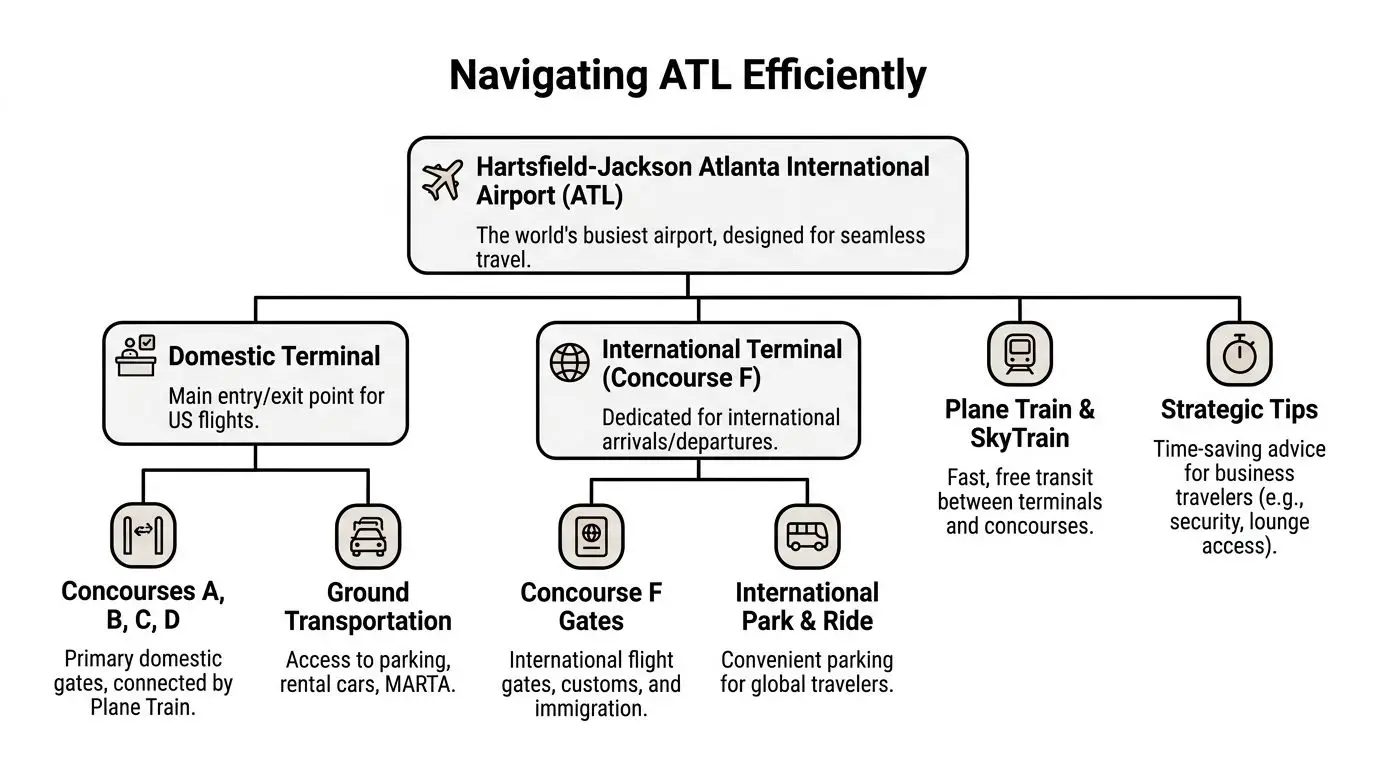
The basic layout
You’ll deal with:
- Domestic Terminal
- International Terminal
- Concourses T, A, B, C, D, E, and F
Most confusion comes from mixing up terminal entry with gate location. You may enter through one side of the airport and still depart from a different concourse entirely.
The Plane Train matters most
Inside security, the Plane Train is the main efficiency tool. It connects the concourses and keeps you from relying only on walking. If your meeting prep, phone calls, or equipment handoff schedule is tight, this is what keeps ATL manageable.
Walking is still useful for short hops. But for longer concourse changes, the train is the better move.
If you’re connecting at ATL, don’t judge distance by the map alone. Judge it by whether you need a train stop, escalator, and gate cluster change.
How business travelers usually lose time
The airport isn’t the problem. Decision lag is.
Check your gate before you stop
Don’t sit down at Concourse T if your gate is in E or F. Confirm the gate first, then decide where to work, eat, or make calls.
Separate landside and airside thinking
Before security, focus on check-in, bag drop, and checkpoint choice. After security, focus on concourse movement and gate timing.
Use the right terminal for the trip
International departures and arrivals create different traffic patterns than domestic trips. If your team books a car service or pickup, terminal accuracy matters.
This local page on Hartsfield-Jackson Atlanta International Airport location and access is helpful if you’re coordinating arrival instructions for employees, vendors, or project teams.
A simple working method
Use this sequence every time:
- Confirm terminal and airline
- Check gate and concourse
- Clear security before stopping
- Use the Plane Train if the gate is far
- Choose a workspace near your actual departure area
That approach sounds obvious. In ATL, it saves missed calls, rushed transfers, and unnecessary walking.
Ground Transportation and Parking For Business
Outside the terminal, your decision usually comes down to one thing. How much uncertainty can your schedule tolerate?
A consultant heading to Midtown for a same-day presentation has different needs than a facilities manager carrying project materials to a nearby site. Some travelers need the lowest cost. Others need the highest control.
ATL Ground Transportation Comparison for Business Travelers
| Method | Avg. Time to Midtown | Estimated Cost | Best For |
|---|---|---|---|
| MARTA rail | Varies by time of day and connection timing | Lower-cost option | Solo travelers with light luggage and flexible schedules |
| Rideshare | Varies with traffic and pickup congestion | Variable | Direct trips when convenience matters |
| Taxi | Varies with traffic | Metered or set by local rules | Simple curbside service without app coordination |
| On-site parking | Depends on terminal access and walking distance | Higher total trip cost for longer stays | Travelers who need vehicle control |
| Off-site parking | Depends on shuttle timing | Often lower than on-site | Longer trips with planned buffer time |
| Black car service | Scheduled around your itinerary | Premium | Executives, client-facing travel, and tight schedules |
Which option fits which job
MARTA for predictable downtown access
For professionals traveling light, rail can be a sensible choice. It avoids some road congestion and works well when your destination is close to a station.
Rideshare for direct routing
Uber and Lyft are convenient, but pickup zones and surge periods can add friction. They work best when you want door-to-door travel and can absorb some variability.
Taxi for simple dispatch
Taxis still matter because they remove app coordination. If your phone battery is low or your team wants a straightforward reimbursement path, this can be the easiest option.
Parking for project-based travel
If you’re driving equipment samples, documents, or multiple bags, parking can be worth the tradeoff. On-site parking favors control. Off-site parking favors budget.
When premium ground transport makes sense
For board meetings, client pickups, or tightly sequenced travel days, a scheduled car can reduce uncertainty. Teams comparing options may find this overview of Black Car Service at the airport useful when evaluating higher-control transportation.
Ground transport for equipment and pickups
Business travel often overlaps with operational work. An employee may land at ATL in the morning and head directly to a warehouse, office closure, or decommissioning project.
In those cases, passenger transport is only half the plan. The other half is local logistics. Scheduled IT equipment pickup in Georgia becomes relevant.beyondsurplus.com/it-equipment-pickup-georgia/) becomes relevant for companies coordinating retired hardware, office cleanouts, or project-based asset removal.
Planning rule: If the trip involves equipment, don’t plan airport transport and asset transport separately. Treat them as one workflow.
A lot of business delays happen after landing, not in the air. The right transportation choice fixes that.
Traveler Services and Amenities to Maximize Productivity
ATL can either drain a workday or preserve it. The difference usually comes from where you set up and how quickly you switch from travel mode to work mode.
Where to work without wasting time
Lounges help if you already have access through your airline or membership program. They’re useful for stable seating, power, and quieter call conditions than open gate areas.
If you need privacy, Minute Suites can be the better option. A short private session works well for contract review, video calls, or regrouping between meetings.
What to look for in a productive airport stop
- Power access: Don’t assume every gate cluster has convenient outlets.
- Seating stability: Some areas turn over constantly, which makes focused work harder.
- Noise level: Concourse traffic can be manageable in one zone and distracting in another.
- Food proximity: A workspace near reliable food saves time during short layovers.
Good habits for business travelers
Don’t open your laptop at the first empty seat. Choose a spot based on the next task.
If you need to answer email, almost any decent seat works. If you need to review sensitive files, handle procurement documents, or join a call, choose a more controlled setting.
Work in layers. Use open seating for low-risk tasks and private space for anything involving contracts, budgets, or internal systems.
ATL’s broad amenity mix supports that approach. The airport is built for volume, which means there are usually multiple ways to make waiting time useful if you make decisions deliberately.
The Engine of Commerce ATL Cargo and Logistics
ATL’s business significance becomes clearest on the cargo side. Passenger volume gets the headlines. Logistics capability drives the commercial value.

According to the FAA airport capacity profile, ATL’s five parallel runways, including the 12,390-foot Runway 9L-27R, support 237 operations per hour, and in west flow instrument conditions the airport can maintain 197 to 204 operations per hour through reduced separation and advanced flow management at the FAA ATL Airport Capacity Profile.
Why those runway facts matter to business users
Those numbers aren’t abstract. They tell you ATL was built to keep aircraft moving under demanding conditions.
For logistics managers, that means a stronger planning environment for:
- Time-sensitive equipment shipments
- Replacement hardware moving between sites
- Project materials tied to data center work
- Retired IT assets entering secure downstream processing
Reliability starts with physical design
Five parallel runways give the airport operational flexibility. Long runway lengths and heavy-load capability matter for larger aircraft and dense traffic patterns.
That’s especially relevant when a company needs dependable movement for high-value or regulated assets. Think servers, networking gear, storage arrays, or specialized devices that can’t sit in a vague chain of custody.
A business example
Suppose a company is decommissioning infrastructure in Atlanta while consolidating systems elsewhere. People often focus only on labor and trucking. But the airport’s broader logistics environment affects schedule confidence, vendor coordination, and fallback planning if timelines change.
That’s where ATL stands apart. It supports a large commercial ecosystem around freight, movement, and rapid regional access.
Cargo planning isn’t only about what flies. It’s about how quickly a business can recover when a timeline shifts.
Asset recovery and enterprise logistics
Organizations with surplus IT hardware also need a path for value recovery, not just disposal. Equipment may need to be inventoried, transported, wiped, sorted, and remarketed or recycled under controlled documentation.
For companies handling that process in Georgia, asset recovery services in Georgia connect the airport-region logistics story to the practical work of managing retired technology responsibly.
ATL’s role in commerce makes more sense when you view it this way. It’s not only a destination. It’s a coordination engine for movement, timing, and business continuity.
Understanding Security and Airport Operations
Security is where business travelers most often feel the airport’s scale. The line in front of you is only one small piece of a much larger operating system.
ATL processes over 350,000 annual departures, posts a 79% on-time departure rate, handles about 2,700 daily arrivals and departures, and serves roughly 275,000 passengers per day according to PreFlight Airport Parking’s ATL stats guide. For professionals, that means even a modest delay can ripple into meetings, project starts, and handoff schedules.
How to move through security with less risk
Arrive with a decision already made
Know whether your priority is speed, certainty, or flexibility. Travelers with meetings shortly after landing should protect schedule margin, not optimize for a narrow arrival window.
Keep checkpoint strategy simple
If you have access to faster screening programs, use them. If not, reduce friction by organizing devices, identification, and bags before you enter the queue.
Treat delays as an operating condition
Weather, staffing, and traffic flow all affect throughput. The right response isn’t frustration. It’s planning.
Why operational scale changes your travel habits
At a small airport, a delay may stay local. At ATL, a small interruption can touch gate assignments, crew timing, security queues, rideshare pickup demand, and downstream connections.
That’s why seasoned business travelers build buffer into:
- Meeting start times
- Equipment delivery windows
- Vendor arrival expectations
- Site access schedules
The airport can be efficient and still require contingency planning. Those two things aren’t contradictory.
If your work depends on same-day execution, the essential skill isn’t moving fast. It’s reducing the number of things that can fail at once.
Leveraging Local Expertise for Business Logistics and ITAD
The overlooked business issue near ATL isn’t another restaurant recommendation. It’s what happens when travel, operations, and compliance collide.

A recent airport crisis exposed that gap clearly. During TSA staffing shortages, travelers faced 2.5-hour security lines, yet there was still no practical airport guidance for enterprises that needed secure electronics disposal or data-bearing asset handling, as noted by CBS News Atlanta. That matters because delays don’t erase compliance duties under the FTC Disposal Rule.
Where companies get exposed
A business traveler may arrive in Atlanta for any of these jobs:
- office closure support
- data center decommissioning
- laptop refresh coordination
- merger-related asset consolidation
- medical or lab equipment retirement planning
If schedules slip, the hardware doesn’t stop being sensitive. Drives still need controlled destruction or wiping. Equipment still needs chain-of-custody documentation. Assets still need to be removed from offices, staging areas, or project sites.
What local support should actually do
A useful local partner should help with the parts that air travel doesn’t solve:
Scheduled pickups
When equipment is spread across offices, storage rooms, or temporary project sites, pickup coordination matters more than generic recycling advice.
Certified data destruction
If devices store company or customer data, disposal isn’t enough. The process needs documentation.
Recovery and disposition workflow
Some assets should be remarketed. Others should be physically destroyed. Good planning separates those paths early.
One Atlanta option is Beyond Surplus in Atlanta, which provides scheduled pickups and certified data destruction for organizations managing retired technology in the airport region.
Operational reality: Flights move people. They don’t close the compliance gap around retired hardware.
Why this matters around ATL
The atlanta hartsfield jackson atlanta international airport area is full of business activity. Teams fly in for audits, expansions, relocations, and infrastructure changes. Many of those projects generate surplus electronics, storage media, and equipment that can’t be left behind casually.
That’s why local ITAD capability belongs in the same planning conversation as air travel, hotel blocks, and ground transportation. When the project ends, the asset risk remains until someone documents, transports, destroys, or recovers it properly.
Your Strategic Partner in Atlanta
ATL works best when you stop thinking of it as only an airport. It’s a business operating environment.
For travel, that means understanding terminal flow, ground transportation, security rhythm, and productive use of layovers. For logistics, it means recognizing why cargo infrastructure, runway capacity, and regional access make Atlanta a serious hub for enterprise operations. For compliance, it means knowing that equipment retirement and secure data handling don’t pause just because flights are delayed.
Companies that operate near atlanta hartsfield jackson atlanta international airport need more than travel tips. They need a plan for movement, timing, documentation, and asset control.
If your organization needs secure electronics recycling, IT asset disposition, data destruction, or project-based equipment removal in the Atlanta market, contact Beyond Surplus to coordinate a business pickup or discuss a compliant ITAD workflow.