
For business owners and IT managers in Georgia, managing retired electronics is a critical legal and financial responsibility. Disposing of a single company laptop improperly isn't just an environmental misstep—it's a direct threat to your data security, brand reputation, and bottom line. Secure business e-waste recycling in Georgia is not merely a "best practice"; it is an essential component of modern corporate risk management for commercial and enterprise entities.
Why Smart E-Waste Management in Georgia Is Non-Negotiable
Failing to properly handle retired IT assets creates serious liabilities that many business owners don't see until it’s far too late. The biggest risks aren't just environmental. They're financial and legal, tied to a complex web of rules governing both hazardous materials and data privacy. For any Georgia organization, the first step is understanding these obligations to build a compliant and secure plan for your electronics recycling and IT equipment disposal needs.
The High Cost of Regulatory Non-Compliance
Georgia businesses must adhere to federal laws like the Resource Conservation and Recovery Act (RCRA). This law holds your company legally responsible for hazardous waste "from cradle to grave." That liability doesn’t just disappear when the equipment leaves your facility. If your e-waste ends up with an uncertified vendor who disposes of it improperly, your company can still be on the hook for cleanup costs and hefty fines.
Consider a logistics company in Atlanta disposing of old office computers in a commercial dumpster. Those devices contain circuit boards with lead and batteries with cadmium, both classified as hazardous materials under RCRA. If discovered, the company could face penalties from the Georgia Environmental Protection Division (EPD), resulting in thousands of dollars in fines and damaging its hard-won reputation.
The Looming Threat of a Data Breach
Beyond environmental regulations, data privacy laws like the FTC Disposal Rule require companies to take reasonable measures to protect sensitive customer information on discarded devices. An old hard drive from a server or administrative computer might seem harmless, but it can easily become the source of a catastrophic data breach.
Imagine a healthcare provider in Savannah retiring a dozen workstations. If those hard drives aren't professionally destroyed, they could be acquired and searched for protected health information (PHI). A breach like that would trigger HIPAA violation penalties, which can climb into the millions of dollars, not to mention the irreparable damage to patient trust.
This is precisely why professional business e-waste recycling in Georgia is so crucial. It’s not just about recycling components; it's about a documented, secure chain of custody that guarantees your sensitive data is permanently destroyed.
As you explore this process, it helps to see the bigger picture. You can learn more about the environmental impact of electronic waste in our detailed article, which covers the global and local consequences of improper disposal. Working with a certified partner like Beyond Surplus turns these risks from a potential disaster into a structured and defensible part of your business operations.
Building Your Internal E-Waste Management Playbook
A robust e-waste recycling program for your Georgia business doesn’t start when the truck arrives. It begins with a clear, documented internal playbook that makes the entire process repeatable and secure. Without this framework, IT assets get lost, sensitive data is exposed, and you miss opportunities for IT asset recovery.
The first step is a thorough inventory of all IT assets slated for retirement. This includes not just laptops and desktops, but also servers, networking gear, company phones, and even specialized equipment like medical or laboratory equipment.
Categorize for Clarity and Security
Once you have a complete list, sort everything into logical buckets. This step helps prioritize handling and identifies potential value.
- High-Data Sensitivity Assets: This is your highest-risk category, including hard drives, servers, and smartphones containing customer data or proprietary information. For these, certified data destruction is non-negotiable.
- Potential Value Recovery Assets: This bucket is for newer equipment, usually 3-5 years old, that still holds market value. Recent-generation laptops, enterprise-grade servers, and networking switches can often be sold through an ITAD partner to recoup some of your initial investment.
- Standard Recycling Assets: Everything else goes here. This includes old monitors, broken keyboards, tangled cables, and printers with no resale value. These items require environmentally responsible recycling.
This categorization clarifies your needs and facilitates a more productive conversation with a business e-waste recycling Georgia vendor. You're no longer dealing with a random pile of electronics—you're managing distinct asset groups.
Assigning Roles and Securing Assets
Designate an internal champion, such as an IT or facility manager, to serve as the single point of contact. This person is responsible for inventory, vendor coordination, and enforcing internal protocols, preventing old equipment from being misplaced or improperly discarded.
Next, establish a secure, designated collection area—a locked room or a caged-off section of a warehouse—where all retired assets are stored until pickup. This simple measure is crucial for maintaining a clean chain of custody and stopping equipment—and the data on it—from disappearing.
Key Takeaway: An unmanaged pile of old electronics in a storage closet is a data breach waiting to happen. A designated, secure collection area is your first line of defense in a compliant IT asset disposition program.
This diagram illustrates the direct path from improper asset handling to major business risks.
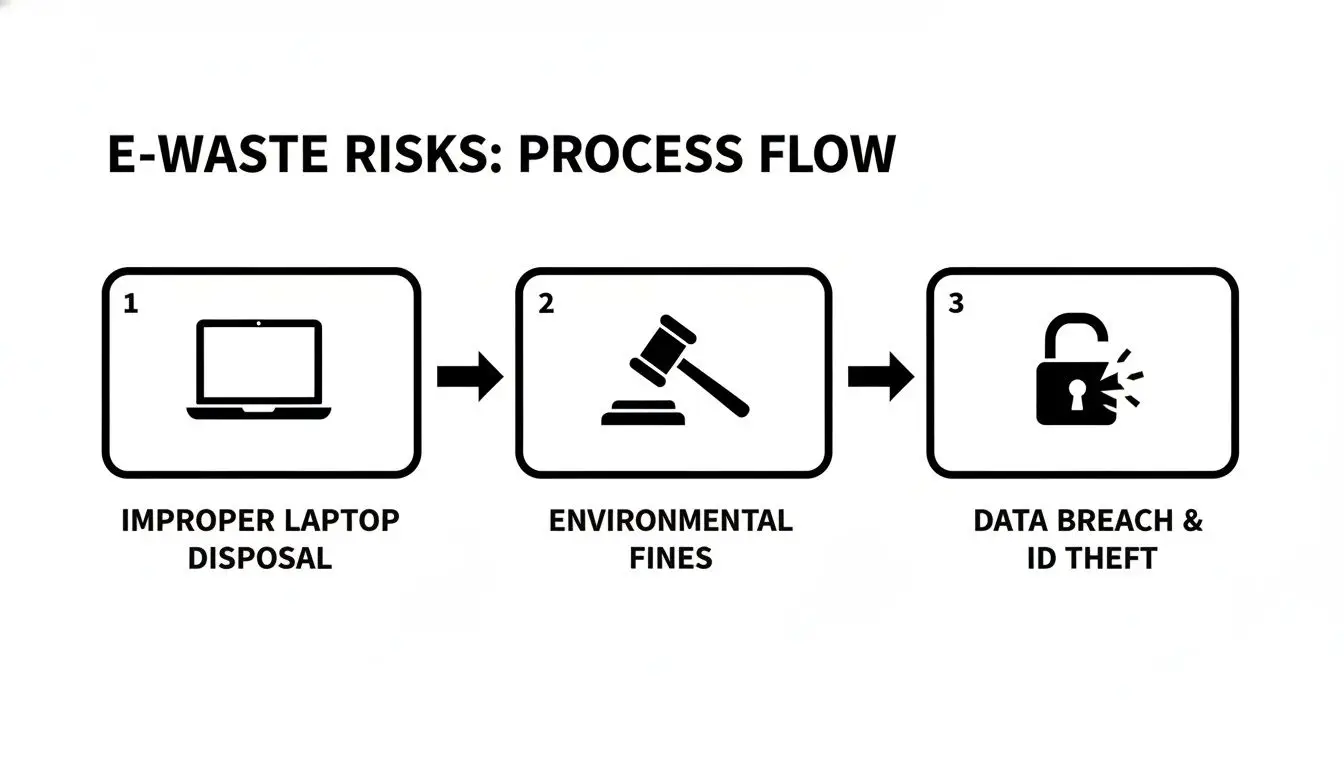
As you can see, a single improperly handled laptop can lead to regulatory fines and a public data breach. A clear internal playbook turns a complex task into a manageable part of your company's routine operations. You can get more insights on this by exploring our resources on IT asset lifecycle management. This playbook makes your entire secure e-waste management program scalable, consistent, and defensible.
Finding the Right Certified E-Waste Partner in Georgia

When it comes to business e-waste recycling in Georgia, selecting your partner is the most critical decision you will make. This choice is directly tied to your company's data security, legal compliance, and public reputation. A premier partner acts as a shield, protecting you from massive liabilities, while a poor one can expose you to unforeseen financial and legal risks.
The absolute, non-negotiable starting point for any business is certification. If a vendor cannot provide proper, independently audited credentials, they are not a viable option.
Why Certifications Are Your First Line of Defense
In the IT Asset Disposition (ITAD) industry, two certifications are paramount: R2v3 (Responsible Recycling) and e-Stewards. These certifications guarantee that a recycler meets the highest standards for data security, environmental handling, and worker safety.
R2v3 Certification: This standard covers the full lifecycle of your electronics, requiring a secure chain of custody, verified data destruction methods, and proof that hazardous materials are managed correctly. An R2v3-certified vendor has a documented system to track every item and prevent e-waste from being illegally exported or dumped.
e-Stewards Certification: Often considered the gold standard for environmental protection, e-Stewards enforces a strict zero-tolerance policy for exporting hazardous e-waste to developing nations and prohibits the use of prison labor. It also mandates in-depth audits of downstream partners.
When your Georgia business works with a recycler holding these certifications, you are transferring your risk to a professional who has been thoroughly vetted. You can learn more about the specifics and see what R2 certification means for your business here.
Certified ITAD Vendor vs Standard Recycler Comparison
| Feature | Certified ITAD Partner (e.g., Beyond Surplus) | Standard Recycler |
|---|---|---|
| Data Security | Guaranteed data destruction to NIST 800-88 standards; on-site services available. | No data destruction guarantee; data security is the customer's responsibility. |
| Certifications | R2v3 and/or e-Stewards certified, ensuring strict environmental and security protocols. | Typically not certified for electronics; may just be a scrap metal or general recycler. |
| Chain of Custody | Secure, serialized tracking from pickup to final disposition; detailed reporting. | No formal tracking or reporting; items are often co-mingled. |
| Liability & Insurance | Carries specialized data breach and environmental liability insurance to protect clients. | Carries general liability only; offers no protection against data breach or compliance fines. |
| Reporting & Compliance | Provides Certificates of Destruction and Recycling, satisfying audit and compliance needs. | Offers a basic weight ticket or receipt, which is insufficient for business compliance. |
| Value Recovery (ITAD) | Assesses equipment for remarketing potential (buyback), recovering value for the client. | Focuses only on scrap material value; no resale or asset recovery services. |
As illustrated, a certified ITAD partner provides a professional service designed to protect your business, while a standard recycler simply processes material. For any enterprise concerned with data and compliance, the choice is clear.
Going Beyond the Certificate: Questions Every Georgia Business Should Ask
While a certificate is a great start, you must dig deeper to ensure a vendor's promises align with their operations. Their answers to these questions will reveal their true capabilities.
Critical Vetting Questions:
"Can you walk me through your chain-of-custody process, from the moment you arrive until the equipment is processed?" A professional will immediately describe serialized asset tags, secure vehicles, and access-controlled facilities. Vague answers are a major red flag.
"What are my options for data destruction, and can you perform it on-site at our Georgia office?" You should hear about multiple methods, such as data wiping compliant with NIST 800-88 standards and physical shredding. The availability of on-site hard drive shredding is the gold standard for security and transparency.
"What are your insurance liability limits for a data breach or environmental incident?" A true ITAD partner will have specialized insurance policies with multi-million dollar coverage. Do not hesitate to request a copy of their certificate of insurance.
"How do you audit your downstream partners?" Certified recyclers are required to vet the companies they send materials to. Ask how they confirm that partners handling materials like circuit boards or batteries are also certified and compliant.
Choosing a vendor based on the lowest price is a dangerous gamble. The true cost of a data breach or an environmental fine will always be exponentially higher than the cost of professional, certified business e-waste recycling services in Georgia.
Guaranteeing Secure Data Destruction and Compliance
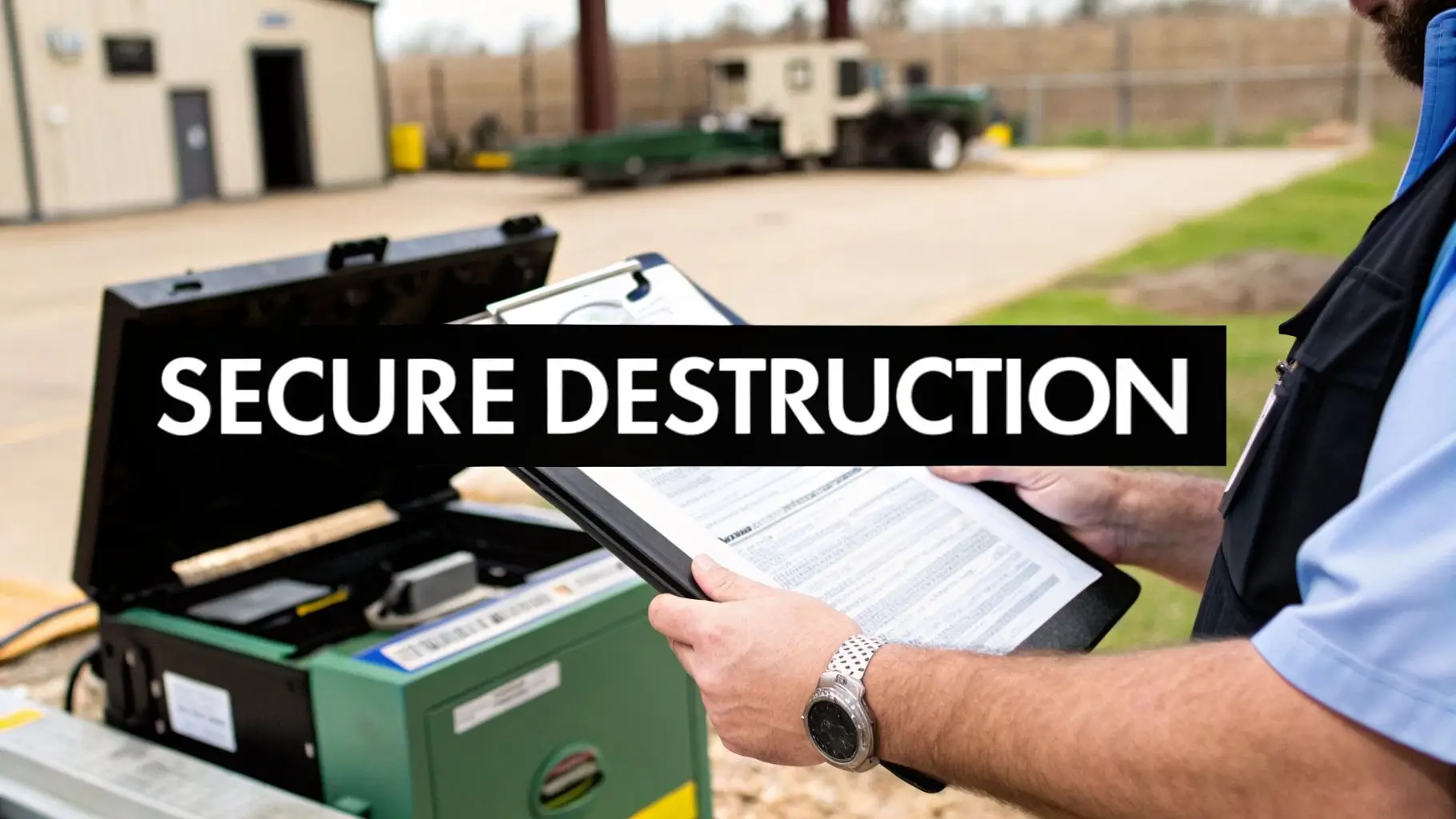
When you hand over retired company hardware, you are not just disposing of electronics—you are transferring a liability. Every laptop, server, and phone contains a ghost of your company’s data, and simply pressing "delete" is insufficient. For corporate data, there is no room for error.
This is why the core of any business e-waste recycling Georgia program isn't just recycling; it's guaranteed data destruction. A professional partner should provide multiple options tailored to your specific needs.
Choosing the Right Destruction Method
Your choice depends on your company's risk tolerance and whether the hardware has resale value. There are three primary methods for handling data.
- Data Wiping (Sanitization): This digital deep clean uses specialized software to overwrite every sector of a hard drive with random data, making the original information completely unrecoverable. This is the ideal choice for newer hard disk drives (HDDs) that can be resold, as it preserves the hardware's value. To review the official standards for this process, see our guide on NIST SP 800-88 compliance.
- Degaussing: This method uses a powerful magnet to scramble data on magnetic storage like older HDDs and backup tapes. It is fast and absolute but renders the drive unusable. Note that degaussing is ineffective on modern Solid-State Drives (SSDs).
- Physical Shredding: This is the most definitive solution. The device—whether a hard drive, SSD, or phone—is fed into an industrial shredder that tears it into tiny metal fragments. It is the go-to method for damaged drives, proprietary equipment, or any high-security asset where reuse is not an option.
On-Site Shredding: The Ultimate Security Guarantee
For businesses requiring absolute certainty, on-site shredding is the gold standard. A mobile shredding truck comes directly to your office or warehouse, allowing you to witness the destruction of your hard drives firsthand. This provides an unbroken chain of custody, making it the preferred method for organizations subject to HIPAA or FACTA compliance and eliminating the risks of transporting data-bearing assets off-site.
A Certificate of Data Destruction isn't just a piece of paper—it's your legal proof of compliance. This document officially transfers liability from your company to the vendor, documenting the serial numbers of the destroyed assets and the method used. Without it, you have no verifiable defense in the event of a future audit or data breach investigation. Always insist on receiving this crucial report.
That closet full of old servers and laptops doesn't have to be a liability. For many Georgia businesses, it represents a hidden revenue stream. The key is shifting your mindset from simple "disposal" to strategic IT Asset Disposition (ITAD) and value recovery.
This financial strategy can turn a cost center into a source of income, helping fund your entire recycling program. Not every piece of old electronics is destined for the shredder—a surprising amount of retired corporate hardware still holds significant value on the secondary market.
What’s Actually Valuable in Your IT Closet?
Knowing which equipment has resale potential is key to a profitable buyback program. A professional ITAD partner can quickly assess your inventory and pinpoint these high-return items.
Here’s what typically generates the best return:
- Recent-Model Laptops and Desktops: Computers that are three to five years old, especially business-class models from major brands, are always in demand.
- Enterprise-Grade Servers: Decommissioned servers are packed with valuable components like CPUs and high-capacity RAM that can often be resold individually.
- Networking Gear: Switches, routers, and firewalls from brands like Cisco, Juniper, and Arista hold their value exceptionally well.
- Company Smartphones and Tablets: Mobile devices are a hot commodity, especially in large, uniform batches.
How the Value Recovery Process Works
When you engage an ITAD vendor for business e-waste recycling in Georgia, their team begins by evaluating your equipment's age, condition, functionality, and current market demand.
Based on this assessment, they will present you with a buyback offer. You can learn more about how to maximize your return with our asset recovery services in Georgia to see exactly how this works. This approach creates a circular economy for your old IT hardware. Instead of paying to have everything securely destroyed, you get paid for equipment that can be safely refurbished and given a second life.
This financial model is becoming a core part of smart business operations. The global e-waste recycling market is experiencing explosive growth, with the industry valued at $2.3 billion in 2025 and projected to expand to $5.6 billion by 2034. For Georgia-based companies, this trend translates into increased demand from enterprises seeking certified e-waste recycling partners. Discover more insights about the benefits of corporate electronics recycling in Georgia on beyondsurplus.com.
This growth signals a massive economic opportunity. By choosing a partner like Beyond Surplus that offers a robust ITAD and buyback program, you’re not just managing e-waste—you’re actively tapping into a profitable and sustainable market. In many cases, the revenue generated can completely offset the recycling costs of older, no-value assets, making your entire e-waste program financially self-sufficient.
Answering Your Georgia E-Waste Recycling Questions
When it comes to corporate electronics disposal, specific questions often arise. For any Georgia business aiming to build a secure and compliant program, clear answers are essential for confident decision-making. Let's address some of the most common inquiries we receive from business clients.
What Types of Business Equipment Can Be Recycled?
The short answer is: virtually everything with a plug or a battery. It's a common misconception that e-waste recycling is limited to computer recycling and laptop disposal. A comprehensive business e-waste recycling Georgia program must cover all your IT assets.
This includes:
- Networking Hardware: Routers, switches, firewalls, and modems.
- Peripherals: Monitors, printers, scanners, keyboards, and mice.
- Data Center Equipment: Including servers and storage arrays as part of a data center decommissioning project.
- Specialized Equipment: Gear from medical facilities (medical equipment disposal), labs (laboratory equipment disposal), or manufacturing floors requires certified disposal.
A professional ITAD partner like Beyond Surplus is equipped to handle this entire spectrum, ensuring every item is managed according to its material composition and data security requirements.
Is a Certificate of Destruction Really Necessary?
Yes, absolutely. This is non-negotiable for any business. A Certificate of Data Destruction serves as your official, legal proof that all data on your company’s devices was destroyed in compliance with privacy laws like HIPAA and the FTC Disposal Rule.
This certificate is the document that formally transfers liability from your business to your recycling vendor. It’s your shield against massive fines or legal trouble if a data breach is ever traced back to one of your old devices. Without it, you have no audit trail to prove you did your due diligence.
How Much Does Business E-Waste Recycling in Georgia Cost?
The cost varies depending on your specific needs and the type of equipment being retired. While vendors have fees for services like secure transport, logistics, and data destruction, this is not always a net expense.
If your old equipment retains value—such as newer laptops, enterprise servers, or networking gear—a full-service ITAD partner with a buyback program can transform the financial equation. The return offered may offset recycling costs or even generate revenue for your company.
Can My Employees Just Drop Off Old Equipment?
No, and we strongly advise against this practice. It exposes your business to significant risks. Local collection events and retail drop-off bins are designed for residential e-waste and lack the required security measures for business assets. They offer no secure chain of custody, no certified data destruction, and no liability paperwork. For corporate compliance, using a certified ITAD vendor for electronic waste pickup is the only responsible path to ensure data protection and fulfill your legal and environmental obligations.
Contact Beyond Surplus for electronics recycling and secure IT asset disposal. We provide professional, secure, and compliant technology disposal services, including data destruction and IT asset buyback, for businesses across Georgia and nationwide. Schedule your pickup with Beyond Surplus today.