
For businesses across the United States, managing the disposal of window air conditioners is a critical operational task fraught with environmental regulations and financial risks. It's more than hauling away old equipment; it involves strict compliance with laws governing hazardous materials. Every unit contains refrigerants and valuable metals, making professional, certified disposal an essential component of modern corporate responsibility and risk management.
The Hidden Costs of Window AC Disposal for Businesses
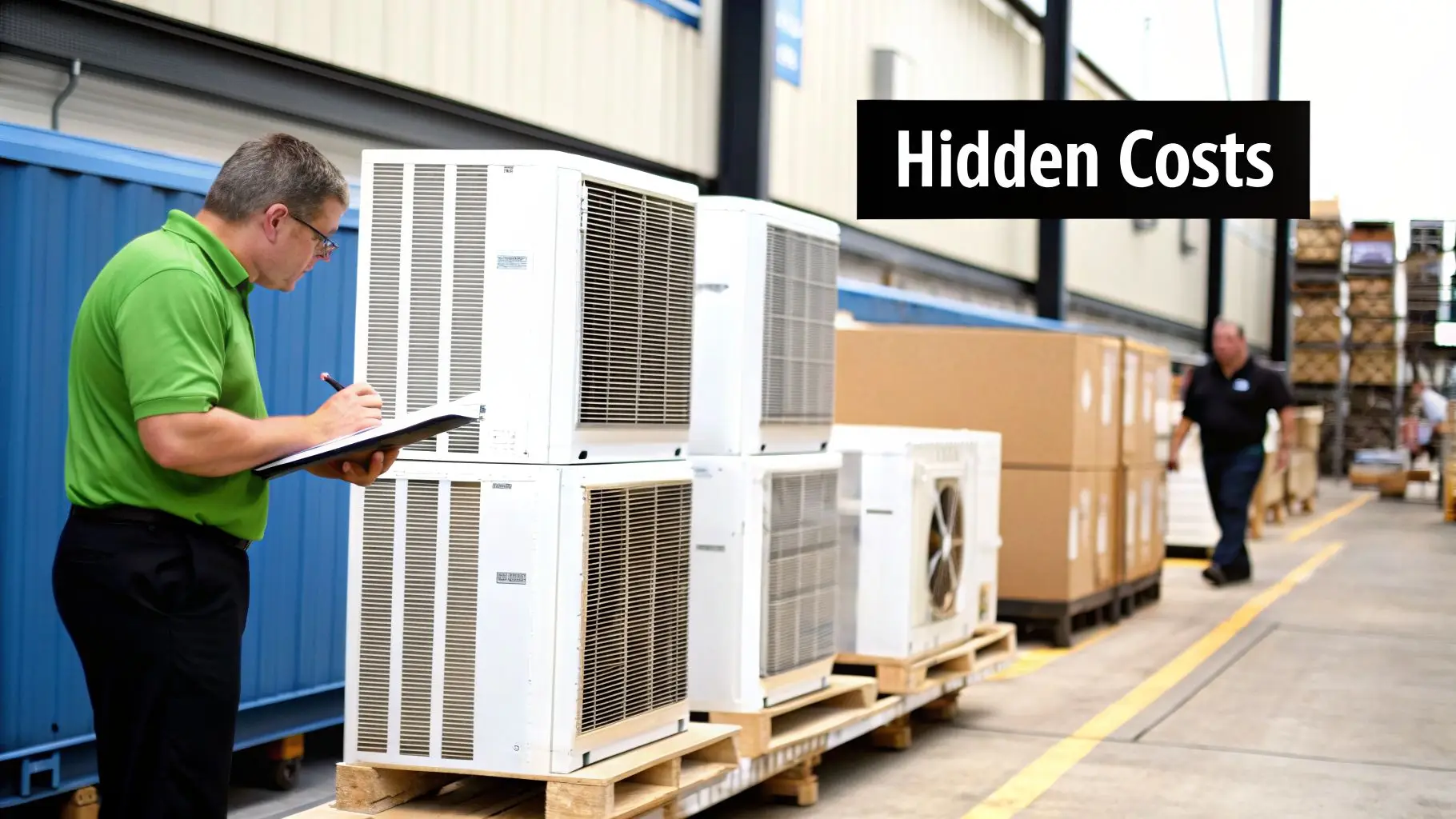
When an office building, hotel, or multi-facility corporation upgrades its cooling systems, the focus is typically on the new, energy-efficient models. But what about the dozens, or even hundreds, of old window ACs left behind? These are not merely bulky e-waste; they represent a significant liability that many businesses underestimate.
Attempting to discard them via standard waste streams is a serious error. The Environmental Protection Agency (EPA) enforces strict rules for handling refrigerants, and non-compliance can result in substantial fines that impact the bottom line.
Beyond Compliance Fines
The financial risks extend beyond government penalties. A company's reputation is perpetually on the line. In an era where clients, partners, and stakeholders prioritize corporate environmental stewardship, a public misstep in handling hazardous waste can inflict lasting brand damage.
Furthermore, businesses must account for all potential disposal expenses. While understanding typical junk removal pricing is a starting point, it's crucial to partner with a vendor who provides transparent, all-inclusive quotes for compliant services. This ensures your project budget covers the entire asset lifecycle, from secure pickup to certified recycling.
The core issue is liability. Until a business obtains a certificate of recycling from a certified vendor, the legal responsibility for that window AC unit—and its hazardous contents—remains entirely with the original owner.
This is precisely why engaging a certified electronics recycling and IT asset disposal (ITAD) firm is a strategic business decision. A professional partner like Beyond Surplus ensures every step is executed correctly, from safely recovering refrigerant to recycling all constituent materials. This transforms a potential liability into documented proof of your company's commitment to regulatory compliance. Dive deeper into the importance of this by exploring the environmental impact of electronic waste in our detailed guide.
The Growing Market for AC Recycling
The demand for compliant AC disposal has spurred significant market growth. The global air conditioner recycling market was valued at approximately USD 5 billion in 2022 and is projected to reach USD 8 billion by 2028, expanding at a compound annual growth rate (CAGR) of 8%. This expansion is driven by massive demand for new AC units, particularly in developing commercial sectors.
In the United States alone, millions of window units are decommissioned annually. Programs like the EPA’s Responsible Appliance Disposal (RAD) provide guidance for businesses, facilitating the recycling of up to 65 pounds of metals—including valuable copper, aluminum, and steel—from a single unit. A certified recycling partner offers a seamless, documented, and fully compliant process, providing your business with a clear end to its liability.
Understanding Your Legal Obligations for AC Disposal
When it's time to retire old window AC units from your commercial properties, simply discarding them is not a legally viable option. For businesses, ignorance of disposal laws is not a defense, and the consequences of non-compliance can be severe. Understanding your core obligations is the first step toward a risk-free disposal process.
The most significant regulation comes from the federal government: Section 608 of the U.S. Clean Air Act. This law, enforced by the Environmental Protection Agency (EPA), is unequivocal: refrigerants must be recovered by a certified professional before an appliance is disposed of.
This "certified recovery" cannot be performed by an in-house maintenance team. It requires specialized equipment and technicians holding an EPA 608 certification, who are trained to safely extract hazardous coolants. The penalties for violating this regulation can amount to tens of thousands of dollars per day, per violation.
The EPA Clean Air Act Section 608
The purpose of Section 608 is to prevent the release of ozone-depleting and greenhouse gas refrigerants into the atmosphere. For facility managers, IT managers, and business owners, this mandate establishes a non-negotiable step in the disposal process.
Here’s what your business must ensure:
- Certified Technicians Only: The individual accessing the refrigerant circuit on any AC unit must hold the proper EPA certification.
- Specialized Equipment: Refrigerant recovery must be performed using EPA-approved equipment designed to capture and store these substances.
- Documentation is Critical: You must be able to prove compliance. This proof comes in the form of a Certificate of Recycling from a qualified ITAD vendor.
It is also beneficial to stay informed about refrigerant types, such as knowing what replaced R22 refrigerant, to better understand the critical need for professional handling.
The FTC Disposal Rule: It’s Not Just About Refrigerant
While the EPA focuses on environmental protection, the Federal Trade Commission (FTC) is concerned with data security. The FTC’s Disposal Rule requires businesses to take appropriate measures to destroy sensitive information derived from consumer reports.
You might wonder, "How does my window AC relate to data?" Consider a large-scale project, like a hotel renovation or an office clear-out. Those AC units are often just one component of a larger asset retirement initiative. If you are also disposing of computers, servers, or other data-bearing devices, the entire project falls under stricter data security scrutiny. This is why our approach to compliant electronics recycling in Georgia is designed to cover both environmental and data security requirements.
Commercial Scenario: A Hotel Chain Upgrade
A hotel chain upgrading 300 rooms must dispose of 300 old window AC units. Contracting a random scrap hauler introduces massive risk. If that hauler illegally vents the refrigerant, the hotel corporation could be held liable. Without a documented chain of custody and recycling certificates, the hotel has no proof of compliance—a significant liability that a certified ITAD partner completely eliminates.
Key Regulations for Commercial AC Disposal
To navigate the legal landscape effectively, businesses must understand the primary regulations governing air conditioner disposal. These rules mitigate environmental damage and protect sensitive data. The table below summarizes key federal mandates.
| Regulation | Governing Body | Key Requirement for Businesses | Primary Risk of Non-Compliance |
|---|---|---|---|
| Clean Air Act (Section 608) | EPA | Must use an EPA-certified technician to recover all refrigerant before disposal. | Significant fines (up to $44,539 per day per violation), legal action. |
| FTC Disposal Rule | FTC | Must destroy sensitive consumer information on any accompanying electronics. | Fines, class-action lawsuits, severe reputational damage. |
| RCRA (Resource Conservation and Recovery Act) | EPA | Governs the disposal of hazardous components like capacitors and circuit boards. | Fines and criminal charges for "cradle-to-grave" mismanagement of hazardous waste. |
Ultimately, managing legal obligations for AC disposal is about transferring liability. Working with a certified recycler who provides a complete, documented paper trail protects your business from fines, safeguards your brand, and ensures old assets are handled responsibly.
How to Prepare Bulk Window AC Units for Pickup
For a facility manager facing a large quantity of old window AC units, preparing them for professional recycling pickup may seem daunting. However, a bit of preparation can make the entire process faster, smoother, and more cost-effective.
The most critical rule is: never attempt to drain refrigerants or dismantle the units yourself. This is not only hazardous but also illegal under EPA regulations, which mandate that only certified technicians handle these materials. Your role is to prepare the units for a safe and efficient handover to your certified disposal partner.
Consolidate and Stage for Easy Access
First, consolidate all units in a single location. Requiring a pickup crew to collect units from various rooms or floors increases labor time and service costs.
Select a single, easily accessible ground-floor area, such as a loading dock, an empty storage room, or a warehouse corner. For a project involving 30 AC units from an office building, having them all palletized and staged at the loading dock can cut pickup time significantly compared to a room-by-room collection. This time saved translates directly to cost savings.
Create a Simple Asset Inventory
Before the pickup, create a basic inventory list. A simple spreadsheet is sufficient and adds a layer of professionalism.
Your inventory should include:
- Total Quantity: The final count of all AC units for disposal.
- Makes and Models: Note the brands if easily visible (e.g., GE, Frigidaire).
- Unit Condition: A brief note on whether units are damaged helps the crew plan their handling strategy.
Providing this list to your disposal partner in advance allows them to prepare the Bill of Lading and ensures the final Certificate of Recycling is accurate, preventing downstream discrepancies.
Pro Tip: If available, use pallets and a pallet jack. Stacking AC units securely on standard 40"x48" pallets streamlines loading. Depending on their size, 8-12 window units can typically fit on a single pallet, drastically speeding up the pickup process.
This visual illustrates the three key stages of compliant AC disposal that your preparation facilitates.
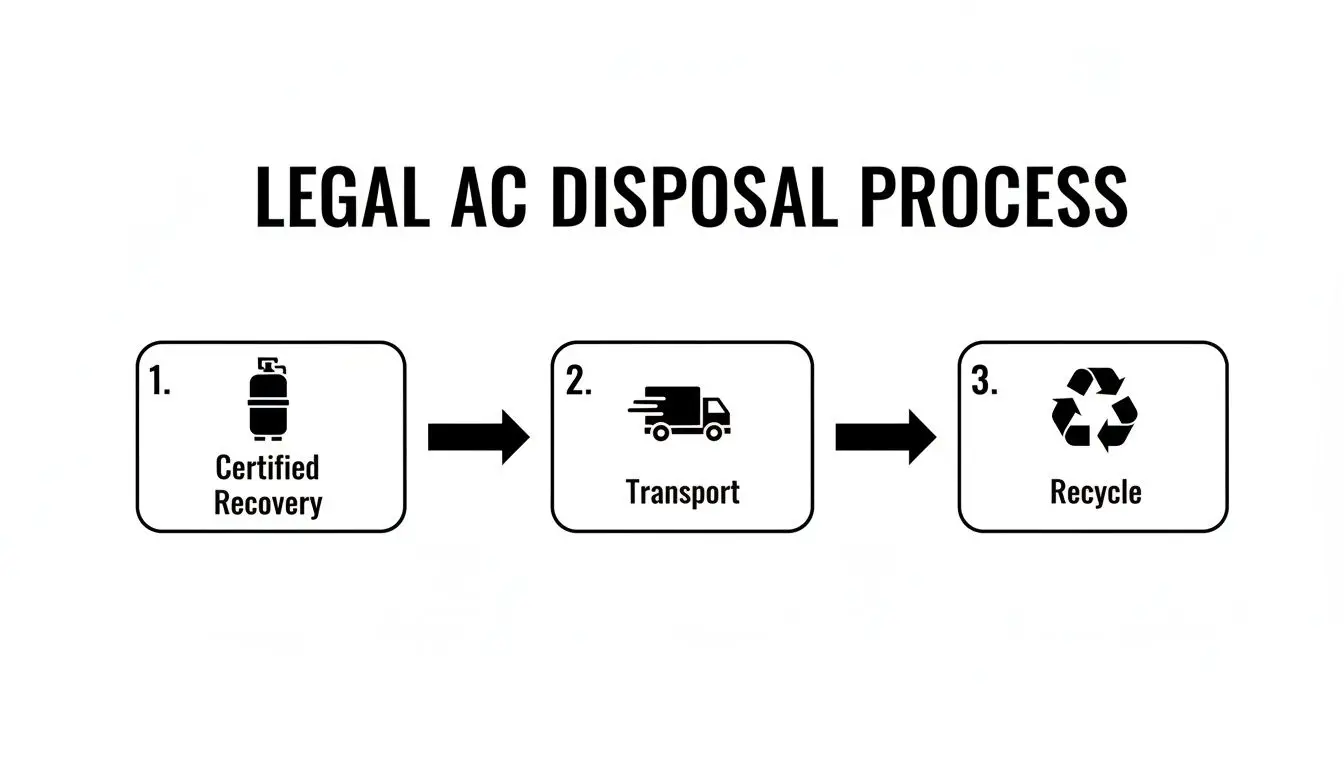
As shown, the process always begins with certified refrigerant recovery before transport and final recycling.
Coordinate a Seamless Pickup Schedule
Finally, clear communication with your recycling partner is essential. A brief call or email to confirm logistics will prevent day-of-pickup issues and maintain operational continuity.
Be sure to cover these key details:
- Access and Parking: Inform them where their truck should park. Mention any loading dock height restrictions or specific access hours.
- On-Site Contact: Designate a go-to person on pickup day to grant access and sign paperwork.
- Special Instructions: Communicate any security gates, specific on-property routes, or other protocols beforehand.
A well-planned pickup is an undisruptive one. If you are coordinating the disposal of other equipment, our guide on appliance recycling drop-off and pickup services may also be helpful. These steps ensure your asset disposition project is a success.
Why Certified Recycling Beats the Scrap Yard Every Time
For a business with a quantity of old window AC units, taking them to a local scrap yard for a small payout might seem appealing. It appears simple, and you receive cash. However, this is a dangerously short-sighted approach that exchanges a few dollars for immense long-term business risk.
The scrap yard path is fraught with hidden liabilities. A scrap dealer's primary interest is metal value, not environmental compliance. There is no guarantee that hazardous refrigerants will be handled according to strict EPA regulations.
Crucially, your legal responsibility does not end upon payment from the scrapper. Without a formal, documented transfer of liability, your business remains responsible for that unit under the "cradle-to-grave" principle. If the AC unit is later found illegally dumped, it can be traced back to your company, resulting in significant fines and brand damage.
The Myth of Scrap Value
Let's analyze the financial aspect. A local scrap dealer might offer $5 to $15 per unit. For 20 units, that's approximately $200. While this seems preferable to paying for a service, it completely ignores the massive financial risk involved. A single EPA fine for improper refrigerant venting can exceed $40,000. Suddenly, that $200 "profit" is not a worthwhile trade.
This is where a certified electronics recycler fundamentally alters the value proposition. Choosing a certified partner is not a cost—it is an investment in corporate risk mitigation.
The Power of Certification and Documentation
A certified recycler, particularly one holding credentials like the R2 (Responsible Recycling) standard, operates under a different business model centered on compliance, security, and environmental protection. When you work with a certified firm like Beyond Surplus, you are not merely disposing of old equipment; you are purchasing peace of mind.
Here’s what a certified process provides that a scrap yard cannot:
- Guaranteed Compliant Refrigerant Recovery: Certified technicians use specialized, EPA-approved equipment to safely recover all refrigerants.
- A Documented Chain of Custody: A detailed paper trail tracks the assets from pickup to final disposition, ensuring nothing is lost or illegally diverted.
- Official Certificates of Recycling: This is your legal proof that the units were processed in full compliance with all federal, state, and local laws. This certificate officially transfers all liability from your business to the recycler.
Understanding these credentials is key. Learn more in our guide on what R2 certification means for your business.
The true return on investment (ROI) in professional AC disposal is not derived from scrap metal. It comes from the complete elimination of regulatory, financial, and reputational risk. A Certificate of Recycling is an insurance policy for your business.
For many businesses, the choice between a scrap yard and a certified recycler hinges on perceived cost versus actual risk. The following comparison clarifies this.
Scrapping vs. Certified Recycling: A Business Risk Comparison
The table below breaks down the outcomes of each option, highlighting the vast difference between a quick payout and a secure, documented process.
| Factor | Local Scrap Dealer | Certified Recycler (e.g., Beyond Surplus) |
|---|---|---|
| Primary Goal | Extract valuable metals for resale. | Ensure environmental compliance and data security. |
| Liability | Remains with your business ("cradle-to-grave"). | Transferred to the recycler via a Certificate of Recycling. |
| Documentation | A simple cash receipt, if any. | Full chain of custody and a legally binding Certificate of Recycling. |
| Refrigerant Handling | No guarantee of EPA-compliant recovery. High risk of illegal venting. | Guaranteed, documented recovery by trained technicians. |
| Data Security | Not applicable; not their focus. | If applicable (smart ACs), guaranteed data destruction. |
| Reputational Risk | High. Association with improper disposal can damage your brand. | Zero. Protects your brand by demonstrating corporate responsibility. |
| Financial Outcome | Small, one-time payment ($5-$15 per unit) vs. massive potential fines. | A service fee that acts as an insurance policy against fines and lawsuits. |
The scrap dealer route is a high-stakes gamble. A certified recycler provides a comprehensive, documented solution that protects your business, your brand, and the environment. The market for these appliances is vast; window AC sales are projected to exceed USD 8.2 billion in 2025 and are forecasted to hit USD 13.1 billion by 2036. Each unit contains hazardous materials that require professional management.
For businesses in regulated industries, adherence to rules like the FTC Disposal Rule is non-negotiable. A partner like Beyond Surplus provides pickup, secure processing, and essential recycling certificates for seamless compliance. You can read more about these market trends and their implications.
Choosing a Partner for Total Asset Disposition
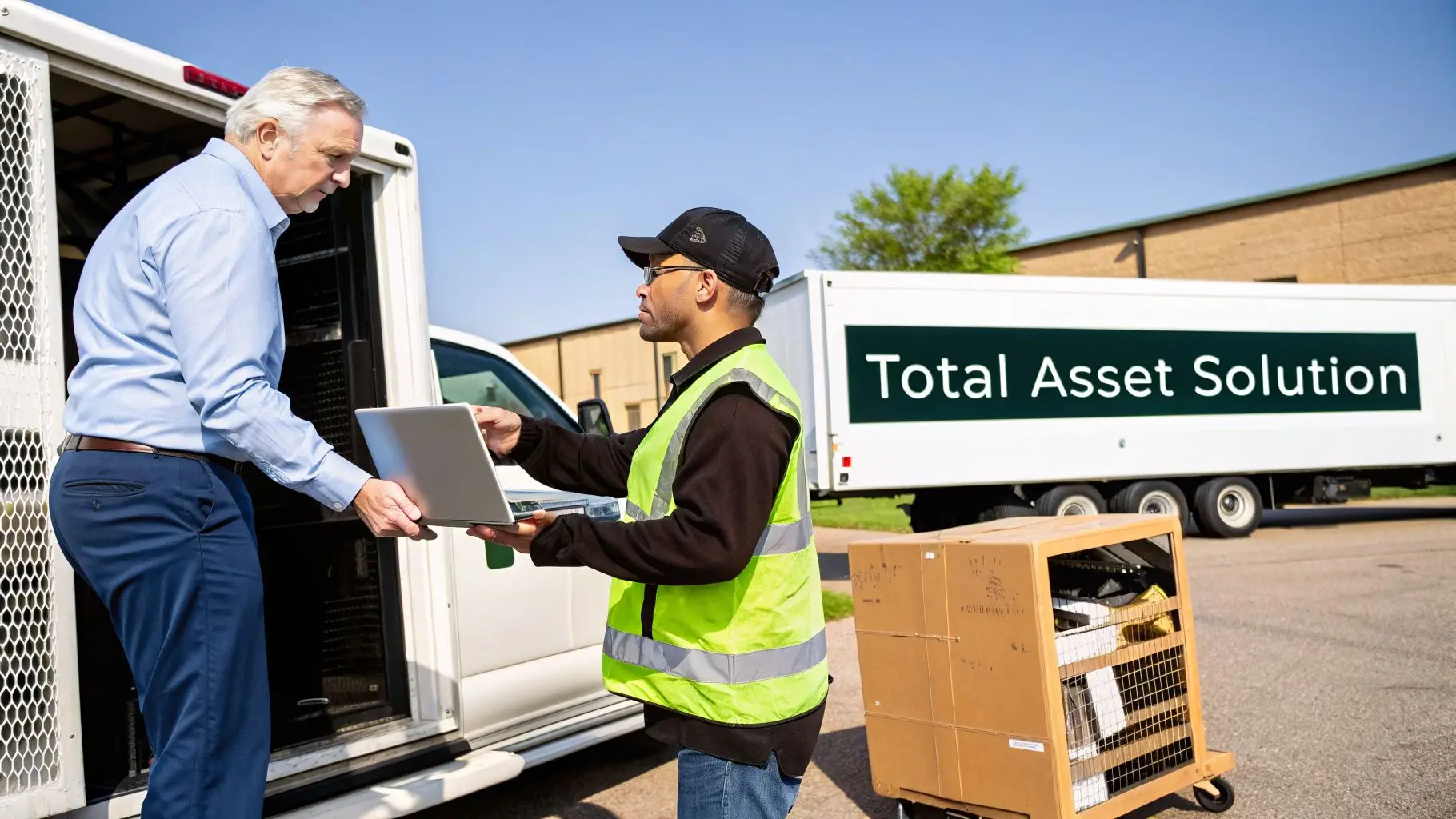
In a business context, the need for proper disposal of window air conditioners rarely occurs in isolation. It is typically one task within a much larger project, such as an office-wide technology refresh, a data center decommissioning, or a complete facility closure. Viewing these AC units as one component of a larger asset management strategy is key to efficient and compliant operations.
A single-source partner can transform a logistical challenge into a streamlined process. Instead of engaging a separate scrap hauler, data destruction firm, and e-waste recycler, you can consolidate all services under one trusted IT Asset Disposition (ITAD) vendor. An experienced partner understands that the same truck dispatched to pick up 50 old window ACs can also securely transport pallets of retired laptops, servers, and networking equipment, thereby cutting costs, simplifying scheduling, and minimizing business disruption.
Unifying Reporting and Compliance
Managing multiple vendors means tracking disparate paperwork—a weight ticket from a scrap dealer, a certificate of data destruction from another company, and potentially no documentation for other items. This fragmented approach creates significant compliance gaps.
A total asset disposition partner provides a single, comprehensive report for every asset handled.
This unified documentation includes:
- A detailed inventory of every asset collected, from AC units to desktop computers.
- A formal Certificate of Recycling covering all e-waste, confirming proper environmental handling.
- A separate Certificate of Data Destruction detailing the sanitization or shredding of all data-bearing devices.
This single source of truth is your best defense in an audit, providing undeniable proof that every piece of retired equipment was managed according to all federal and state regulations.
Choosing a partner for total asset disposition means you are strategically managing the end-of-life for all company assets, ensuring security, compliance, and environmental responsibility are addressed in one seamless project.
The Nationwide Advantage
Many businesses operate across multiple states. A company headquartered in one city may need to close a satellite office or decommission a data center in another. Coordinating different local vendors in each market is an administrative burden that consumes time and resources.
This is where a partner with a nationwide reach becomes invaluable. A provider like Beyond Surplus can arrange secure logistics and pickup services anywhere in the contiguous United States. Whether it's a few pallets or a full truckload, the process remains consistent, secure, and fully documented, regardless of location.
For a company executing a nationwide equipment refresh across 15 branch offices, a national ITAD partner offers:
- One Point of Contact: A single project manager for all locations.
- Standardized Procedures: The same secure chain-of-custody protocols are applied everywhere.
- Centralized Reporting: One consolidated report covers the entire project.
This approach guarantees consistency and control, mitigating the risks of using unfamiliar local vendors. To make the right choice, perform thorough due diligence. Our guide on building a robust vendor due diligence checklist can help you partner with a qualified and certified provider. By selecting a partner who can handle everything from window air conditioners to sensitive data center hardware, you gain efficiency, simplify logistics, and achieve bulletproof compliance.
Business AC Disposal FAQs
When managing the disposal of commercial window ACs, facility and IT managers frequently have the same questions. Here are direct answers to common inquiries, focused on ensuring your business remains compliant and secure.
Can My Staff Drain the Refrigerant from Old AC Units?
No. Draining refrigerant is a regulated activity under Section 608 of the EPA's Clean Air Act. Only an EPA-certified technician using specialized recovery equipment can legally handle refrigerants. Attempting this internally is a serious compliance violation that can result in heavy fines for your business. A professional recycling partner will manage this as a standard, non-negotiable part of their service.
What Paperwork Do I Need After Disposing of 50 AC Units?
For any commercial disposal project, you must obtain a Certificate of Recycling or a Certificate of Destruction from your disposal vendor. This document is your legal proof that every unit was managed in accordance with environmental laws. It officially transfers liability from your company to the vendor. Without it, your business could remain legally responsible for those assets indefinitely.
Are Window AC Units Considered E-Waste?
Yes. Window air conditioners are a type of e-waste, often categorized as "white goods" or appliances. Their disposal is highly regulated because they contain both valuable recyclable metals (copper, aluminum, steel) and hazardous materials (refrigerants, oils, and potentially old PCB capacitors). Due to these hazardous components, they cannot be landfilled and require processing through a certified electronics recycling stream.
Is There Resale Value in Old Commercial Window ACs?
While the units contain valuable scrap metal, the costs associated with compliant disposal—including labor-intensive, regulated work like refrigerant recovery and transportation—almost always exceed any potential scrap value. Consequently, businesses should expect to pay a net fee for professional disposal services.
The real value for your business is not a small payment from scrap metal. It is the complete risk mitigation, guaranteed liability transfer, and peace of mind that comes from certified, compliant disposal. That is the true return on investment.
Why Can't I Just Drop Them at the City Dump?
Most municipal landfills and sanitation departments have policies prohibiting the acceptance of appliances containing refrigerants. They will either be refused, or the facility will have a separate process not designed for bulk commercial loads. More importantly, public services do not provide the liability-transfer documentation that your business requires for its compliance records. To plan your project, it's also wise to know what items a recycler cannot accept; you can review our list of restricted or non-accepted items. The only way to ensure cradle-to-grave liability is properly transferred is to work with a certified commercial recycler who issues the correct certificates.
Contact Beyond Surplus for certified electronics recycling and secure IT asset disposal across the United States.