
For Atlanta businesses, a corporate electronics recycling event is far more than a simple disposal initiative; it's a strategic imperative. These professionally managed events provide a secure and compliant framework for retiring obsolete IT equipment, mitigating data breach risks, and significantly enhancing your company’s Environmental, Social, and Governance (ESG) profile. A well-executed event in Atlanta, GA, transforms the complex challenge of IT asset disposition (ITAD) into a tangible victory for your organization, reinforcing your commitment to data security and corporate responsibility.
Why Your Atlanta Business Needs a Plan for E-Waste
IT managers and business owners across Atlanta know the cycle: new technology is deployed, and old equipment accumulates. Storing outdated servers, laptops, and monitors in a back room is not a viable strategy—it's a significant liability.
Corporate electronics recycling events offer a secure, compliant, and structured solution for managing this end-of-life hardware. By partnering with a certified specialist for commercial e-waste management in Atlanta, you demonstrate a serious commitment to protecting sensitive corporate and client data while preventing hazardous materials from entering local landfills. This proactive approach is essential for any modern enterprise operating in Georgia.
Confronting the Global E-Waste Problem
The volume of global e-waste is growing at an alarming rate, posing a direct business risk to companies everywhere. The statistics are a clear call to action for every enterprise.
The Global E-waste Monitor 2024 reported a staggering 62 million tonnes of electronic waste was generated in 2022. Of this, only 22.3% was formally collected and recycled. The forecast is even more concerning, with the total expected to reach 82 million tonnes by 2030, a growth rate five times faster than documented recycling efforts.
For businesses, this gap represents a critical vulnerability. Every unrecycled device is a potential data breach, and improper disposal can lead to severe regulatory penalties and lasting brand damage.
By organizing or participating in a certified Atlanta electronics recycling event, your business becomes an active part of the solution. You ensure your retired IT equipment is managed responsibly, safeguarding your data and your reputation.
To successfully execute such an event, it's crucial to break down the process into distinct phases, each with a clear objective and critical actions to ensure comprehensive planning and execution.
Core Components of a Successful Business Recycling Event
| Planning Phase | Key Objective | Critical Action Item |
|---|---|---|
| Strategy & Goal Setting | Define what success looks like for your event. | Determine event scope: internal-only for your Atlanta office or a B2B drive for local enterprises. |
| Vendor Selection | Secure a certified and insured Atlanta electronics recycling partner. | Verify R2 or e-Stewards certification and request a Certificate of Insurance (COI). |
| Logistics & Operations | Create a seamless and safe experience for participants. | Develop a traffic flow plan and clear, visible signage for drop-off points at your Atlanta location. |
| Marketing & Communication | Maximize participation and highlight your company's efforts. | Prepare email templates and social media posts for internal and external promotion targeting the Atlanta business community. |
| Execution & Data Security | Ensure all devices are handled securely on event day. | Confirm on-site data destruction services (e.g., hard drive shredding) with your selected vendor. |
| Post-Event & Reporting | Document the event's success and ensure compliance. | Collect Certificates of Destruction and Recycling and summarize key metrics for ESG and compliance reports. |
This framework provides a clear roadmap, turning a complex process into a manageable set of tasks. With the right local partner and a solid plan, you can execute an event that delivers on every strategic front.
The Bottom-Line Benefits for Your Business
A professionally managed e-waste event is a strategic investment. By partnering with a certified vendor like Beyond Surplus for your Atlanta computer recycling needs, you guarantee every device is processed according to strict federal, state, and industry standards.
Here are the core advantages:
- Eliminate Data Breach Risks: On-site services like hard drive shredding provide irrefutable proof that sensitive business data has been permanently destroyed.
- Stay Compliant: Receiving official Certificates of Destruction and Recycling transfers liability away from your company and provides the necessary documentation for audits and compliance with regulations like the FTC Disposal Rule.
- Boost Your Brand: Promoting your commitment to responsible electronics recycling positions your company as an environmentally and socially conscious leader within the Atlanta business community.
- Unlock Hidden Value: Some of your retired equipment may retain residual value. A qualified ITAD partner can assess assets for resale, potentially creating a revenue stream from your obsolete hardware through IT asset recovery services.
Ultimately, a professional electronics recycling event turns a potential liability into a corporate asset. It sends a powerful message about your company's values while securely managing end-of-life IT equipment.
Blueprint Your Event for Flawless Execution
A successful Atlanta electronics recycling event doesn’t happen by chance. The real work begins long before the first piece of equipment is collected, and a robust plan is what separates a smooth, professional operation from a logistical failure.
First, define the scope of your event. Is this an internal drive for your employees to turn in obsolete company assets? Or are you planning a larger B2B event to serve other local Atlanta businesses? Your target audience and scale will dictate all subsequent planning.
Establish a Realistic Timeline and Budget
For most corporate or multi-business events, a 90-day planning timeline is ideal. This provides sufficient time to properly vet partners, secure a location in the Atlanta area, and execute a promotional strategy without being rushed.
A thorough approach to step by step event planning is essential. Detailed upfront planning helps anticipate needs and prevent last-minute issues, which is critical when handling sensitive IT assets and ensuring secure e-waste management.
Your budget must account for all potential costs, including vendor fees, marketing materials, facility rental, and staffing. A clear budget also strengthens your negotiating position with potential ITAD partners. Some vendors offer revenue sharing on valuable, remarketable assets, which can offset or even fully cover your event costs.
Vetting Your ITAD Partner—A Critical Decision
Choosing your ITAD partner is the single most important decision you will make. This is the company you are entrusting with your sensitive data and the compliant disposal of every asset collected. A poor choice here can expose your organization to significant financial and reputational risk.
Your vetting process must be rigorous, with a focus on verifiable credentials. Do not rely on a vendor's claims—demand proof.
Here’s a practical checklist for evaluating potential electronics recycling services in Atlanta:
- Verify Certifications: Insist on seeing their R2v3 or e-Stewards certification. These are the premier industry standards, guaranteeing the vendor adheres to strict protocols for data security, environmental protection, and worker safety.
- Confirm Insurance: Your partner must carry adequate liability insurance, including specific coverage for data breaches and environmental pollution. Request a copy of their Certificate of Insurance (COI) to verify policy limits.
- Assess Data Destruction Capabilities: Can they perform on-site, physical hard drive shredding? This is the gold standard for secure data destruction, providing indisputable proof of sanitization.
- Review Their Documentation Process: A legitimate partner provides a complete, auditable chain of custody. This includes serialized reports and official Certificates of Data Destruction and Recycling, which are your legal documents proving compliant disposal.
This visualization shows how a strong ITAD strategy helps retire assets, eliminate risk, and improve your company's environmental standing.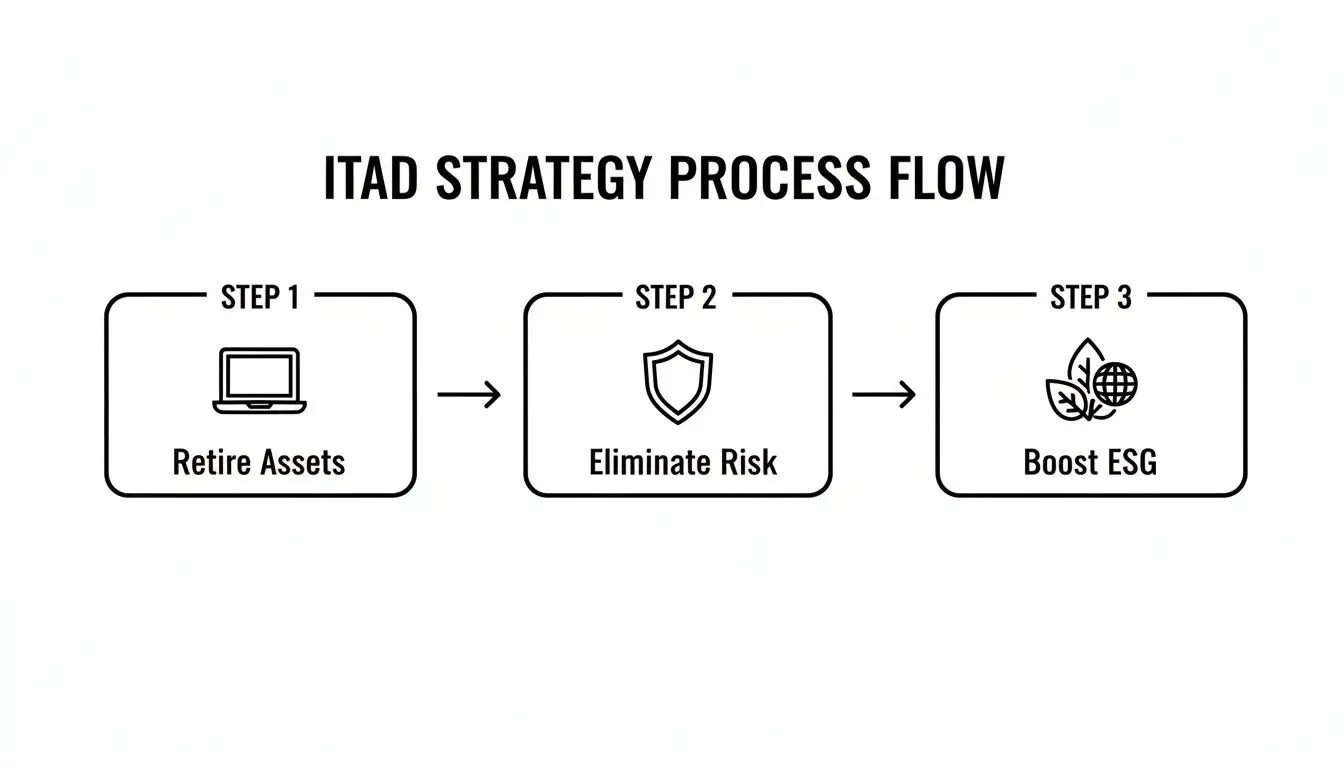
The flow highlights that secure asset retirement directly translates into reduced liability and enhanced corporate social responsibility.
Selecting a certified partner isn't just a best practice; it is your primary defense against downstream liability. The right partner assumes the risk, ensuring that every asset is managed correctly from the moment it leaves your possession.
This foundational blueprint—defining your scope, setting a timeline, and meticulously vetting your partner—is the key to a successful, secure, and impactful electronics recycling event. It transforms a logistical challenge into a powerful strategic opportunity for your Atlanta business.
Nailing the Logistics and Compliance Checklist
This is where your strategic plan becomes an operational reality. The success of your Atlanta electronics recycling event hinges on how effectively you manage the on-the-ground details. Finalizing logistics, the site plan, and compliance requirements ensures a smooth, secure, and fully compliant event.
The first major consideration is your location. For a business-focused event, a corporate parking lot or an accessible warehouse loading dock in the Atlanta area is often ideal. You must consider traffic flow, accessibility for participant vehicles and collection trucks, and overall site safety. Ensure there is adequate space for clear entry and exit lanes, a designated drop-off area, and a secure zone for on-site data destruction, all designed to prevent bottlenecks.

Securing the Site and Managing Flow
Once you have selected a location, it must be prepared for event day. If your event is open to other local businesses, you may need to check with the city of Atlanta or the county regarding permits. Some jurisdictions require temporary event permits, particularly if the event could impact public traffic.
Effective site management depends on several key factors:
- Traffic Control: Use cones, barriers, and large, clear signage to direct vehicles. A one-way traffic flow is almost always the best method to prevent congestion and maintain a steady pace.
- Staff and Volunteer Coordination: Position trained staff to direct traffic, answer questions, and assist with unloading equipment. This ensures an efficient and professional experience for all participants.
- Safety First: Designate clear pedestrian walkways separate from vehicle lanes. Ensure all on-site staff are equipped with high-visibility safety vests and protective gloves.
The demand for well-managed commercial e-waste services is growing rapidly. The global electronics recycling market is projected to expand from USD 43.2 billion in 2025 to USD 147.9 billion by 2035. A significant driver of this growth is the industrial sector—including enterprises and data centers—which accounts for 40.0% of demand as companies seek more efficient methods for IT asset retirement. With PCs and laptops comprising 45.0% of the market, the importance of an expert ITAD partner is undeniable.
Prioritizing Bulletproof Data Security
Data security is not just a feature of your event; it is the main reason for it. Your participants—whether your own employees or representatives from other companies—are entrusting you with their most sensitive data. A single security lapse can have severe consequences, making on-site data destruction a non-negotiable requirement.
The most effective way to provide absolute peace of mind is to offer on-site hard drive shredding. When business clients can witness their hard drives, SSDs, and backup tapes being physically destroyed into irreparable fragments, it eliminates all doubt about data security.
This service is a major attraction for any corporate recycling event. Your ITAD partner should bring a mobile shredding truck to your Atlanta location, creating a transparent processing station for all data-bearing devices. Upon completion, your vendor must provide a formal Certificate of Data Destruction compliant with standards like NIST SP 800-88.
This certificate is your official documentation proving you have fulfilled your data sanitization responsibilities. By building your event logistics around this security-first approach, you create an event that is not only efficient but also rigorously compliant, protecting both your participants and your own organization from risk.
Getting the Word Out: How to Promote Your Event for Maximum Turnout
You’ve dedicated significant effort to planning a secure and compliant electronics recycling event in Atlanta. Now, you must ensure that local businesses know about it. Effective promotion is the final, critical step that transforms a well-planned event into a resounding success.
Your promotional strategy will vary depending on your target audience. An internal event for employees requires a different approach than a B2B community drive. However, the objective remains the same: create a clear, compelling message that motivates the right people to participate.
Crafting a Message That Resonates
For any B2B event, your message must immediately answer the question: "What's in it for my business?" IT managers and business owners are busy; your promotions must cut through the noise and demonstrate tangible value.
Focus your messaging on what matters most to a commercial audience:
- Certified Data Security: Heavily promote the availability of on-site hard drive shredding. This is a powerful draw for businesses concerned about data privacy when disposing of old IT equipment.
- Convenient and Cost-Free: Clearly state that the event is free for businesses. Frame it as a simple, no-cost service for securely and responsibly disposing of obsolete technology, such as through a laptop disposal or computer recycling service.
- A Boost to Corporate Responsibility: Show how participation is an easy win for their company’s environmental goals and brand image. This is particularly effective when targeting other Atlanta-based enterprises.
When you center your message on these key benefits, you are not just offering a drop-off service—you are providing a valuable business solution.
Promoting an Internal Event to Your Team
If the event is for your own employees, the goal is to maximize internal participation. Begin promoting the event at least four to six weeks in advance using all available internal communication channels.
Send a series of emails from company leadership announcing the event, detailing accepted items, and explaining the data security measures. Post flyers in high-traffic areas like break rooms and lobbies. Use your company's intranet or internal messaging platforms for reminders and countdowns. This consistent communication builds momentum and ensures high engagement.
An internal recycling event does more than clear out storage closets. It demonstrates to your team that the company is committed to security and sustainability. This reinforces a culture of corporate responsibility and enhances employee morale.
Reaching Out for B2B and Community Events
When your event is open to other Atlanta businesses, you need a broader outreach strategy. Local business organizations are an excellent starting point.
- Chambers of Commerce: Contact the Metro Atlanta Chamber and other local chambers. Ask them to feature your event in their newsletters or email blasts to their members.
- Professional Networks: Use platforms like LinkedIn to post event details. Target Atlanta-based professionals and share the event in local business groups.
- Direct Outreach: For a B2B-focused event, a targeted email campaign to local IT managers, facility managers, and business owners can be highly effective.
For organizations looking to make a greater impact, tying a recycling event to social good can be a powerful motivator. You can learn more about how these initiatives strengthen communities by reading about social impact recycling efforts.
Ultimately, clearly communicating the value of attending your secure, professional Atlanta electronics recycling event is the final step to ensuring it’s a major success.
Executing a Smooth and Secure Event Day
After extensive planning and promotion, event day is when your strategy comes to life. A seamless operation on the day demonstrates your competence and commitment to your partners and the Atlanta business community, creating a professional and secure experience for every participant.

The day should begin with an early team briefing. Ensure all staff and volunteers understand their specific roles, the site layout, and the procedures for handling different types of electronics. An organized start is non-negotiable for a professional event.
Place large, easy-to-read signs at the entrance and along the entire collection route. This establishes a simple, one-way traffic pattern that keeps vehicles moving and prevents frustrating backups.
Setting Up for Success
Your site layout must be intuitive. Designating separate, clearly marked stations for general e-waste and for secure hard drive shredding is a game-changer. This separation is crucial for managing flow and ensuring participants who require certified data destruction can access it without delaying others.
The quality of your team directly impacts the efficiency and security of your Atlanta electronics recycling event. Using winning event staffing solutions ensures you have trained professionals who can manage traffic, handle assets safely, and maintain a professional atmosphere throughout the event.
Your crew should be equipped with safety vests and gloves and must be knowledgeable about which materials are accepted and which are not. This preparation allows them to handle unexpected situations with confidence, such as a sudden change in weather or a large influx of attendees. Having pop-up tents ready for key stations can be invaluable.
Managing the Intake and Data Destruction Process
Your intake process must operate with precision. As vehicles arrive at the drop-off point, staff should be prepared to greet drivers, confirm the items being dropped off, and efficiently unload the equipment. For business clients arriving with large quantities of IT equipment, such as during a data center decommissioning, a professional ITAD partner proves its worth by palletizing and shrink-wrapping everything on-site.
For data destruction, transparency is key to providing participants with complete peace of mind.
- Guide Them: Direct vehicles with laptops, hard drives, servers, or other data-bearing devices to the dedicated shredding station.
- Document Everything: Before any device is destroyed, your team must scan its serial number. This creates a detailed audit trail for the Certificate of Destruction.
- Let Them Watch: The most impactful step is allowing participants to witness their media being fed into the industrial shredder. This visual confirmation provides the ultimate assurance of data security.
This step is absolutely critical. Businesses require irrefutable proof that their sensitive data has been permanently eliminated. To learn more about compliant data destruction methods, you can review our guide to secure data destruction services.
A day-of-event checklist is an indispensable tool. It should cover everything from the initial morning safety brief and signage placement to the final site sweep and reconciliation of collected assets with your ITAD partner. No detail is too small.
As the event concludes, the teardown phase must be just as organized. All collected e-waste must be securely loaded onto GPS-tracked trucks for transport to the certified processing facility. Finally, ensure the site is left cleaner than you found it. Orchestrating a seamless event day not only delivers on your promises—it solidifies your reputation as a responsible and security-focused organization in the Atlanta market.
Don't Pack Up Yet: The Real Work Begins After the Event
The last car has left your Atlanta electronics recycling event, but your responsibilities are not over. In fact, some of the most critical steps occur after the event concludes. This post-event phase is where you secure your compliance documentation and translate a successful day into a measurable and communicable achievement.
The event itself is the operation, but the follow-up provides the proof of compliance. Without proper documentation from your ITAD partner, you have no official record that all assets were managed according to legal and environmental standards. This paperwork is non-negotiable for protecting your organization.
Nail Down Your Compliance with Certified Paperwork
Two documents are absolutely essential: the Certificate of Data Destruction and the Certificate of Recycling. The job is not complete until these are in your possession.
The data destruction certificate is your legal proof that all sensitive information was sanitized or physically destroyed in accordance with standards like NIST 800-88. It should include serialized asset details, linking the destruction back to specific devices. The recycling certificate confirms that all non-reusable e-waste was processed in an environmentally sound manner, officially transferring liability from your company to the certified vendor.
These certificates are the final, official handshake of your event. They close the loop on your chain-of-custody, providing the auditable trail necessary for compliance with regulations such as the FTC Disposal Rule and internal governance policies.
Failing to obtain this documentation leaves your company exposed to significant risk. A professional ITAD partner will have a streamlined process for delivering this paperwork promptly. If you want to understand what this process entails, get in touch with the team at Beyond Surplus to learn about our certified documentation procedures.
Tally Up Your Success and Tell Your Story
With your compliance documents secured, it's time to quantify and communicate your success. Request an impact report from your ITAD partner. This report translates your efforts into results that resonate with your leadership team, employees, and the broader Atlanta community.
Key metrics to highlight include:
- Total Weight Collected: The total pounds or tons of e-waste successfully diverted from landfills.
- Asset Count: A breakdown of how many laptops, servers, monitors, and other devices were collected.
- Data Destruction Metrics: The total number of hard drives and other storage media that were physically shredded.
- Environmental Wins: Metrics such as greenhouse gas emissions avoided or the quantity of valuable resources recovered.
The most important post-event records are those that prove compliance and quantify your success. Here’s a checklist of the documentation you must collect and the internal reports you should generate.
Post-Event Documentation Checklist
| Document/Report | Purpose | Key Information to Verify |
|---|---|---|
| Certificate of Data Destruction | Proves secure data sanitization and transfers liability. | Serial numbers of destroyed media, date of destruction, method used (e.g., shredding). |
| Certificate of Recycling | Confirms environmentally compliant processing of all e-waste. | Total weight of materials recycled, statement of compliance with R2v3/e-Stewards standards. |
| Internal Impact Report | Quantifies success for internal stakeholders and external marketing. | Total weight, number of units, hard drives shredded, and key environmental metrics. |
Once this information is organized, share it widely. These are not numbers to be filed away.
Incorporate these results into your company's ESG (Environmental, Social, and Governance) report. Draft a press release for local Atlanta business journals. Create visually appealing posts for your social media channels. By actively promoting your success, you amplify the positive impact of your event and reinforce your brand’s reputation as a responsible leader in the community.
Common Questions About Electronics Recycling Events
Even with the most thorough planning, business leaders often have questions before committing to an electronics recycling event. As an IT manager or business owner in Atlanta, getting clear, authoritative answers helps you move forward with confidence. Here are some of the most common questions we hear regarding corporate electronics recycling events.
What Is the Most Important Factor When Choosing a Recycling Event Partner?
The single most important factor is certification. Your business must partner with a vendor holding an active R2v3 or e-Stewards certification. These are not merely logos; they are your guarantee that the partner meets the highest industry standards for data security, environmental compliance, and worker safety.
A certified partner provides a fully traceable chain of custody, tracking every asset from collection to final disposition. This shields your company from the significant financial and legal risks of downstream liability and ensures they can issue the official certificates required to prove compliance.
Can Our Business Recover Value from the Electronics We Collect?
Yes, absolutely. Many of the IT assets collected at your Atlanta event, especially enterprise-grade servers, networking gear, medical equipment, and newer laptops, may retain significant market value. A true IT Asset Disposition (ITAD) partner will evaluate all collected equipment for remarketing potential.
This process, known as IT Asset Value Recovery (ITAVR), can turn a disposal cost into a revenue source.
- Items with resale value are professionally tested, data-wiped, and refurbished.
- The partner sells the assets through established secondary markets.
- Your company receives a share of the net revenue generated from the sales.
This financial return can often offset or even exceed the costs of the event, generating a net profit for your organization.
How Do We Guarantee Data Security for All Collected Devices?
The undisputed best practice for guaranteeing data security at a recycling event is on-site hard drive shredding. You should exclusively consider partners who can bring an industrial-grade, mobile shredder directly to your event location in Atlanta.
This allows your team and other business participants to physically witness their hard drives, SSDs, and other storage media being destroyed. This visual confirmation provides an unparalleled level of assurance. For all other devices, your vendor must use locked, GPS-tracked transport and provide a certified report detailing the final disposition of every serialized asset.
How Far in Advance Should We Start Planning Our Event?
For a well-organized corporate or B2B electronics recycling event, we recommend a 90 to 120-day planning window. This timeframe allows ample opportunity to properly define your goals, thoroughly vet a certified ITAD partner, secure a suitable location in the Atlanta area, and execute a promotional campaign that effectively drives business participation.
While a smaller, internal-only collection might be achievable on a shorter timeline, a three-month runway is the best practice for ensuring a smooth, successful, and stress-free event.
Planning a successful and secure electronics recycling event in Atlanta requires an expert partner you can trust. Beyond Surplus offers certified ITAD solutions, including on-site data destruction, IT equipment disposal, and value recovery, to ensure your event is compliant, secure, and impactful. Contact us today to schedule your next corporate recycling event.