
When your business in Atlanta, Georgia searches for "ewaste disposal near me," it’s about more than just clearing out old technology. For any commercial enterprise, this is a moment to protect your company from significant data, financial, and regulatory risks. The right answer is always a certified IT Asset Disposition (ITAD) partner like Beyond Surplus, who can transform this operational necessity into a strategic security move.
Why 'Ewaste Disposal Near Me' Is a Strategic Search for Atlanta Businesses
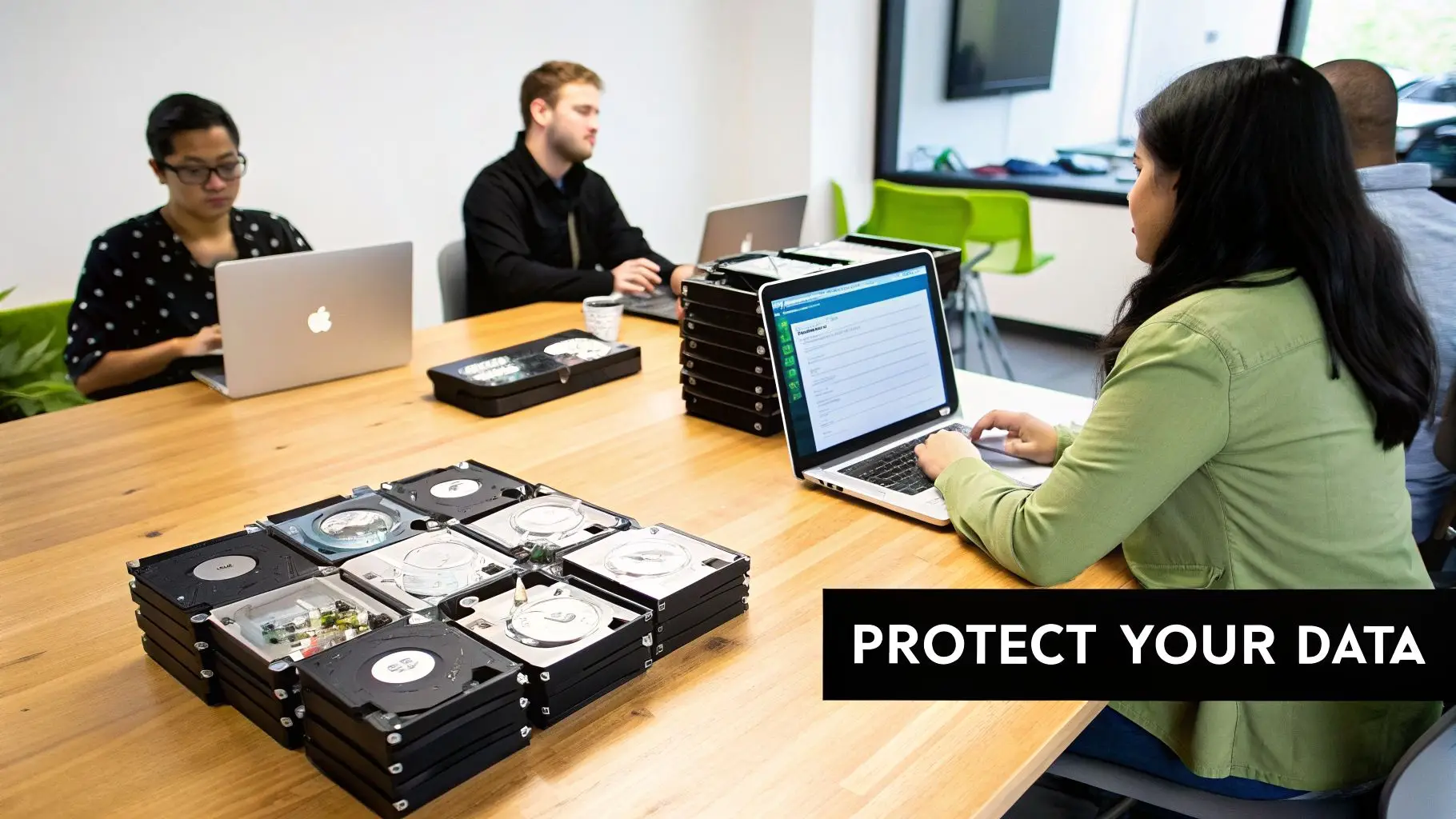
For a business, looking up local e-waste disposal is worlds apart from a residential cleanup. That search marks a critical point in your IT asset lifecycle—one filled with risk but also loaded with opportunity. It's a search driven by the very real need to protect sensitive corporate data, stay compliant with regulations, and maintain your brand’s reputation.
A single discarded hard drive containing customer records, company financials, or intellectual property is a ticking time bomb. Mishandled IT equipment can quickly lead to devastating data breaches. The fallout isn't just about a damaged reputation; failing to comply with data privacy laws comes with steep financial penalties that can impact your bottom line.
The True Cost of Neglecting Commercial E-Waste
The sheer volume of electronic waste is staggering. Back in 2022, the world generated 62 million tonnes of e-waste, which was an 82% jump from 2010. What’s truly alarming is that only 22.3% of it was properly collected and recycled.
This global problem has a direct impact on your business. When disposal isn't managed correctly, it opens you up to several major risks that can have lasting consequences. The table below breaks down the primary risks businesses face when they fail to manage electronic waste correctly.
Business Risks of Improper E-Waste Disposal
| Risk Category | Description | Potential Business Impact |
|---|---|---|
| Data Security Breaches | Sensitive data can often be recovered from hard drives and SSDs if not professionally destroyed. | Loss of customer trust, theft of intellectual property, significant reputational damage, and potential lawsuits. |
| Regulatory Fines | Laws like the FTC Disposal Rule, HIPAA, and GDPR require secure data destruction. Non-compliance is not taken lightly. | Severe financial penalties, mandatory audits, and increased regulatory scrutiny. |
| Environmental Liability | Improperly dumping electronics can lead to legal action for environmental contamination and harm your corporate social responsibility profile. | Fines from environmental agencies, negative press, and damage to your brand image as an irresponsible company. |
| Loss of Asset Value | Retired equipment that is still functional often holds residual value. Simply trashing it means throwing money away. | Missed opportunity to recover capital through resale or remarketing, which could offset the cost of new equipment. |
Failing to address these risks isn't just a compliance issue; it's a direct threat to your business's stability and reputation.
Partnering with a certified ITAD provider like Beyond Surplus is the most effective way to neutralize these threats. It turns disposal from a liability into a secure, compliant, and value-driven process for your Atlanta-based enterprise.
Transforming Risk Into Advantage
A professional e-waste disposal plan does so much more than just free up a storage closet. It gives you a documented and auditable process for handling every piece of end-of-life technology. This includes secure transportation, certified data destruction, and environmentally responsible recycling.
You can learn more by checking out our guide to finding local e-waste recycling options.
Ultimately, a proactive approach to e-waste ensures your business is not just compliant but truly secure. By working with a certified partner, you gain the peace of mind that comes from a verifiable chain of custody. You turn a necessary task into a powerful part of your company's risk management and sustainability strategy.
How to Find and Vet the Right ITAD Partner in Atlanta
Once you start searching for professional e-waste disposal services, you'll find a lot of options. The real challenge isn’t just finding a company; it's finding the right one. You need a partner you can absolutely trust with your sensitive data and your brand's reputation. It's time to look past the basic sales pitch and dig into their qualifications, certifications, and documented processes.
A simple scrap hauler might offer to take your old equipment for free, but what you're not getting is security, compliance documents, or any guarantee against environmental harm. A true IT Asset Disposition (ITAD) firm is a security partner, providing a verifiable chain of custody from the moment they pick up your assets to their final destruction. For any business that cares about its data, that distinction is everything.
Look for Gold-Standard Certifications
The most reliable sign of a legitimate ITAD provider is their certifications. These are proof that a company’s processes have been rigorously audited by an independent third party for security, environmental responsibility, and worker safety.
The two certifications you absolutely need to look for are:
- R2v3 (Responsible Recycling): This is the top-tier standard in the electronics recycling industry. An R2v3 certification guarantees the vendor follows strict guidelines for data destruction and environmental protection, and it proves they have a documented process for tracking all materials downstream.
- e-Stewards: Developed by the Basel Action Network, the e-Stewards standard is famous for its strict rules against exporting hazardous e-waste. It’s your guarantee that your assets are being managed in the most socially and environmentally responsible way possible.
If a potential vendor lacks these certifications, they likely lack the validated processes needed to protect your Atlanta business from serious liability.
Key Questions for Your Vetting Checklist
When you start talking to a potential partner, the answers they give to specific questions will reveal their professionalism. Go beyond "What do you charge?" and get into the details of their process.
An ITAD firm’s real value is measured in risk mitigation, not just disposal fees. Their ability to provide auditable proof of data destruction and compliant recycling is what truly protects your organization.
Make sure to ask questions like these:
- Data Destruction: "Can I see a sample Certificate of Data Destruction? Will it list the serial number for every single hard drive you destroy?"
- Downstream Process: "Who are your downstream partners, and can you prove they are also certified?"
- Chain of Custody: "What documentation do you provide to track our assets from pickup to final recycling?"
- Logistics: "What security measures do you have in place while our equipment is in transit?"
It’s also crucial to ask about their logistics capabilities, especially if you have large or heavy IT assets like data center equipment. Some projects may even require specialized heavy haul transportation to move equipment safely.
Asking these tough questions upfront is the best way to separate a truly qualified ITAD partner from a simple recycler.
Preparing Your IT Assets for Secure Disposal
Your responsibility for data security does not end when the disposal truck pulls away. What your team does before any equipment leaves your facility is a critical part of protecting your company from risk.
Getting your internal preparation right makes the entire disposal process smoother and establishes a clean chain of custody.
First, create a detailed inventory of every asset being disposed of. This isn’t just a quick headcount. Create a log with the device type, brand, model, and—most importantly—the serial number for each item. This list is your foundation for tracking and will be what you reference against the certificates of destruction you receive later.
Data Sanitization Versus Physical Destruction
With your inventory locked down, it’s time to deal with the data. You have two main paths, and the right choice depends on your security policies and the equipment's potential resale value.
Software-Based Data Wiping
This method uses specialized software to overwrite all data on a hard drive or SSD, making it unrecoverable.
- The industry benchmark is the NIST 800-88 standard, which outlines different levels of sanitization.
- This is the best route for newer, working equipment that might be resold, as it keeps the hardware functional.
Physical Destruction
This approach is the complete obliteration of the storage media.
- Hard drive shredding is the most secure and common method. The drives are ground into tiny metal bits, making data recovery impossible.
- Choose this for drives with highly sensitive data, old or broken drives, or if your company policy simply demands total destruction.
For a more detailed breakdown of these methods, check out our guide on how to completely wipe a hard drive.
Streamlining the Pickup Process
Once the inventory is done and data is handled, gather all the equipment. Find a secure, controlled spot—like a locked storage room or a caged-off section of your warehouse—to stage all the assets while you wait for pickup. This prevents equipment from being misplaced or accessed improperly.
Staging all assets in one easy-to-access location doesn't just tighten up security. It also makes the actual pickup go much faster, minimizing disruption for your team.
If you can, palletize the equipment or at least organize it neatly. This makes the handover to your ITAD partner seamless. By creating a repeatable process for all your end-of-life gear, you turn a complicated headache into a secure, documented, and manageable task.
The infographic below shows the simple but critical process for vetting any ITAD partner you consider.
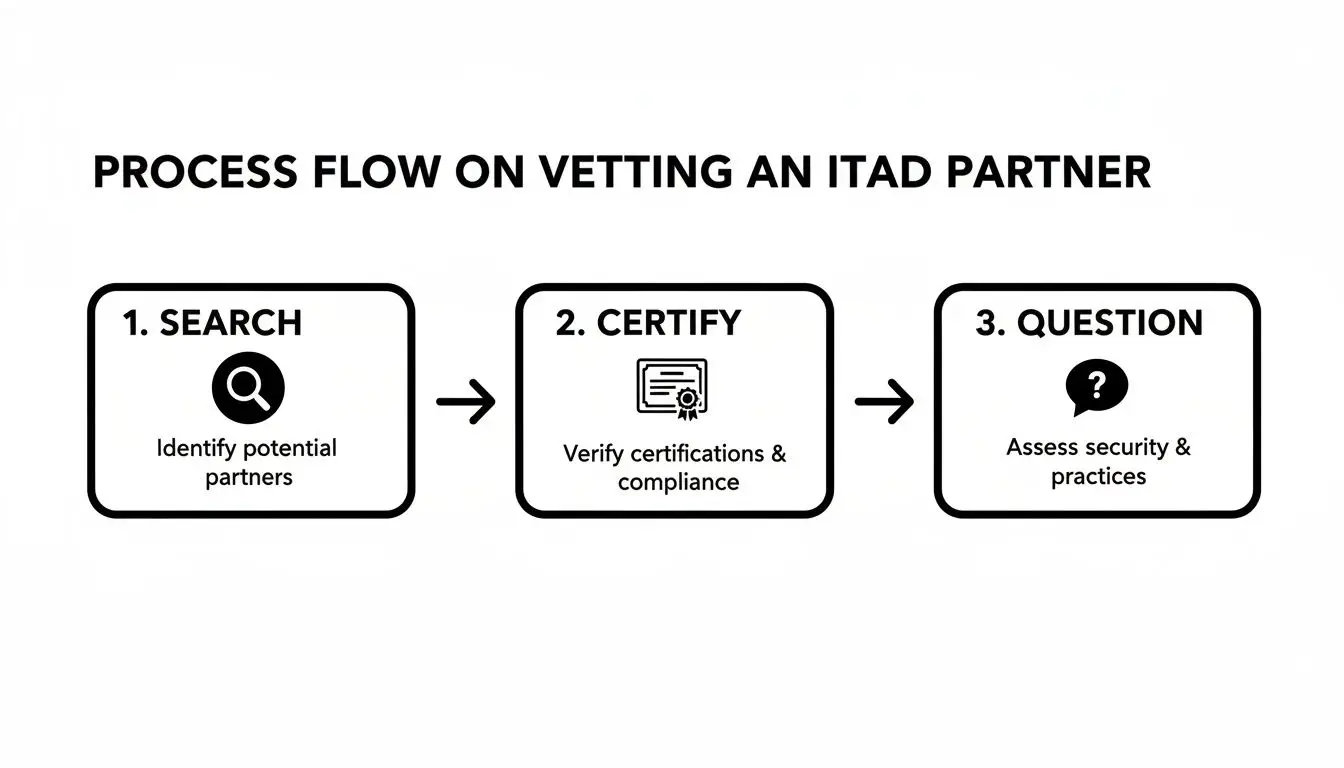
As you can see, finding the right partner goes beyond a simple web search. It requires you to verify their certifications and ask the tough questions to ensure they can truly meet your security and compliance needs.
For businesses in Atlanta seeking professional e-waste disposal, the choice comes down to two options: self-hauling equipment to a drop-off point or scheduling a professional business pickup. For commercial needs, the choice is clear.
The Problem with Drop-Offs for Business E-Waste
Drop-off services are designed for residential use. For any business, trying to do it yourself introduces serious risks and logistical headaches:
- Security Gaps: The moment you load company equipment into a vehicle, you create a gap in your chain of custody. If that equipment is lost or stolen, the liability lands directly on you.
- Inefficient Use of Time: Your team has to spend valuable time loading, transporting, and unloading what is often heavy, bulky equipment.
- Lack of Documentation: A casual drop-off doesn't provide the on-site documentation needed to formally start a secure chain of custody, which is a must-have for compliance.
For any company with compliance obligations, scheduled pickups aren't just an option—they're the industry standard. A DIY drop-off simply can’t offer the security and documentation you need.
Why Scheduled Pickups Are the Professional Standard
A scheduled business pickup is far more than a convenience; it’s a core part of a secure IT asset disposition (ITAD) strategy. When you work with a certified recycler like Beyond Surplus for your Atlanta enterprise needs, the pickup service is designed to fit right into your operational and security workflow.
If your company has multiple offices, a nationwide pickup service provides a single, consistent process for all locations, simplifying management.
On pickup day, a professional logistics crew comes right to your facility. They’ll confirm the inventory, securely pack the assets into a locked truck, and provide the initial paperwork that formally transfers custody. This documented handover is the single most important step in protecting your company from liability. While pickups are standard for businesses, you can learn more about the intended use of our electronics drop-off locations for residential needs.
Understanding Disposal Costs and Compliance Documentation
It’s easy to view e-waste disposal as just another operational cost, but that’s a risky perspective. Think of it less as an expense and more as a critical investment in protecting your business from liability. The price you pay for professional services directly reflects the level of security and compliance you receive.
Factors Influencing E-Waste Disposal Costs
No two e-waste disposal quotes are the same because no two projects are identical. The final cost you’ll see from an ITAD provider is built from several key services.
- Equipment Type and Volume: This is the biggest driver. Recycling office laptops is completely different than a full data center decommissioning, which requires far more labor and specialized logistics.
- Logistics: Is the equipment in one Atlanta location or multiple sites? How easy is it to access and remove? A single pickup from a ground-floor office will cost less than a coordinated nationwide project.
- Data Destruction Method: Your security needs have a direct impact on the price. On-site hard drive shredding is priced differently than off-site shredding or software-based wiping.
While these services come at a cost, many businesses find they can significantly offset or even eliminate these expenses through IT Asset Value Recovery (ITAVR).
If your retired equipment is relatively new, a good ITAD partner can determine its fair market value. That value is returned to you, either as a check or as a credit against your final invoice. It's a great way to turn old liabilities into a fresh revenue stream.
The Critical Role of Compliance Documentation
While getting money back on old assets is beneficial, the most valuable thing you get from a professional disposal service is the documentation. This paperwork is your official proof that you followed the law and properly transferred liability. Neglecting this can lead to serious consequences. Without proof of proper disposal, your business stays on the hook legally and financially.
There are two documents you absolutely must have:
- Certificate of Data Destruction: This is your official record proving every data-bearing device was destroyed according to standards like NIST 800-88. It should be serialized, listing each hard drive by its unique serial number. Our article on the hard drive certificate of destruction dives into why this level of detail is critical for creating an audit trail.
- Certificate of Recycling: This document confirms that your non-data assets were recycled in an environmentally sound way, following R2v3 or e-Stewards standards. It’s your proof of environmental compliance and corporate social responsibility.
Answering Your Business E-Waste Disposal Questions
When your Atlanta business starts looking for an "e-waste disposal near me" solution, many practical questions arise. Getting clear, authoritative answers is essential for making a confident, compliant decision.
What Items Are Typically Accepted for Business E-Waste Recycling?
Professional ITAD companies are set up to handle a huge range of commercial and enterprise-grade equipment—the technology that runs your organization. This includes:
- Servers, storage arrays, and SAN equipment
- Networking hardware like switches, routers, and firewalls
- Computers, desktops, and laptops in bulk
- Monitors of all types (CRT and LCD)
- Business telecom systems and VoIP phones
- Data center hardware, including server racks and large UPS systems
- Medical equipment and laboratory equipment
Always confirm with your vendor, but a recycler that specializes in business e-waste is built to handle virtually any technology asset from a modern commercial environment.
How Can I Be Certain Our Company's Sensitive Data Is Destroyed?
This is the most critical question. Reputable vendors use secure data destruction methods that follow strict NIST 800-88 guidelines. For the highest level of security, physical hard drive shredding—either on-site at your facility or off-site at theirs—is the gold standard, grinding drives into unrecoverable pieces of metal.
Always insist on a serialized Certificate of Data Destruction. This isn't just a piece of paper; it's your official proof of compliance. It should list every single hard drive by its unique serial number, legally transferring liability from your organization to the vendor.
Is It Possible to Get Paid for Our Old IT Equipment?
Yes, absolutely. This process is called IT Asset Value Recovery (ITAVR) or a buyback program. If your company has a good amount of functional equipment from the last 3-5 years—such as enterprise servers, a fleet of laptops, or high-end networking gear—a certified ITAD partner can assess its fair market value. That value can come back to you as a check or as a credit applied to your recycling services, often offsetting or even eliminating the cost of disposal.
What Makes a Recycler 'Certified' and Why Does It Matter?
Certifications like R2v3 and e-Stewards are your ultimate seal of approval. They mean an independent third party has audited the recycler's entire operation, verifying everything from data security protocols to environmental safety. Working with a certified vendor is your guarantee that your e-waste won't be illegally exported or landfilled and that your sensitive data is handled according to the highest industry standards, shielding your business from legal and reputational fallout.
Contact Beyond Surplus for certified electronics recycling and secure IT asset disposal in Atlanta. We provide professional computer recycling, data center decommissioning, and IT equipment disposal services designed to protect your Georgia business.