
Los Angeles IT directors usually hit the same wall at the same time. Storage rooms fill with retired laptops, dead networking gear, obsolete medical devices, and pallets of drives from a refresh or decommission. Finance wants the space back. Security wants proof the data is gone. Legal wants a paper trail. Facilities just wants it off the floor.
That’s why ewaste la isn’t a disposal issue. It’s a compliance and liability issue with an asset recovery component. If you treat it like junk hauling, you create avoidable risk.
The scale of the problem is already large enough to justify a tighter process. In 2022, the world generated a record 62 million tonnes of electronic waste, an 82% increase from 2010, yet only 22.3% was formally collected and recycled, leaving US$62 billion in recoverable resources lost, according to the WHO summary of the Global E-waste Monitor 2024). For Los Angeles businesses, that global trend shows up as local pressure. More devices. More audits. More liability if you cut corners.
Businesses that need a commercial process for ewaste recycling services should build around chain of custody, certified data destruction, and documentation from day one.
Navigating E-Waste Compliance for Los Angeles Businesses

An LA business doesn’t get judged by good intentions. It gets judged by records, handling practices, and whether sensitive equipment leaves the site under control.
Why ordinary disposal fails
Old desktops, switches, monitors, and storage arrays often contain regulated components and sensitive data. Once they leave your loading dock without documentation, you lose visibility. If something gets dumped, exported improperly, or shows up with recoverable data, your team owns the problem first and argues about fault later.
Practical rule: If your vendor can’t document custody, destruction, and downstream recycling, you don’t have a recycling program. You have exposure.
What a business process should look like
A workable ewaste la program for enterprise operations usually includes:
- Asset identification: Tag what’s leaving and match it to an internal inventory.
- Security classification: Separate data-bearing assets from non-data peripherals.
- Pickup controls: Require scheduled handling, signed transfer, and auditable transport.
- Final documentation: Collect certificates for recycling and, where needed, data destruction.
This is especially important in sectors such as healthcare, finance, education, and government contracting, where disposal mistakes turn into audit findings fast.
Understanding LA's E-Waste Regulatory Environment
California treats electronic waste more seriously than many other states, and Los Angeles businesses should assume scrutiny, not leniency.
EWRA and DTSC both matter
The Electronic Waste Recycling Act shapes how covered electronic devices are handled in California. The Department of Toxic Substances Control enforces hazardous waste rules that can affect how businesses store, ship, and dispose of electronic equipment. That combination catches companies that rely on informal cleanouts or office move vendors who aren’t structured for IT asset disposition.
Consider tax compliance as an analogy. You can’t solve it by being “mostly organized.” You need the right categories, the right records, and the right specialist.
In California, DTSC audits of businesses increased 25% in 2025, and recent LA County pilot audits fined 15% of sampled firms for improper e-waste disposal, according to Human-I-T’s Los Angeles e-waste overview. That should end the debate about whether enforcement is real.
What IT directors should do now
Use your internal disposal workflow as a compliance control, not an operations afterthought.
- Map ownership: Security, procurement, facilities, and IT all touch end-of-life assets. Put one owner in charge.
- Define approved channels: Ban ad hoc recycling, unscheduled drop-offs, and undocumented pickups.
- Standardize records: Keep shipment logs, serial-based inventories, and final certificates in one place.
- Review policy: If your current procedure is vague, tighten it.
A useful way to formalize that discipline is to align the disposal workflow with a broader Environmental Management System (EMS). That won’t replace legal review, but it does help teams create repeatable controls instead of improvising each refresh cycle.
If your team needs the regulatory baseline for handling electronics and related materials, keep a working reference to universal waste regulations. It helps prevent the common mistake of treating all retired IT equipment as simple trash.
Compliance in Los Angeles isn’t hard because the rules are mysterious. It’s hard because businesses try to manage specialized waste with generic office procedures.
Secure Data Destruction and Liability Transfer
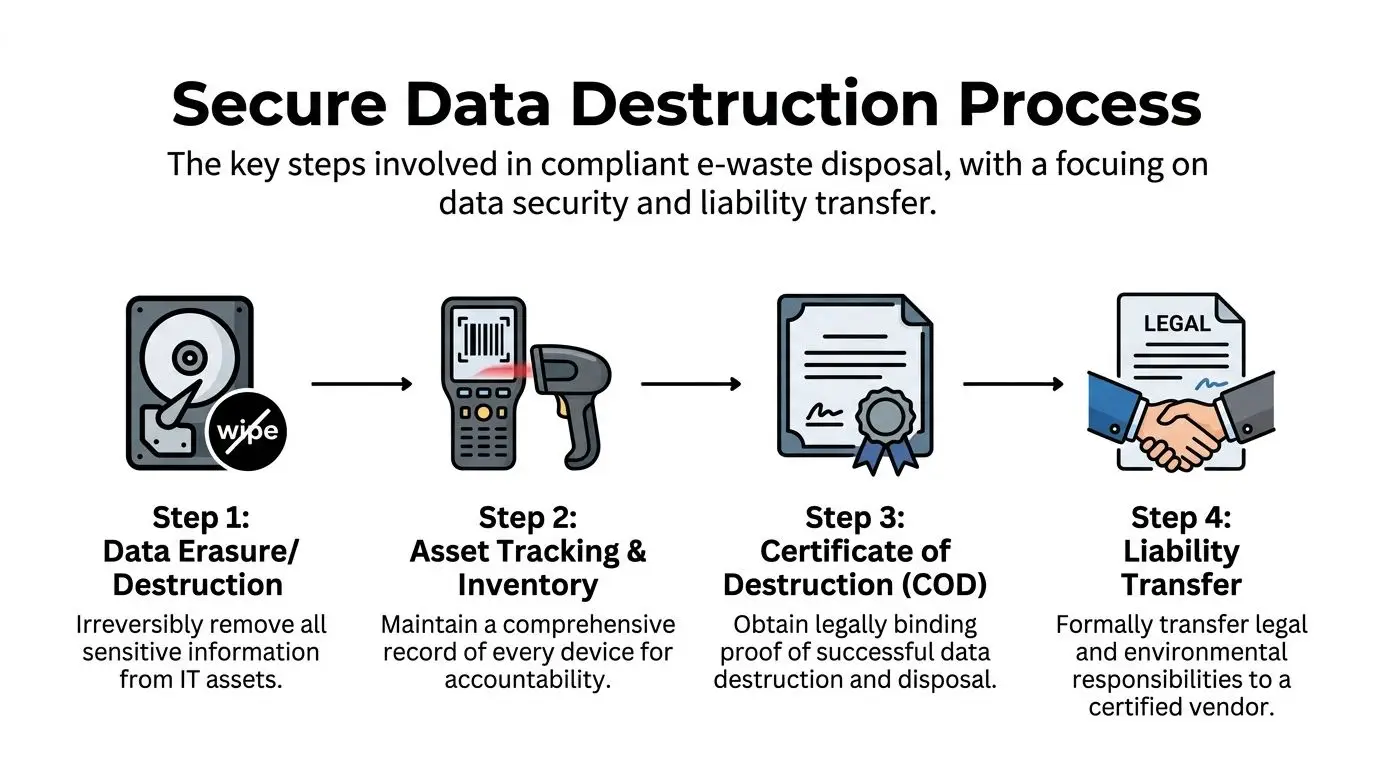
Most ewaste la failures aren’t really recycling failures. They’re data governance failures.
If a storage device leaves your facility with recoverable information, you’ve already lost control of the highest-risk part of the process. Recycling comes second. Security comes first.
Wiping is not the same as provable destruction
Logical wiping can be appropriate for some reuse scenarios, but only if it’s validated, documented, and tied to specific assets. For drives from high-risk environments, failed equipment, mixed inventory, or compressed decommission schedules, physical destruction is often the cleaner option.
For data center de-installations, on-site industrial shredding ensures NIST 800-88 compliant data destruction before transport, and that process allows certified recyclers to transfer liability via certificates while supporting FTC Disposal Rule compliance, according to this explanation of recycled electronics processing and secure shredding.
That matters because the moment of highest exposure is often transport. If drives are destroyed before they leave the site, you remove the argument about what might have happened in transit.
The document that protects you
The key document isn’t a generic pickup receipt. It’s a Certificate of Data Destruction tied to the assets and method used.
A proper certificate should support four things:
- Proof of method used for destruction or erasure.
- Traceability back to devices, drives, or serialized inventory.
- Date and custody record showing who handled the assets.
- Liability transfer from your organization to the certified ITAD vendor.
Without that, legal and compliance teams are left defending assumptions.
If you want to see what that documentation should support internally, review a hard drive destruction certificate process. It’s the difference between “we believe the data was destroyed” and “we can prove it.”
What I recommend in Los Angeles
For LA operations, I’d use a simple rule set:
- For failed drives or mixed lots: shred.
- For data center exits: require on-site shredding before transport.
- For reusable endpoint devices: allow wiping only with auditable reporting.
- For regulated environments: make certificates mandatory, not optional.
If your vendor talks more about recycling volume than chain of custody, they’re solving the wrong problem.
How to Prepare Your IT Assets for Disposition
Poor prep creates delays, inventory disputes, and security gaps. Good prep makes pickup faster and documentation cleaner.
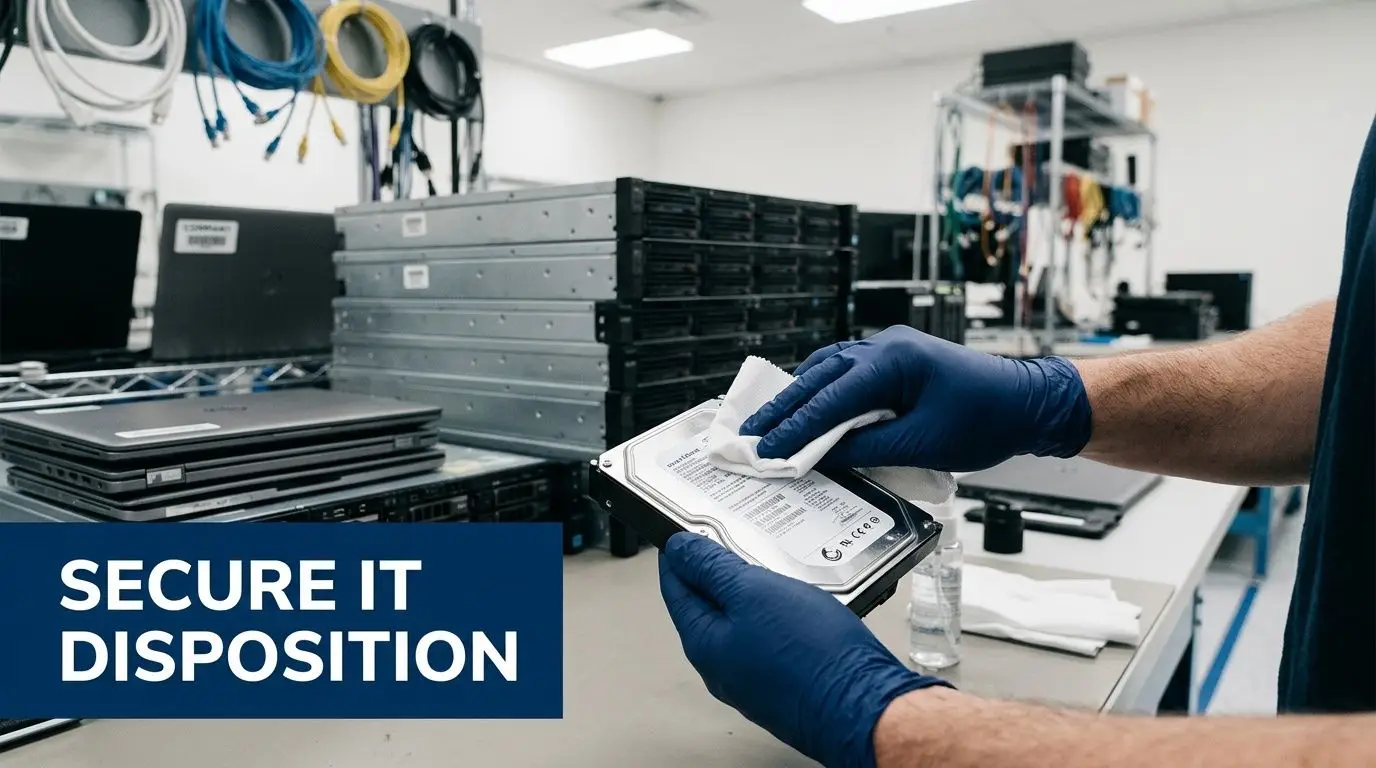
Build the internal handoff before pickup day
Start with an inventory. It doesn’t need to be elegant. It needs to be complete enough that your team can verify what left and what was destroyed, resold, or recycled.
Include device category, manufacturer, model, serial number when available, and whether the item contains storage media. For servers, SAN equipment, laptops, and copiers, be explicit about embedded drives. Teams miss those constantly.
Stage by outcome, not by department
Don’t pile everything together and expect the vendor to sort your risk for you. Separate assets into practical groups:
- Redeploy or resale candidates
- Data-bearing assets for destruction
- Non-data peripherals
- Broken or incomplete equipment for recycling
- Special handling items such as batteries or screens
That simple segregation reduces confusion and helps preserve any remaining value.
Make the loading area work
Use a staging area with controlled access. Palletize heavy equipment. Box loose accessories. Keep cables, drives, and small devices from walking away before pickup.
A strong prep checklist looks like this:
- Lock the scope: Freeze the pickup list the day before collection.
- Remove surprises: Identify assets that need de-racking, disconnects, or labor support.
- Confirm contacts: Assign one IT lead and one facilities lead for the handoff.
- Photograph staged loads: Basic visual records help resolve disputes later.
- Hold documents ready: PO, service order, site rules, and internal release approval should be available.
This isn’t glamorous work. It’s what keeps disposition projects from turning messy.
Comparing Pickup and Drop-Off Services for LA Businesses
A lot of companies search ewaste la and land on drop-off options. For business use, that’s usually the wrong model.
Drop-off works for convenience, not control
Drop-off can be fine for a single non-sensitive item. It is not a strong fit for pallets of corporate laptops, retired network closets, or a branch consolidation with serialized hardware.
Why? Because drop-off breaks the process in three places. Your staff transports assets without a managed chain of custody. Your documentation is thinner. And your internal labor cost goes up because employees are doing logistics work that should sit with an ITAD provider.
Pickup protects value and documentation
Logistics isn’t just about moving equipment. It affects what you recover and what you can prove.
Recycling 1 ton of e-waste can recover 300 to 500g of Rare Earth Elements worth $500 to $2,000, according to this overview of electronics recycling and materials recovery. That’s one reason efficient handling matters. When loads are packed, tracked, and processed correctly, businesses preserve more recoverable value from retired IT assets.
Here’s the practical comparison:
| Model | Best for | Main weakness |
|---|---|---|
| Drop-off | Small, low-risk loads | Weak custody and poor scalability |
| Scheduled pickup | Offices, labs, clinics, branches | Requires planning |
| Managed decommission pickup | Data centers and large refreshes | Needs project coordination |
My recommendation for LA enterprises
Use drop-off only for edge cases with no sensitive data and minimal volume. For everything else, schedule pickup.
For companies evaluating local logistics options, electronics drop-off locations can be useful as a reference point. But for corporate assets, the better standard is a business pickup with inventory control, documented transfer, and downstream reporting.
A pickup model costs more discipline upfront. It usually costs less risk afterward.
How to Choose a Certified ITAD Partner for Your LA Operations
Vendor selection decides whether your ewaste la program reduces risk or just hides it for a while.
What to verify before signing
Start with certifications and documentation. Ask whether the vendor supports recognized ITAD and recycling standards, provides serialized reporting where appropriate, and issues data destruction and recycling certificates. If they answer loosely, keep looking.
Then test operational depth:
- Can they handle data center de-installations?
- Do they support on-site services when needed?
- Can they manage multi-site pickups under one reporting structure?
- Will they disclose downstream processing clearly?
Insurance and indemnification matter too. So does responsiveness when legal, audit, or procurement asks for records months later.
Don’t ignore value recovery and social impact
An ITAD partner shouldn’t focus only on destruction. Reuse, refurbishment, and buyback can improve economics if the process stays secure.
There’s also a business case for asking whether socially oriented refurbishment programs fit your ESG or DEI framework. According to the NBCLX-referenced material in the provided research set, partnering with social enterprises for e-waste can align with DEI goals, with similar programs shown to reduce recidivism by 43% and recover 20% to 30% more value from refurbished tech through reuse-focused models, as summarized in this video reference.
That doesn’t replace certification. It adds another decision factor once compliance and security are already in place.
If your procurement team needs a tighter evaluation process, use a structured vendor due diligence checklist. It keeps the conversation anchored on evidence instead of sales language.
One factual example of a provider model is Beyond Surplus, which offers nationwide pickup, secure data destruction, certificates of recycling and destruction, and support for business IT asset disposition.
Frequently Asked Questions About E-Waste Management in LA
Do LA businesses need more than a recycling receipt
Yes. A receipt shows a handoff happened. It does not prove secure destruction, downstream compliance, or liability transfer. For business assets, require inventory records and final certificates.
Should drives be removed before pickup
Usually, yes if your internal policy requires separate tracking or immediate destruction. In some projects, especially decommissions, drives can stay in equipment if the vendor is handling audited shredding or documented destruction under controlled custody.
Can one vendor manage multiple LA sites and out-of-state offices
Yes, but only if they can standardize chain of custody and reporting across locations. That’s where many local-only recyclers fall short. Enterprise teams need one process, not a patchwork.
Is resale worth the effort
Sometimes. Reuse value depends on age, condition, completeness, and whether data-bearing devices can be processed securely. The wrong vendor destroys value by mixing resale candidates with scrap too early.
What happens to material after pickup
A proper ITAD process sorts for reuse, component harvesting, data destruction, and commodity recycling. You should expect documentation, not vague assurances.
Contact Beyond Surplus for certified electronics recycling, secure data destruction, and commercial IT asset disposition support for Los Angeles operations.