
For business owners and IT managers in Atlanta, Georgia, a pile of retired hard drives represents a significant data security risk. You know they contain sensitive corporate information, but what's the most reliable way to ensure that data is permanently destroyed? While many assume deleting files or formatting a drive is sufficient, this is a dangerous misconception. When it comes to absolute data erasure for your Atlanta-based enterprise, physical destruction through professional hard drive shredding is the only guaranteed method. It transforms a potential liability into a manageable pile of scrap metal, ensuring your company's compliance and peace of mind.
Why Software-Based Erasure Fails Your Business
Simply hitting "delete" or even reformatting a hard drive does not actually remove the data. Imagine a library where you've only discarded the card catalog; all the books—your sensitive business data—are still on the shelves, accessible to anyone with the right tools.
Software deletion only removes the pointers that tell the operating system where to find the files. The underlying data remains intact and recoverable, creating a substantial security risk for any Atlanta organization handling confidential information. As long as the physical hardware exists, there's a chance that data can be extracted using readily available recovery software. This applies to traditional hard disk drives (HDDs), modern solid-state drives (SSDs), servers, and a wide array of office equipment.
The Inherent Risk of "Deleted" Data
When a file is deleted, the drive is not instructed to wipe the information. It is merely told that the space is now "available" for new data. Until that specific sector is overwritten—a process that may not occur for a very long time—the original file is still recoverable.
This leaves your business exposed to significant liability. To illustrate the ineffectiveness of common methods, consider this comparison.
Data Deletion Methods: A Commercial Security Overview
| Method | How It Works | Data Recovery Potential | Best For |
|---|---|---|---|
| File Deletion | Removes the pointer to a file, marking the space as available. | Very High. Data is easily recoverable with basic software. | Clearing up space for non-sensitive, internal use. Not for asset disposal. |
| Drive Formatting | Wipes the file allocation table, making files seem inaccessible. | High. Most data can still be recovered with specialized tools. | Preparing a drive for internal reuse with non-sensitive data. |
| Data Wiping Software | Overwrites the drive with random 1s and 0s multiple times. | Low to Moderate. Can fail on bad sectors or SSDs; not 100% verifiable. | Lower-risk scenarios where physical destruction is not an option. |
| Hard Drive Shredding | The drive is mechanically shredded into tiny, unusable pieces. | Zero. Data is physically obliterated and 100% unrecoverable. | Any business with compliance needs or sensitive corporate information. |
As the table shows, anything short of physical destruction leaves your organization vulnerable to a data breach. For any Atlanta enterprise governed by compliance regulations like HIPAA, GLBA, or the FTC Disposal Rule, relying on software-based methods is an unacceptable risk. A single breach from an improperly retired asset can lead to millions in fines and destroy your brand's reputation.
Other methods carry their own significant flaws:
- Degaussing, which uses powerful magnets, is effective on some older magnetic hard drives but is completely ineffective on modern SSDs.
For any Atlanta-based organization governed by compliance standards like HIPAA, GLBA, or the FTC Disposal Rule, relying on these methods is a gamble. A single data breach from an improperly disposed-of asset can result in millions of dollars in fines and irreparable brand damage.
Ultimately, software-based wiping can fail due to human error, software glitches, or incompatibility with certain drive types. It can never provide the absolute certainty that physical destruction offers.
The only way to be 100% certain that your corporate data is unrecoverable is to physically demolish the platters and memory chips where it’s stored. That’s precisely what hard drive shredding accomplishes, turning a potential liability into a pile of harmless, recycled fragments.
What Happens During a Professional Hard Drive Shredding Service
Ever wonder how a hard drive goes from being a major data liability to a harmless pile of recycled metal? A professional hard drive shredding service isn't just about breaking things; it's a carefully choreographed process designed for one thing: absolute security and compliance for your Atlanta business.
It all starts the moment we take possession of your IT assets. An unbreakable chain of custody is immediately established. This means we create a detailed inventory of every single drive, scanning and logging each serial number. This creates a perfect, auditable trail from your door to the moment of destruction, guaranteeing no device ever goes unaccounted for.
The Mechanical Destruction Phase
Once the drives are inventoried and secured, they meet the industrial shredder. These are not office paper shredders; they are powerful machines built to tear through hardened steel. The process is swift and final.
- Intake: Drives are fed onto a conveyor and into the shredder's hopper.
- Shredding: A set of rotating steel teeth grabs, rips, and pulverizes the drives. This violent action demolishes the metal casing, shatters the circuit boards, and, most importantly, destroys the data platters or solid-state memory chips inside.
- Cross-Cutting: To meet high-security standards, the shredder uses a cross-cut system that slices the fragments over and over, making sure the resulting pieces are incredibly small.
- Output: What comes out the other side is a pile of metal fragments that look like confetti. The pieces are completely mixed together, making reassembly impossible.
The goal isn't just to bend the drive; it is to physically annihilate the platters where your data resides, making data recovery a physical impossibility. As we cover in our guide to secure data destruction, this is a level of finality that software-based wiping can never truly promise.
Achieving Irrecoverable Data
Simply hitting "delete" on a file doesn't actually erase it. It just removes the signpost pointing to where the data is stored, leaving the information itself behind like a ghost on the drive, often recoverable with basic software.
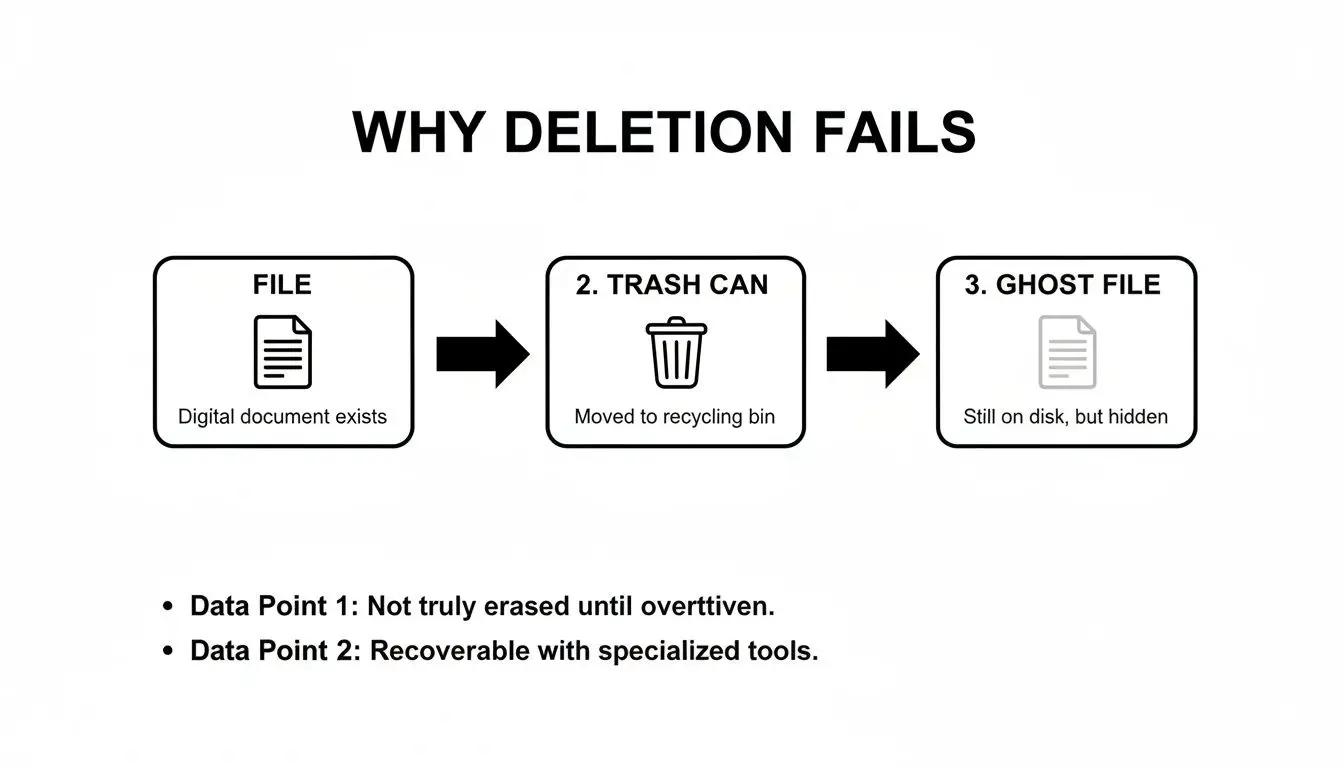
This graphic shows that even after you empty the recycling bin, the data can linger on the drive until it's overwritten, creating a serious security gap for your business. Physical shredding closes that gap for good by utterly destroying the storage medium itself. The size of the shredded particles is a critical part of ensuring that security.
Industry standards, like those set by the National Security Agency (NSA), define the maximum particle size to guarantee data is gone forever. A professional service like Beyond Surplus strictly follows these rigorous standards, ensuring your data is destroyed beyond any hope of reconstruction.
The Final Steps: Verification And Recycling
The process isn't over just because the drives are in pieces. After the destruction is complete, you receive a formal Certificate of Data Destruction. This is a legal document that serves as your official record and proof of compliance for any audit. It lists the unique serial numbers of every device we shredded, confirming they were destroyed according to industry best practices.
Finally, the shredded material itself is handled responsibly. The mix of aluminum, steel, and other metals is securely transported to a certified recycling partner. There, the materials are sorted, processed, and reintroduced into the supply chain. This completes the asset lifecycle, transforming a potential data risk into a verified, secure, and environmentally friendly solution for your Atlanta company.
On-Site vs. Off-Site Shredding: Which Is Right For Your Atlanta Business?
When it comes to shredding hard drives, one of the first major decisions your Atlanta business will face is where the destruction should occur. You can have a vendor bring a mobile shredding truck directly to your location, or you can have your retired drives securely transported to their facility for processing.
Both on-site and off-site shredding are secure, industry-standard options. The best choice depends on your organization’s unique requirements for security, compliance, budget, and logistics. This decision is not merely about convenience—it's about matching the service to your risk tolerance and legal obligations.
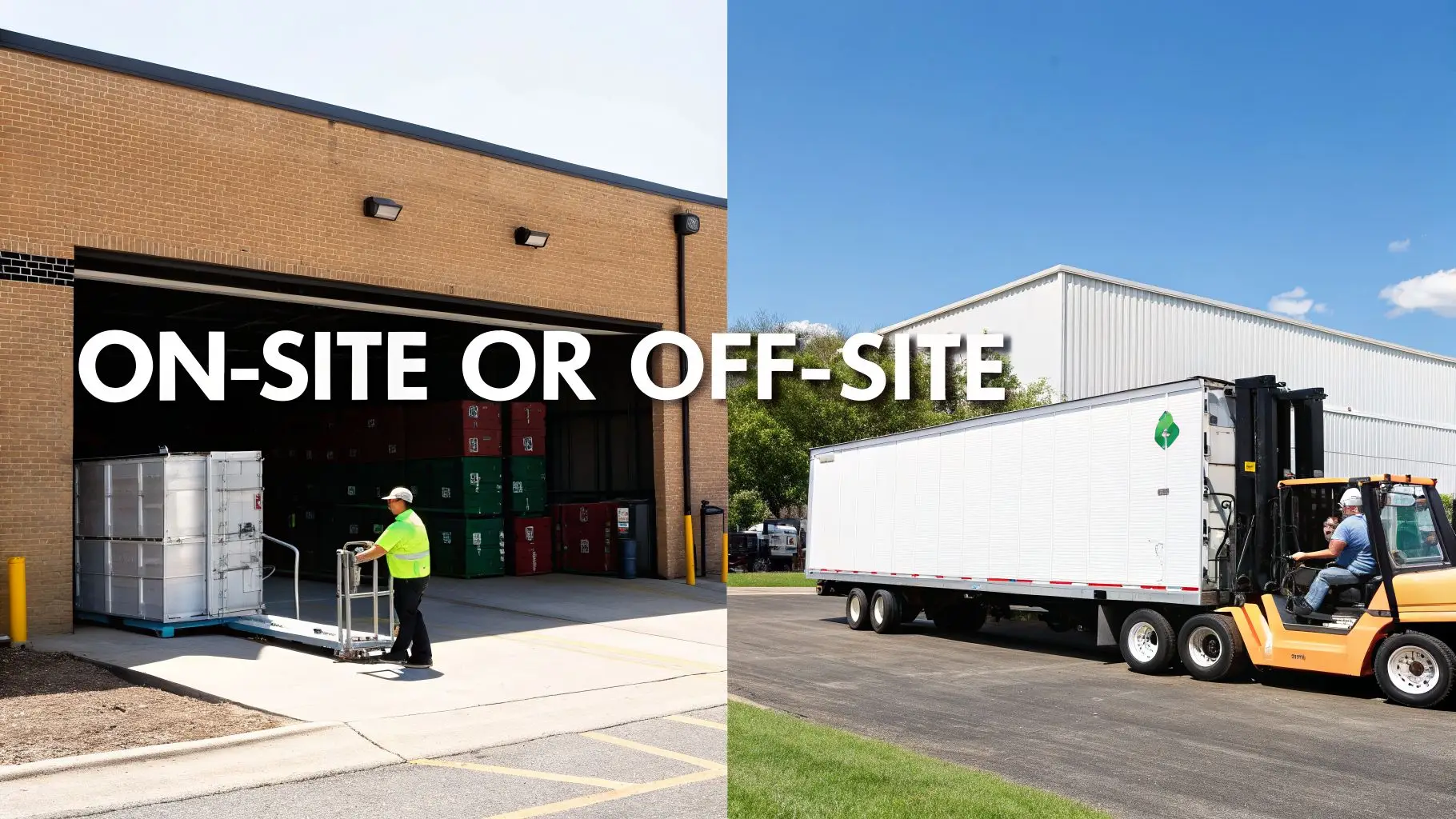
When to Choose On-Site Shredding
On-site shredding delivers the highest level of transparency available. A specialized truck equipped with an industrial shredder parks at your Atlanta facility, and the entire destruction process unfolds before your eyes. Your team can physically witness every single drive being converted into tiny metal fragments.
This method is the preferred choice for organizations operating under the strictest security and compliance frameworks.
- Healthcare Providers in Atlanta: Witnessing the shredding firsthand provides undeniable proof of HIPAA compliance.
- Financial Institutions: Banks and investment firms can instantly verify that client data is permanently destroyed, satisfying GLBA mandates.
- Government Agencies: When dealing with classified or sensitive public data, on-site destruction is often a required security protocol.
Watching the process eliminates any doubt regarding the chain of custody at its most critical point. If your internal policy dictates that data-bearing assets cannot leave your property intact, then our on-site data destruction services are the definitive solution.
When to Choose Off-Site Shredding
Off-site shredding is an exceptionally efficient and cost-effective option, particularly for large-scale IT asset disposal projects. With this service, a certified vendor collects your hard drives in sealed, lockable containers that are often GPS-tracked for enhanced security.
The drives are then securely transported to a specialized destruction plant where the shredding takes place under constant surveillance.
While you do not witness the shredding in person, a reputable vendor provides a strict, documented chain of custody from the moment your assets are collected until they are destroyed and recycled.
This approach is ideal for situations where scale and operational efficiency are primary concerns:
- Data Center Decommissioning: For retiring hundreds or thousands of servers at once, off-site processing is faster and causes less disruption to your Atlanta operations.
- Large Enterprise Upgrades: When refreshing hardware across an entire company, consolidating all assets for off-site shredding is more straightforward.
- Cost-Sensitive Projects: By shredding large volumes at a central facility, vendors can operate more efficiently and pass those savings on to your business.
The demand for secure data destruction is massive and growing. The Hard Drive Shredder Market was estimated at USD 1.24 billion in 2024, driven by these exact compliance needs. This growth underscores how both on-site and off-site services are essential to modern IT asset management in Atlanta and across the US.
Comparing On-Site and Off-Site Hard Drive Shredding for Atlanta Businesses
To clarify the decision, a side-by-side comparison can help you align a service with your specific business priorities.
| Feature | On-Site Shredding | Off-Site Shredding |
|---|---|---|
| Witnessing | Yes, you can watch the entire process at your location. | No, destruction happens at the vendor's secure facility. |
| Chain of Custody | The most secure; assets never leave your sight intact. | Secure, with transport between your site and the facility. |
| Cost | Typically higher due to dedicated truck and staff time. | More cost-effective, especially for larger volumes. |
| Best For | Maximum security, strict compliance, smaller batches. | Large volumes, data center decommissioning, budget-focused projects. |
| Logistics | Simple for you; requires space for the shredding truck. | Vendor handles all transport; less disruptive to your operations. |
Ultimately, both paths lead to the same result: securely destroyed data. The right one for your Atlanta business depends on which features are most critical for your compliance, security, and operational needs.
Navigating Complex Compliance Requirements in Atlanta
For any business in Atlanta, Georgia, destroying old data isn't just a best practice—it's a legal requirement. Failure to properly dispose of hard drives and other devices containing sensitive information can lead to devastating fines and irreparable harm to your company's reputation. This makes certified hard drive shredding an essential component of your corporate risk management strategy.
Understanding the maze of federal and state regulations can be daunting. These laws mandate that you protect sensitive information from its creation to its destruction. You cannot simply discard old equipment or hand it to an uncertified recycler. Such an act is considered negligence and relates directly to the legal concept of due diligence—the requirement to take all reasonable steps to protect sensitive data.
Key Regulations Driving Hard Drive Shredding for Georgia Businesses
Several major regulations form the bedrock of data protection rules in the United States, directly impacting businesses in Atlanta. While they may target different industries, their core mission is the same: to protect consumer and patient information.
- HIPAA (Health Insurance Portability and Accountability Act): This is paramount for the healthcare industry. The HIPAA Security Rule is explicit, requiring covered entities to implement policies for the secure disposal of electronic Protected Health Information (ePHI). Physically destroying the drive is a primary method for ensuring this data is unrecoverable.
- GLBA (Gramm-Leach-Bliley Act): Financial institutions in Atlanta, from local banks to large investment firms, must adhere to GLBA. Its Safeguards Rule mandates a detailed security plan to protect client data, which includes the secure disposal of customer records on retired hardware.
- FTC Disposal Rule: This rule applies to nearly any business that handles consumer credit information. It requires you to take "reasonable measures" to destroy sensitive data. Physical destruction via shredding is a clear and defensible example of a compliant method.
Partnering with a certified vendor for your hard drive shredding is your best defense. It demonstrates your commitment to due diligence and transfers the liability for proper destruction to a trusted expert.
The Certificate Of Data Destruction: Your Legal Shield
Upon completion of the shredding process, you receive a Certificate of Data Destruction (CoDD). This document is far more than a receipt; it is your legal, auditable proof that you have complied with the law.
A Certificate of Data Destruction is a crucial legal document. It lists every single shredded asset by its serial number, officially confirming that your company has fulfilled its legal duty for secure data disposal. This proof is priceless during an audit or if you ever face a legal challenge.
The market is clearly responding to this need for compliance. Spurred on by the explosion of data and tightening regulations, the Hard Drive Destruction Service Market is projected to grow at a CAGR of 10.7% from 2025 to 2033. Businesses are scrambling to avoid data breaches, which now cost an average of $4.45 million per incident, according to a 2023 report.
For many companies, hard drive shredding is just one part of a larger asset retirement strategy. It's about both data security and environmental responsibility. That’s why many now seek providers who offer total waste management solutions to handle all aspects of asset retirement responsibly.
Ultimately, integrating a legal requirement into your core risk strategy is smart business. It protects your Atlanta enterprise from massive fines and, more importantly, preserves the trust you’ve worked to build with your customers. You can learn more about NIST SP 800-88, a key guideline for media sanitization, in our detailed article.
How Different Industries in Atlanta Protect Their Data
Hard drive shredding is not a one-size-fits-all service. Its application and urgency vary significantly across different industries in Atlanta, each with unique data risks and compliance mandates.
Examining how leaders in various sectors utilize professional shredding highlights its critical role in modern risk management. From massive data centers to local medical practices, physically destroying retired IT hardware is the only way to be certain that sensitive data is permanently gone.
Let's look at a few examples where a robust hard drive shredding plan is not just advisable—it's essential for business continuity and compliance.
For Data Centers Decommissioning Servers
Data centers are the engines of the digital economy, but their servers have a finite lifespan. A single server rack can hold petabytes of data for thousands of businesses or millions of individuals. When it's time to decommission that equipment, the risk of a data breach is immense.
Data center operators in and around Atlanta cannot afford to take chances. They rely on large-scale, highly organized shredding operations.
- Mass Inventory Scanning: Every drive is scanned and logged to create a perfect chain of custody, tracking each asset from the server rack to the shredder.
- On-Site or Off-Site Execution: Based on security protocols and the volume of drives, they may choose on-site shredding for real-time verification or use secure, GPS-tracked transport for off-site destruction.
- Verifiable Destruction: The objective is to turn thousands of high-capacity drives into unrecoverable metal fragments, all documented with a formal Certificate of Data Destruction.
For Healthcare Systems Protecting Patient Records
Hospitals, clinics, and other healthcare providers in Atlanta are focused on one thing: protecting Electronic Protected Health Information (ePHI) as required by HIPAA. A retired computer, an old imaging machine, or a simple office workstation could contain sensitive patient files. A data breach could result in millions in fines and a complete loss of patient trust.
HIPAA’s Security Rule specifically requires covered entities to implement policies for the secure disposal of ePHI. Physical destruction through shredding is one of the most direct and defensible methods to achieve this compliance, ensuring patient data is irrecoverably destroyed.
That’s why healthcare organizations implement meticulous shredding programs. They frequently use on-site hard drive shredding to maintain a fully witnessed and unbroken chain of custody, providing maximum security and peace of mind.
For Financial Firms and Manufacturers
Financial firms in Atlanta, such as banks and investment companies, operate under the Gramm-Leach-Bliley Act (GLBA). This law demands the protection of customer financial data. When a loan officer's laptop or a trader's workstation is retired, those drives must be physically destroyed to eliminate any risk of a data leak.
The situation is similar for manufacturing and R&D companies, who use shredding to protect their most valuable asset: intellectual property. Blueprints, formulas, and trade secrets stored on computers in a lab or on a factory floor are prime targets for corporate espionage. Shredding drives from retired equipment ensures that this priceless IP does not leave the facility.
This growing need for secure destruction is clear in market trends. The global Hard Disk Destruction Equipment Market, which supports professional hard drive shredding services, was valued at USD 2.85 billion in 2025. It's expected to climb to USD 4.23 billion by 2032, driven by companies racing to comply with tough privacy laws like HIPAA and the FTC Disposal Rule.
Choosing The Right Hard Drive Shredding Partner in Atlanta
Be advised: not all hard drive shredding vendors are created equal. Selecting the wrong partner in Atlanta can lead to the very data breaches and compliance penalties you are trying to prevent.
This is not about hiring a vendor to break old equipment. You are selecting a security partner who should function as an extension of your own risk management team.

The stakes are immense. A vendor with lax security protocols or an opaque chain of custody is not a partner; they are a liability. Your decision must be based on verifiable facts that demonstrate their commitment to security and environmental stewardship.
Non-Negotiable Vendor Criteria
When vetting potential partners for hard drive shredding in Atlanta, there are several non-negotiable standards. These credentials are your proof that a vendor operates at the highest level of security and accountability.
Your vetting process must prioritize these essentials:
- Industry Certifications: Insist on premier certifications like R2 (Responsible Recycling) or e-Stewards. These are not mere logos; they signify adherence to rigorous, third-party audited standards for data security, environmental safety, and worker protection.
- Verifiable Chain of Custody: The vendor must demonstrate a transparent, documented chain of custody. This process must include serialized tracking from the moment they take possession of your drives until you receive the final Certificate of Data Destruction.
- Adequate Insurance: A professional partner will carry substantial insurance policies, including Data Breach and Pollution Liability coverage. This provides a financial backstop in the unlikely event of an incident during transport or destruction.
If a potential vendor hesitates or cannot provide proof of these core credentials, consider it an immediate red flag. A true security partner operates with full transparency and can readily supply the documentation to substantiate their claims.
Questions To Ask A Potential Atlanta Partner
Certifications are a starting point, but you must dig deeper to understand a vendor's operational integrity. Asking targeted questions will reveal the quality of their service and their suitability as a trusted partner.
Before signing any contract, ensure you ask:
- Can we witness the shredding process? For on-site service, this should be standard. For off-site, do they permit witnessing or provide video evidence?
- What does your chain-of-custody documentation look like? Request a sample report. It must detail every step—pickup, transport in secure containers, and final destruction—with all assets reconciled by serial number.
- Who are your downstream recycling partners? All shredded material must go to a certified recycler. Your vendor must identify their partners and prove they are also certified, ensuring your environmental commitments are met.
- What is included on the Certificate of Data Destruction? Confirm that it will list every serial number from the shredded devices. This is your non-refutable, auditable proof that the job was completed correctly.
Making the right choice requires thorough due diligence. For a detailed guide, download our comprehensive vendor due diligence checklist to ensure you cover all critical areas. The right partner empowers you to manage asset retirement with total confidence, knowing your data is permanently destroyed and your compliance is secure.
Frequently Asked Questions About Hard Drive Shredding in Atlanta
Even after deciding that professional hard drive shredding is the correct strategy for your Atlanta business, specific questions often arise. Here are straightforward answers to the most common inquiries from commercial clients.
What Types Of Devices Can Be Shredded?
It is a common misconception that shredding is limited to traditional spinning hard drives. In reality, industrial shredders are powerful enough to destroy nearly any data-bearing device, providing a single, comprehensive solution for your retired IT assets.
We can securely destroy a wide range of hardware for your business, including:
- Hard Disk Drives (HDDs) from any desktop, laptop, or server.
- Solid-State Drives (SSDs), which must be physically destroyed to ensure data is unrecoverable.
- Backup Tapes such as LTO, DLT, and other magnetic tape formats.
- Mobile Devices, including all types of corporate smartphones and tablets.
- Optical Media like CDs, DVDs, and Blu-ray discs.
Is Hard Drive Shredding Environmentally Friendly?
Yes, provided you partner with a certified vendor. A responsible partner like Beyond Surplus manages the entire process with sustainability as a core principle.
Once shredded, the fragments of aluminum, steel, and circuit boards are transported to a certified downstream recycling partner. These facilities smelt the materials, separating them for reuse in new products. This keeps your old technology out of landfills and supports your company’s corporate environmental goals.
How Much Does Hard Drive Shredding Cost for Atlanta Businesses?
The cost of hard drive shredding is not one-size-fits-all, as each project has unique requirements. Pricing depends on several key factors.
Your final quote is typically based on the quantity of drives, whether you select on-site or off-site shredding, and any specific logistical needs at your Atlanta location, such as navigating stairs or using specialized containers. For larger quantities, off-site shredding is often the more budget-friendly option.
Do I Get Proof That The Drives Were Destroyed?
Absolutely. This is a non-negotiable component of any legitimate hard drive shredding service. When the job is completed, you will receive a Certificate of Data Destruction.
This is more than a receipt; it is a formal legal document that serves as your proof of compliance for any audit. It includes a detailed list of the serial numbers of every drive destroyed, confirming your organization has fulfilled its due diligence to protect sensitive corporate data.
Contact Beyond Surplus for certified electronics recycling and secure IT asset disposal in Atlanta, Georgia. We provide auditable, compliant, and environmentally responsible hard drive shredding services tailored to your business needs. Contact us today for a quote and learn more about our secure ITAD solutions at https://sonitechllc.com.