

Let's get one of the biggest mix-ups in waste management cleared up right away. If you've heard the term universal hazardous waste manifest, you might be surprised to learn that, in reality, no such document exists. It's a common but incorrect phrase.
The truth is, items classified as universal waste are deliberately set up to be simpler to manage for business audiences. They are specifically exempt from the intense, formal manifest system required for true hazardous waste, making disposal much easier for commercial and enterprise clients.
Why There’s No Such Thing As a Universal Hazardous Waste Manifest
Understanding the difference between documentation for hazardous waste and universal waste is the first step toward confident compliance. Getting this right helps any IT manager, facility manager, or business owner avoid costly fines and logistical headaches.
What the Real Hazardous Waste Manifest Is For
The official tracking document is called the Uniform Hazardous Waste Manifest (EPA Form 8700-22). It’s a legally required form under the Resource Conservation and Recovery Act (RCRA), and its purpose is to create an unbreakable "cradle-to-grave" chain of custody for truly hazardous materials generated by businesses.
Think of it as the paperwork for a high-security shipment. This manifest ensures that hazardous materials are tracked from the moment they leave your facility, through every step of transportation, all the way to their final Treatment, Storage, and Disposal Facility (TSDF). Every single handover requires a signature, creating a paper trail that leaves no room for error.
How Universal Waste Keeps It Simple for Businesses
In contrast, the universal waste category was created by the EPA to be much simpler for commercial generators. The entire point was to encourage proper electronics recycling of common but technically hazardous items—like batteries, lamps, and most IT equipment—by easing the regulatory burden on businesses.
The core idea behind universal waste rules is efficiency. By simplifying the documentation and handling requirements, the EPA makes it easier for businesses to do the right thing—divert millions of tons of e-waste from landfills without drowning in paperwork.
This streamlined approach is precisely why there is no "universal hazardous waste manifest." The process is more like shipping a standard package with basic tracking. While you still need proper records and labeling, it’s far less intensive than the full manifest system. You can learn more about how to properly manage these materials in our guide to universal waste compliance.
To help clarify the differences, here’s a quick comparison of the requirements for each waste type.
Hazardous Waste vs Universal Waste At a Glance
| Requirement | Standard Hazardous Waste | Universal Waste |
|---|---|---|
| Tracking Document | Uniform Hazardous Waste Manifest (EPA Form 8700-22) required. | No manifest required. Basic records (like a bill of lading) are sufficient. |
| EPA ID Number | Required for all but the smallest generators. | Only required for universal waste destination facilities and transporters. |
| On-Site Accumulation | Limited to 90-180 days, depending on generator status. | Allowed for up to one year. |
| Personnel Training | Extensive, documented training is mandatory. | Basic training on handling and emergency procedures is sufficient. |
| Shipping | Must use a registered hazardous waste transporter. | No specific transporter requirements. |
| Reporting | Biennial reporting is often required for large generators. | No routine reporting is necessary. |
This table shows just how much simpler the universal waste program is by design for business operations.
A Quick History of the Manifest
The hazardous waste manifest system has been a cornerstone of U.S. environmental law since the 1980s. A major update came on June 30, 2018, when the EPA launched the national e-Manifest system to digitize the entire tracking process.
However, it's critical to remember that universal wastes are exempt from these manifest requirements under federal regulation 40 CFR Part 273. This exemption is what allows for the simpler, one-year accumulation and transport rules. For any IT manager or business owner, knowing that universal waste and hazardous waste follow different paths is key to keeping your operations compliant, legal, and responsible.
What Qualifies As Universal Waste
So, you’ve heard about universal waste and its streamlined rules, but what exactly falls into this special category? Think of it as the EPA’s way of creating a simpler, more practical path for recycling common hazardous items found in commercial settings. They designed the universal waste program to cut down on your business's compliance headaches while also protecting the environment.
Getting a handle on these categories—which are federally defined under 40 CFR Part 273—is a game-changer. It helps you properly sort your business waste, skip the complicated manifesting paperwork for these items, and make sure your disposal methods are both cost-effective and fully legal.
The Federal Categories of Universal Waste
The EPA has identified specific items as universal waste because they come from all kinds of businesses and, without proper management, often end up in landfills. While individual states can add their own items to this list, the federal program includes a few core categories you’ll likely find in any commercial building, especially if you’re managing IT or facility assets.
Here are the main federal categories:
- Batteries: This is a wide-ranging group covering most batteries you’d find in a business. It includes everything from the lithium-ion batteries in laptops and the sealed lead-acid batteries in UPS systems to the everyday alkaline batteries in your office equipment.
- Pesticides: This category applies to certain recalled, suspended, or unused pesticides. While you might see them more in landscaping or agriculture, they can show up in any commercial facility.
- Mercury-Containing Equipment: You’ll frequently run into these in older buildings. This includes old-school thermostats, pressure gauges, and different types of electrical switches that contain liquid mercury.
- Lamps: This is just a technical term for bulbs. It covers a huge variety of lighting, including fluorescent tubes, high-intensity discharge (HID) lights, and neon lamps that contain hazardous materials.
For anyone managing IT and facilities, just being able to spot these items is the first step. You can get a better sense of what your business might have by checking out our detailed look at universal waste examples.
The "Why" Behind the Universal Waste Rule
The EPA’s goal here wasn't to get rid of rules but to make them smarter for business. By carving out this special subset of hazardous materials, the agency wanted to make it easier for businesses to recycle things like fluorescent bulbs, batteries, and mercury thermostats. Too many of these items were being tossed into the regular trash from commercial sources, posing a long-term threat to the environment.
The universal waste rules, outlined in 40 CFR Part 273, were a direct response to widespread improper disposal. By allowing for one-year storage without manifests or strict tracking, the regulations ease the compliance burden on everyone from small businesses to large enterprises.
This simplified approach works. It gives businesses a real incentive to participate in electronics recycling programs and makes it far easier to do the right thing with common but hazardous items. Essentially, universal wastes are a streamlined category of hazardous materials that don't require the full uniform hazardous waste manifest, a policy that has successfully boosted commercial recycling rates.
Recently Added Universal Waste Items
The EPA’s list isn’t set in stone; it changes to keep up with new types of waste. A major recent addition to the federal program is aerosol cans. Since February 7, 2020, these cans can be managed under the simpler universal waste rules, which is a huge relief for any facility that uses them for cleaning, maintenance, or other daily tasks.
This change was important because millions of aerosol cans are used by businesses every year. Treating them as universal waste helps prevent them from being punctured or thrown out improperly, which reduces the risk of fires, injuries, and the release of hazardous propellants into the air.
For any waste that does not qualify as universal, the official hazardous waste manifest becomes the single most critical legal document in your compliance toolkit. Think of this form not as mere paperwork, but as a legal passport for regulated materials. It ensures they travel from your facility to their final destination with complete accountability.
If you’re an IT manager overseeing the disposal of complex electronics that fall outside universal waste rules, mastering this process is non-negotiable.
Understanding this document, officially known as EPA Form 8700-22, is all about protecting your company from serious liability. It creates a paper trail—an unbroken chain of custody—that documents every handover from the moment waste leaves your sight.
So, what kind of waste gets to skip this formal process? The infographic below shows the common categories of universal wastes, which are managed under simpler rules.
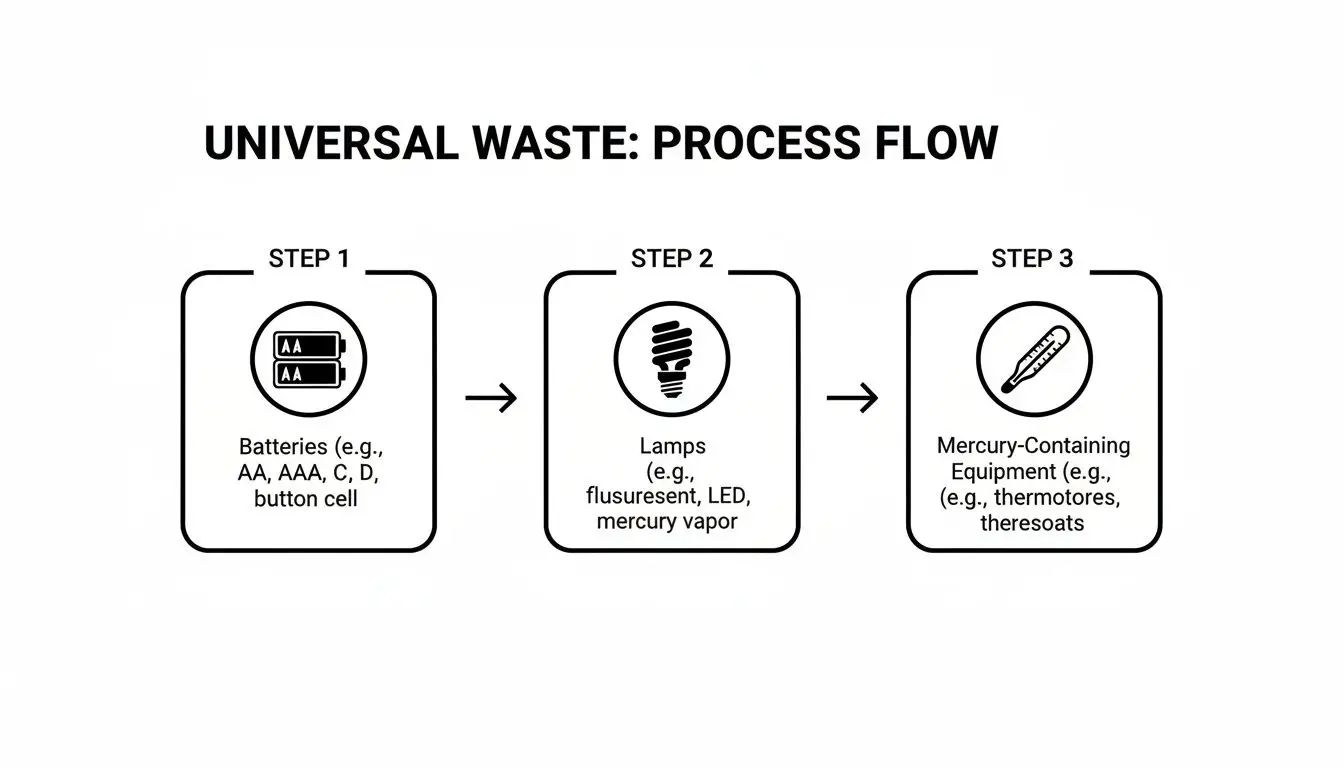
As you can see, everyday items like batteries, lamps, and certain mercury-containing equipment follow a more streamlined path, bypassing the need for a full manifest.
Decoding EPA Form 8700-22: Key Sections
The manifest can look intimidating, but it's really just a detailed logbook. Each section is designed to capture specific information at a key stage of the waste's journey. Knowing who fills out what—and when—is the key to getting it right.
This table breaks down the most critical parts of the form.
| Item Number(s) | Description of Information | Who Completes It |
|---|---|---|
| 1–14 | Generator’s details, emergency contacts, waste description (including EPA waste codes and quantity), and special handling instructions. | Generator (Your Business) |
| 15–16 | Space for international shipment details, if applicable. | Generator (if exporting/importing) |
| 17 | The transporter’s name, EPA ID number, and signature acknowledging receipt of the waste. A second transporter has a separate section. | Transporter |
| 18 | Discrepancy box, used by the final facility if the shipment doesn't match the manifest. | TSDF |
| 19–20 | The designated facility's details, signature confirming receipt, and certification of proper waste handling. | TSDF (Treatment, Storage, and Disposal Facility) |
Think of this form as a relay race baton. The generator starts it, the transporter carries it, and the TSDF brings it across the finish line. A single mistake can break the chain.
The Journey of a Manifested Shipment
The hazardous waste manifest is designed to track waste from "cradle to grave." This journey involves three key players, and each has specific legal duties tied to their role in handling the manifest.
- The Generator (Your Business): You kick off the process. It's on you to correctly identify the waste, fill out the initial sections of the manifest, and sign it before the waste ever leaves your property. Your signature certifies that everything listed is accurate.
- The Transporter: The licensed carrier signs the manifest when they pick up the waste, legally acknowledging they have taken possession of it. They are responsible for its safe delivery and for keeping the manifest with the shipment at all times.
- The TSDF (Treatment, Storage, and Disposal Facility): The final destination facility inspects the shipment the moment it arrives. They sign the manifest to confirm they've received it and then return a final, signed copy to you, closing the loop.
This multi-signature system is designed to leave no gaps in the chain of custody. It gives you a clear, legally defensible record that your waste was managed responsibly from start to finish. Proper documentation is a core part of any compliant program, and that principle applies even to simpler tasks like using proper universal waste labels.
The Shift to the EPA e-Manifest System
Until recently, this whole process was a headache of multi-copy paper forms that were slow, clunky, and prone to errors. Recognizing these flaws, the EPA launched the e-Manifest system nationwide on June 30, 2018.
This digital platform was a game-changer, completely modernizing how hazardous waste is tracked.
- Fewer Mistakes: Digital forms with built-in validation checks catch common errors like incorrect waste codes or missing information before they become a problem. No more trying to decipher messy handwriting.
- Instant Records: The moment the TSDF electronically signs for the shipment, the final manifest is immediately available in your online account. You no longer have to wait weeks for a paper copy to arrive in the mail.
- Total Transparency: Everyone involved—generator, transporter, and TSDF—has access to the same real-time data, which drastically improves communication and accountability.
This digital overhaul has made tracking hazardous waste more efficient, secure, and far easier to audit. For any business generating non-universal hazardous waste today, using the e-Manifest system isn't just an option—it’s a fundamental part of modern environmental compliance.
How State Rules and Generator Status Impact Your Business
Getting a handle on the federal EPA’s hazardous waste rules is just the first step. You can’t stop there. The federal government sets the baseline, but those aren't the final rules you need to follow. Real compliance, especially if you have business locations in different states, means digging into specific state laws and knowing your own waste generator status.
Think of it like a highway speed limit. The national limit is the federal rule, but states can set lower limits for local roads or construction zones. When it comes to hazardous waste, states can—and frequently do—enforce much stricter regulations than the EPA.
Why State Regulations Are Critical for Businesses
You can't just assume following federal guidelines will keep your business in the clear. Many states have their own, tougher requirements that can really change how you manage waste, including what you might consider universal waste.
These differences aren't minor, either. They can include:
- Expanded Universal Waste Lists: Some states add items like electronics (e-waste) or antifreeze to their own universal waste list, even if they aren't on the federal one. This can make things easier for your business, but you have to follow that state’s specific handling rules for those items.
- Stricter Handling Rules: A state might demand more frequent inspections of your waste storage areas, require certain types of containers, or set shorter storage time limits than the one-year federal rule for universal waste.
- Unique Labeling Requirements: You might need to add specific wording or extra warnings to your universal waste container labels, going beyond the basic federal requirements.
One of the most common and expensive mistakes is thinking that what works for compliance in one state will work everywhere. If your business operates nationally, checking with each state's environmental agency isn’t just good advice—it’s a non-negotiable step to avoid violations.
Pinpointing Your Generator Status
Your list of responsibilities is also directly connected to how much hazardous waste your facility produces each month. The EPA has three tiers for waste generators, and your classification determines everything from how long you can store waste to what kind of training your team needs.
The Three Tiers of Hazardous Waste Generators
- Very Small Quantity Generators (VSQGs): These facilities create less than 220 pounds (about 26 gallons) of non-acute hazardous waste each month. They have the most relaxed rules for storage and record-keeping.
- Small Quantity Generators (SQGs): These businesses generate between 220 and 2,200 pounds (roughly 26 to 264 gallons) of non-acute hazardous waste monthly. SQGs have tougher rules, like a 180-day on-site storage limit and required formal employee training.
- Large Quantity Generators (LQGs): Any facility generating more than 2,200 pounds of non-acute hazardous waste per month is in this top tier. LQGs have the strictest regulations, including a 90-day storage limit, detailed contingency plans, and biennial reporting to the EPA.
It's important to remember that your status can change. A big equipment clean-out or data center decommissioning project could temporarily bump a VSQG into the SQG or even LQG category for that month. That shift triggers a whole new level of regulatory responsibility you have to meet.
Keeping a close eye on your waste output is key to staying compliant and avoiding surprise penalties. This is where working with a certified ITAD provider like Beyond Surplus becomes so valuable. We can help your business accurately classify and manage your waste streams, ensuring you meet all your federal and state obligations.
E-Waste Compliance for IT and Facility Managers
If you’re an IT director or facility manager, you know that e-waste is more than just a cleanup job—it's a massive compliance risk for your business. A solid e-waste program is your shield, protecting your organization from steep fines, data breaches, and a tarnished reputation. Done right, what feels like a compliance headache can become a real strategic win.
A successful program doesn't start when the truck shows up for an e-waste pickup. It begins with a smart, step-by-step approach to inventorying, classifying, and documenting every single asset you're retiring. This is where your internal diligence builds the foundation for a disposal process that can stand up to any legal scrutiny.
Your Practical E-Waste Checklist
A clear, actionable plan is everything. If your approach is disorganized, you’re practically inviting compliance gaps and unnecessary risk. Use this checklist to build a structured process for managing your company's old tech.
Inventory and Classify All Assets:
- Start by creating a detailed list of all equipment you're getting rid of. Don't just write down "50 laptops"; you need the make, model, and serial number for each one.
- Next, sort everything out. Keep universal waste like batteries and fluorescent lamps separate from general e-waste like servers and monitors. This is crucial for making sure each waste type is handled according to its specific regulations.
Prioritize Certified Data Destruction:
- Data security is non-negotiable. Every device that holds data—hard drives, SSDs, smartphones, and servers—must be sanitized with certified methods before it ever leaves your building.
- Figure out the right destruction method for your needs. Whether it's wiping, degaussing, or physical shredding, your choice should align with your company’s data security policy and any industry rules you follow, like HIPAA or FACTA.
Establish Rigorous Record-Keeping:
- Keep meticulous records of every single step. This means holding on to your internal inventories, the chain-of-custody documents from your vendor, and—most importantly—the final Certificates of Data Destruction and Recycling.
- These documents are your legal proof. They show you transferred liability and that your assets were handled correctly. You should plan to store them forever.
Working with a certified IT Asset Disposition (ITAD) provider is a great way to manage risk and make this whole process easier. To get a full picture of what these services cover, take a look at our guide explaining what IT asset disposition is.
Turning Compliance into a Strategic Advantage
Looking at e-waste compliance as just an operational chore is a missed opportunity. When you manage it correctly, it becomes a strategic tool that delivers real business value far beyond just clearing out old equipment.
The goal of a modern e-waste program isn't just to check a box. It's to build a process that actively protects the business by eliminating risk, safeguarding brand reputation, and demonstrating a concrete commitment to corporate social responsibility.
By putting a formal e-waste program in place, you’re hitting several key business goals at once:
- Avoiding Six-Figure Fines: Disposing of e-waste improperly or failing to protect sensitive data can trigger severe financial penalties from agencies like the EPA and FTC. A well-documented process is your best defense.
- Safeguarding Company Reputation: A data breach from a single discarded laptop can do permanent damage to your brand’s credibility and the trust your customers have in you. Certified data destruction removes this risk entirely.
- Demonstrating Corporate Responsibility: A well-run ITAD program clearly shows that your company is serious about environmental stewardship and data security. This matters more than ever to customers, partners, and investors.
Ultimately, a proactive and well-documented approach to e-waste, especially when backed by a certified ITAD partner, turns a potential liability into a clear victory for your organization's security, reputation, and bottom line.
How Beyond Surplus Streamlines Your E-Waste Compliance
Keeping up with federal and state waste regulations can feel like a full-time job. The rules are constantly changing, and what works in one state might not work in another. For any business managing old tech like computers, laptops, or data center equipment, it's easy to get tangled in the details.
That’s where partnering with an expert IT Asset Disposition (ITAD) provider like Beyond Surplus comes in. Our job is to manage the entire end-of-life process for your technology, making sure every step is compliant, secure, and fully documented.
From Segregation to Certification
Our process starts with careful classification right at the source. We identify and separate universal waste streams—like the lithium-ion batteries in your laptops or the sealed lead-acid batteries from UPS systems—from general e-waste. This step is critical because it ensures each material is handled according to its specific regulations, helping your business avoid common and costly violations.
This is how we make a tangible difference:
- Nationwide Logistics: We manage secure electronic waste pickups for businesses across the United States, offering a consistent and reliable service no matter where you are.
- Chain of Custody: From the moment your IT assets leave your facility, we create and maintain a documented chain of custody. This gives you a clear and defensible paper trail for every item.
- Certified Data Destruction: We perform certified data destruction on all devices that hold data, providing legally sound Certificates of Data Destruction to protect you from data breach liability.
Assuming Liability and Delivering Peace of Mind
Ultimately, our service is built to formally transfer liability from your company to ours. When you partner with Beyond Surplus, you’re not just getting an e-waste pickup service; you’re gaining a compliance partner.
The most significant value a certified ITAD partner delivers is risk mitigation. By providing meticulous documentation, including Certificates of Recycling and Data Destruction, we legally assume responsibility for the proper handling of your assets, giving you complete peace of mind.
This means you’ll have all the official paperwork needed to satisfy any internal audit or external regulatory inspection. Every asset is processed in full compliance with all federal, state, and local laws, from RCRA to data privacy rules.
For businesses looking for a partner to manage their electronic waste responsibly, learning more about Georgia's e-waste recycling options can provide valuable insight. We take a complex compliance headache and turn it into a simple, worry-free solution for our commercial clients.
Frequently Asked Questions About Waste Manifests
Even after you get the hang of the rules, real-world questions always pop up when you're managing e-waste. Let's tackle some of the most common ones that IT directors and facility managers run into, helping clear up any lingering confusion for business audiences.
Do I Need a Manifest for Old Office Laptops?
This is a great question, and the short answer is almost always no. Your old office laptops don't typically require a hazardous waste manifest.
The reason is that the components fall into different categories. The lithium-ion batteries are handled under the simpler "universal waste" rules, which don't require a manifest. The rest of the hardware is considered standard electronic waste.
A certified ITAD partner like Beyond Surplus handles the sorting for you, making sure each material stream follows its own specific regulations. This means you don't have to worry about creating a manifest for a normal office electronics pickup.
How Long Must My Business Keep Waste Disposal Records?
Record retention really depends on the type of waste you're dealing with. The rules are different for each.
- For fully regulated hazardous waste, the kind that needs a manifest, the EPA requires generators to keep their signed copies for a minimum of three years. This clock starts from the date the transporter first accepted the waste.
- For universal waste and general e-waste, there's no manifest, but it's a critical best practice to keep all your Certificates of Recycling and Data Destruction indefinitely.
Think of these certificates as your legal proof of proper disposal. They document the formal transfer of liability from your company to your ITAD vendor, so you want to hang onto them.
What Is the Biggest E-Waste Disposal Mistake for Businesses?
The most common and expensive mistake we see is improper classification and handling. This single error can lead to serious trouble, and it usually happens in one of two ways.
First, companies treat genuinely hazardous items—like old CRT monitors with leaded glass—as if they were just scrap metal or regular e-waste. This is a direct violation of environmental law that can result in major fines.
Second, they fail to get total, certified data destruction on every device before it leaves their control. This creates a huge and completely avoidable data breach risk, which can destroy a company’s reputation and lead to serious legal problems. Working with a certified ITAD expert is the simplest way to avoid both of these critical risks.
Is My Business Liable If Our Recycler Fails to Comply?
Yes, absolutely. This is one of the most critical and misunderstood parts of waste management for businesses. Under the RCRA "cradle-to-grave" principle, your business remains legally and financially responsible for its hazardous waste if it's mishandled at any point—even long after it's left your facility.
This lasting liability is exactly why choosing a reputable, certified vendor isn't just a good idea—it's an essential risk management strategy. A qualified partner gives you a clear chain of custody and issues formal Certificates of Recycling to legally transfer that liability away from you, protecting your organization from downstream compliance failures.
Navigating the world of e-waste and universal waste compliance is a major challenge for any business. Beyond Surplus offers comprehensive IT asset disposal services to manage the entire process for you, ensuring security, compliance, and peace of mind. Contact Beyond Surplus today for a secure and responsible disposal solution.


