
As an IT or facilities manager in Atlanta, Georgia, you’re tasked with managing a wide range of assets, including aging electronics. When it comes time for disposal, you need a strategy that is both compliant and secure. This is where understanding “universal waste disposal” becomes critical for your Atlanta business. Universal waste is a specific category of hazardous waste, including items like batteries and fluorescent lamps, that is subject to more streamlined regulations by the EPA. This framework is designed to make proper recycling easier and more cost-effective for businesses, ensuring hazardous materials are kept out of landfills.
For companies across Atlanta, and throughout Georgia, a compliant universal waste strategy is a core component of a responsible IT asset disposal (ITAD) plan. Partnering with a certified electronics recycling service like Beyond Surplus ensures your business meets all local and federal requirements for IT equipment disposal, from computer recycling to comprehensive data center decommissioning.
What Is Universal Waste? A Focus for Atlanta Companies
In the context of your Atlanta business operations, think of universal waste regulations as a "fast pass" for disposing of common hazardous items. It’s a regulated system, but one with simplified requirements compared to the strict rules for other hazardous wastes. The EPA created this category because certain items are so common in commercial environments that making proper disposal easier encourages higher rates of recycling and compliance.
This is not a loophole. It is a practical approach to managing a significant waste stream. Every Atlanta office, medical facility, or data center generates universal waste. Consider the sheer volume of spent batteries from laptops and UPS systems, old fluorescent bulbs from overhead lighting, or mercury-containing equipment like thermostats. Applying full-scale hazardous waste rules to every business disposing of these items would create a logistical bottleneck. The universal waste program streamlines this, promoting responsible management of electronic waste and other common hazardous materials.
Why This Special Category Exists
The universal waste program is designed to remove barriers to environmentally sound recycling. By simplifying the regulatory process, the EPA provides strong incentives for businesses to:
- Increase Recycling Rates: Making compliance straightforward and less expensive encourages companies to keep hazardous materials out of landfills.
- Promote Safe Collection: Simpler rules facilitate the establishment of effective collection programs for these common items.
- Improve Safety: The program ensures that materials containing toxic substances like lead and mercury are managed safely from the point of generation.
This system is directly linked to your company’s IT asset disposition strategy in Atlanta. When decommissioning a server room, you’re not just dealing with servers and racks; you are also managing the powerful batteries inside your Uninterruptible Power Supply (UPS) systems. A simple office-wide laptop refresh can generate hundreds of lithium-ion batteries that fall under universal waste rules. These activities, from laptop disposal to medical equipment disposal, require a specialized approach.
As e-waste streams grow, the need for certified electronics recycling services has expanded. The global waste management industry, valued at approximately USD 1,355.6 billion in 2026, reflects this demand. For IT asset disposition companies like Beyond Surplus, this presents an opportunity to provide essential services to businesses facing increasing pressure to manage obsolete technology responsibly. With the market projected to reach USD 2,096.25 billion by 2033, proper e-waste management is now a business and environmental necessity. You can explore the waste management industry market trends to understand the full scope of this issue.
Ultimately, mastering universal waste disposal is the first step in building a robust risk management plan. It means recognizing that the batteries in your equipment, the fluorescent tubes in your facility, and the backup power for your data center are all part of a regulated system that demands a documented disposal strategy.
Identifying Common Universal Waste in Your Atlanta Workplace
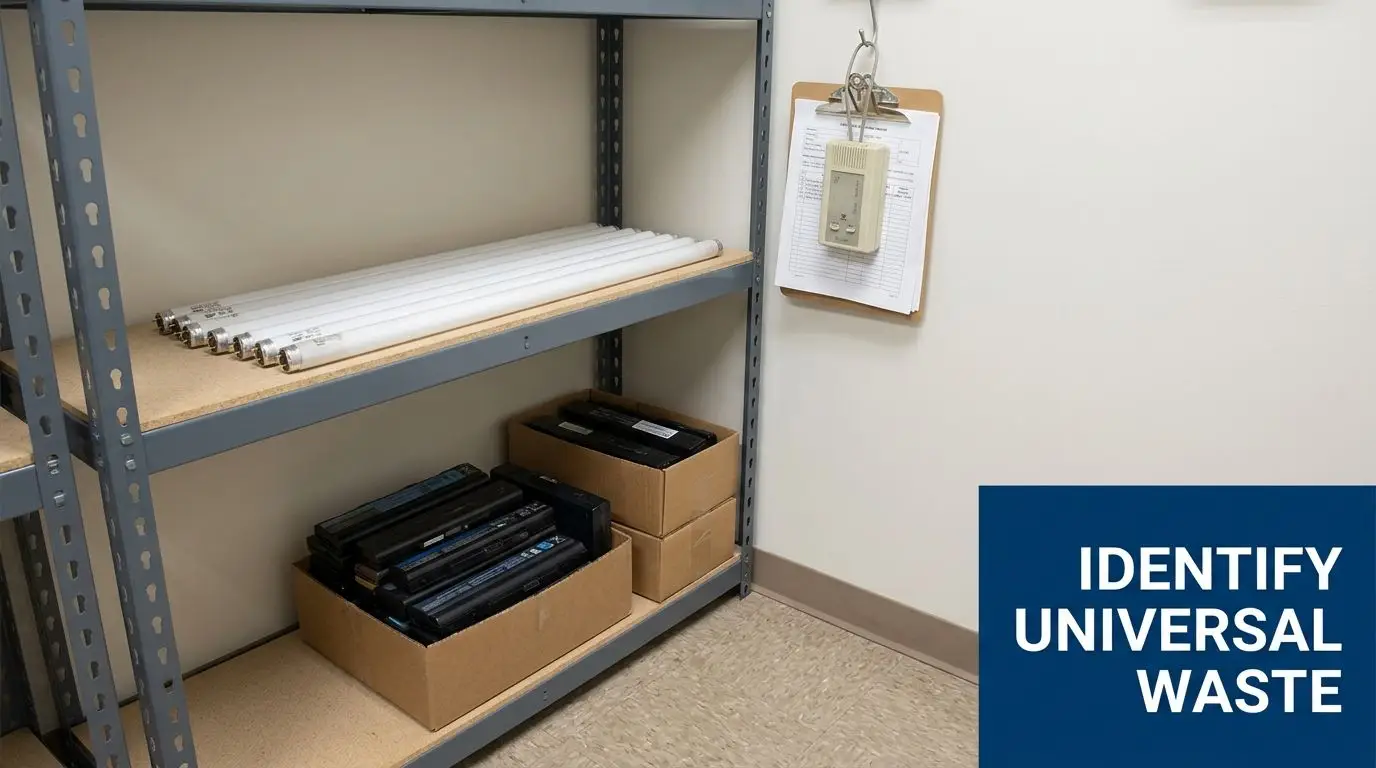
Universal waste items are often hiding in plain sight within your Atlanta facility—in supply closets, data centers, and on employee desks. Identifying these items is the first and most critical step toward compliant and secure e-waste management. Recognizing what constitutes universal waste can prevent costly compliance errors before they occur.
Batteries: The Power Behind Your Operations
Batteries are the most prevalent type of universal waste for any modern business in Atlanta. They power everything from critical data center infrastructure to wireless peripherals at workstations. When conducting an inventory for electronics recycling, look for:
- Lead-Acid Batteries: These are found in Uninterruptible Power Supply (UPS) systems that protect your servers and data centers, as well as in emergency lighting and security systems.
- Lithium-Ion Batteries: These power nearly all portable business electronics, including laptops, company cell phones, tablets, and handheld scanners used in logistics and retail. A corporate-wide device refresh can generate a large volume of these batteries at once.
- Alkaline Batteries: While less hazardous, many states, including Georgia, have regulations concerning the large-scale disposal of AA, AAA, C, and D batteries used in office equipment.
Beyond Surplus offers specialized business battery recycling solutions to help your Atlanta company manage all types of batteries safely and in compliance with regulations.
Lamps and Mercury-Containing Equipment
Your building’s infrastructure is another significant source of universal waste. These items often contain hazardous materials like mercury and require careful handling.
Lamps:
Fluorescent lighting is a prime example. The long tubes in office fixtures, compact fluorescent lamps (CFLs), and high-intensity discharge (HID) lamps used in warehouses all contain small amounts of mercury. When these lamps burn out, they cannot be discarded in regular trash and must be managed as universal waste.
Mercury-Containing Equipment:
This category is more common in older buildings but remains a concern. Legacy thermostats, pressure gauges, and certain electrical switches contain mercury. An office renovation or HVAC upgrade can bring these devices to light, immediately subjecting them to universal waste rules. This is also relevant for laboratory equipment disposal, where older instruments may contain mercury.
How to Spot Universal Waste Across Your Business
Use this reference table to help your IT, facilities, and EHS teams in Atlanta identify common universal waste items and understand their connection to your daily technology assets.
| Waste Category | Common Examples | Intersection with E-Waste / IT Assets |
|---|---|---|
| Batteries | Lead-acid, lithium-ion, alkaline, NiCd | Found in laptops, UPS systems, cell phones, medical equipment |
| Lamps | Fluorescent tubes, CFLs, HID lamps | Part of building infrastructure, requires special handling during facility decommissioning |
| Mercury Equipment | Old thermostats, switches, relays, gauges | Found in facility control systems, older lab and medical equipment |
| Pesticides | Insecticides, fungicides (less common in offices) | Typically relates to groundskeeping, not IT asset disposal |
| Aerosol Cans | Canned air/dusters, cleaning sprays | Used for IT maintenance and general office cleaning |
This table provides a starting point for creating your internal inventory for secure e-waste management.
The Overlap with IT Assets and E-Waste
A robust IT Asset Disposition (ITAD) strategy must account for universal waste. Nearly every piece of electronic equipment contains components regulated under these rules. A retired server is not just a metal box; it's a collection of circuit boards, wiring, a power supply, and is often paired with a UPS full of lead-acid batteries. This is why services like computer recycling and data center decommissioning must be handled by experts.
Failing to identify the backup battery in a server rack as universal waste can turn a routine equipment clear-out into a source of significant legal and financial risk. This is why partnering with a knowledgeable provider for compliant universal waste disposal in Atlanta is not a luxury—it's a necessity for risk management and brand protection.
Navigating Universal Waste Disposal Rules in Atlanta, Georgia
Understanding the regulations for universal waste disposal in Atlanta, Georgia, can seem complex, but the system is designed to provide a structured path for safely handling common hazardous items. The Environmental Protection Agency (EPA) establishes the national framework, but states like Georgia have the authority to implement their own, sometimes stricter, rules. For Atlanta businesses, compliance means adhering to both federal and state-specific requirements.
The Federal Foundation: EPA Rules
The EPA’s universal waste program categorizes businesses into two types of "handlers" based on the amount of universal waste accumulated on-site at any given time. Your company's classification can change, especially during large-scale projects like an office cleanout or a data center decommissioning.
The distinction between handler categories is crucial. It directly affects your responsibilities, from how long you can store waste to the training your employees need.
Determining your classification is the first step toward building a compliant electronic waste pickup and disposal program.
Are You a Small or Large Quantity Handler?
Your Atlanta business will fall into one of two categories, each with its own set of rules.
Small Quantity Handler of Universal Waste (SQHUW): This is the most common classification. Your business is an SQHUW if you accumulate less than 5,000 kilograms (approximately 11,000 pounds) of total universal waste at any time. The rules for SQHUWs focus on safe handling, proper labeling, and ensuring waste is sent to an authorized facility.
Large Quantity Handler of Universal Waste (LQHUW): If your business accumulates 5,000 kilograms or more of total universal waste, you are an LQHUW. This triggers more stringent requirements, including detailed record-keeping, tracking shipments, and notifying the EPA of your activities.
Regardless of your classification, all handlers must send their universal waste to a facility authorized to receive it, such as a certified recycler like Beyond Surplus.
Why Georgia-Specific Rules Are Important
While federal regulations provide a baseline, you must also be aware of Georgia’s specific rules. States can add items to their universal waste list or impose stricter handling standards. For instance, Georgia has specific guidelines for managing electronics, which aligns with the universal waste program's goal of diverting hazardous materials from landfills. A disposal plan that works in another state may not be fully compliant here in Atlanta.
This layered system of rules also intersects with data security. Ensuring your obsolete equipment is environmentally compliant is only one part of the equation. You must also guarantee that all sensitive data is destroyed. For a deep dive into the gold standard for secure data sanitization, our article on the NIST 800-88 guidelines is essential reading for protecting your company’s information during the IT equipment disposal process.
A Practical Checklist for Universal Waste Compliance in Atlanta
Knowing the rules is one thing, but implementing them is what protects your Atlanta business from fines and reputational damage. This checklist translates complex regulations into a practical action plan for your facilities and IT teams to manage universal waste and obsolete electronics compliantly.
Designate and Secure a Storage Area
First, establish a dedicated, central location for collecting universal waste. This area must prevent regulated items from being accidentally mixed with regular trash or other recyclables.
Your storage area should be:
- Clearly Marked: Use signs like "Universal Waste Storage Area" to avoid confusion.
- Secure and Contained: The area should be accessible only to authorized personnel and designed to contain spills or breakage, especially for batteries or lamps.
- Organized: Use separate, clearly labeled containers for each type of waste (e.g., one for batteries, one for lamps).
Get Your Labeling Right
Proper labeling is a critical compliance requirement and a common source of fines. Every container must be clearly identified.
A label identifies the container's contents and marks the start of the one-year accumulation limit. Missing either of these details is a direct compliance violation.
Each label must include:
- The words "Universal Waste"
- The type of waste (e.g., "Batteries," "Lamps," "Mercury-Containing Equipment")
- The accumulation start date (the date the first item was placed in the container)
This simple step is non-negotiable for compliant universal waste disposal.
Document All Employee Training
Your universal waste program is only as effective as the employees who manage it. Train any team member handling these materials on proper sorting, labeling, and emergency procedures for spills or breakage. Document this training with logs showing who was trained, when, and what topics were covered. When vetting partners for electronic waste pickup, our vendor due diligence checklist is an invaluable resource.
Track Your Dates to Avoid Penalties
Both Small and Large Quantity Handlers are allowed to store universal waste for up to one year. This clock starts the moment the first piece of waste is placed in a collection container. Exceeding this one-year limit causes the waste to be reclassified under the much more complex and costly hazardous waste regulations. Use a calendar or logbook to track the "start date" on each container and schedule pickups well before the deadline.
Choose a Certified Recycling Partner in Georgia
Finally, you must partner with a certified and reputable vendor for transportation and recycling. This partner is the final link in your chain of custody and shares your liability. An uncertified vendor could expose your Atlanta business to significant legal and financial risk if materials are mishandled.
The global waste crisis is intensifying, with e-waste as a major contributor. As of 2026, an estimated 130 million tonnes of plastic pollute the environment annually, a figure projected to more than double by 2040. Since electronics are rich in plastics and hazardous materials, this trend puts immense pressure on disposal systems. You can explore more on the global waste crisis and see why certified recycling is so critical.
Why Chain of Custody Is Your Legal Shield in Atlanta
When your old IT assets and universal waste leave your Atlanta facility, who is legally responsible for them? The answer lies in the chain of custody—your most important legal protection in the IT asset disposal process. It is the unbroken, documented trail tracking your assets from your possession to their final, compliant destruction or recycling. Without this documentation, the liability for those assets can return to your company.
Transferring Liability Through Documentation
A clear chain of custody formally transfers liability from your organization to your disposal vendor. This is not a verbal agreement but a transfer proven by specific, critical documents. This process protects your brand, helps you avoid fines, and ensures your discarded assets do not become an environmental liability.
A strong chain of custody acts as a legal receipt for your e-waste. It proves you performed due diligence and entrusted your materials to a certified, responsible party, effectively ending your legal obligation.
The infographic below illustrates the key steps in a compliant universal waste disposal process, which forms the basis of the chain of custody.
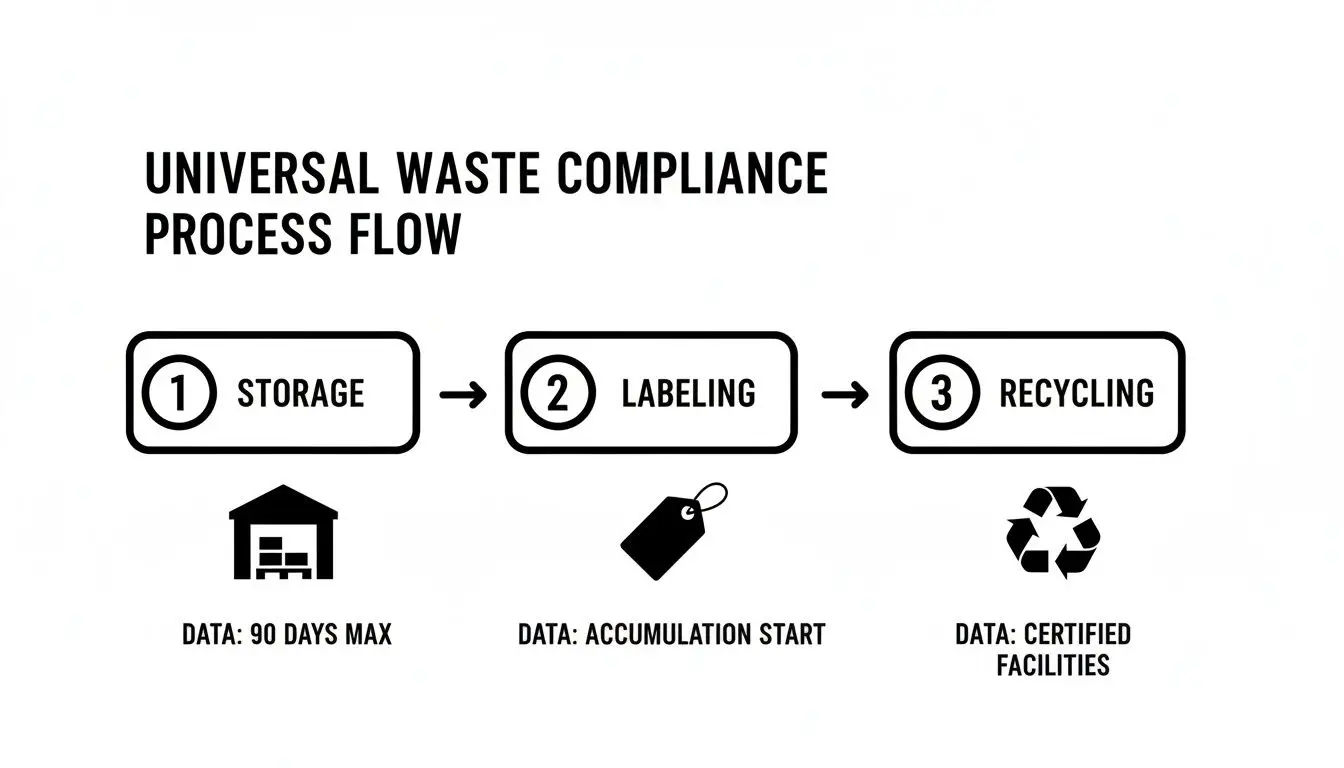
This visual highlights the essential steps—secure storage, accurate labeling, and certified recycling—that a documented chain of custody must meticulously track.
The Power of Certificates
The key documents that finalize this liability transfer are the official certificates issued by your ITAD partner. These papers are your proof that you have met all rules for universal waste disposal and data destruction.
Two documents are absolutely essential:
Certificate of Recycling/Disposal: This document certifies that your physical assets were received and processed according to all federal, state, and local environmental regulations. It lists the materials and confirms they were handled responsibly.
Certificate of Data Destruction: This certificate confirms that all data on your hard drives, SSDs, and other media was permanently destroyed. It should detail the destruction method (e.g., shredding) and the serial numbers of the destroyed devices, proving compliance with data privacy laws like HIPAA or FACTA.
For any business needing to understand the legal importance of this paperwork, you can learn more about the Certificate of Destruction and its role in your compliance strategy. When formalizing your disposal agreements, a free AI contract generator can help draft contracts for your ITAD partnerships.
Without these certificates, you have no proof of proper disposal. If an auditor investigates or your old equipment is found illegally dumped, the chain of custody breaks at your door, leaving you fully exposed. A professional partner ensures that chain is never broken.
How ITAD Services Ensure Total Compliance for Atlanta Businesses
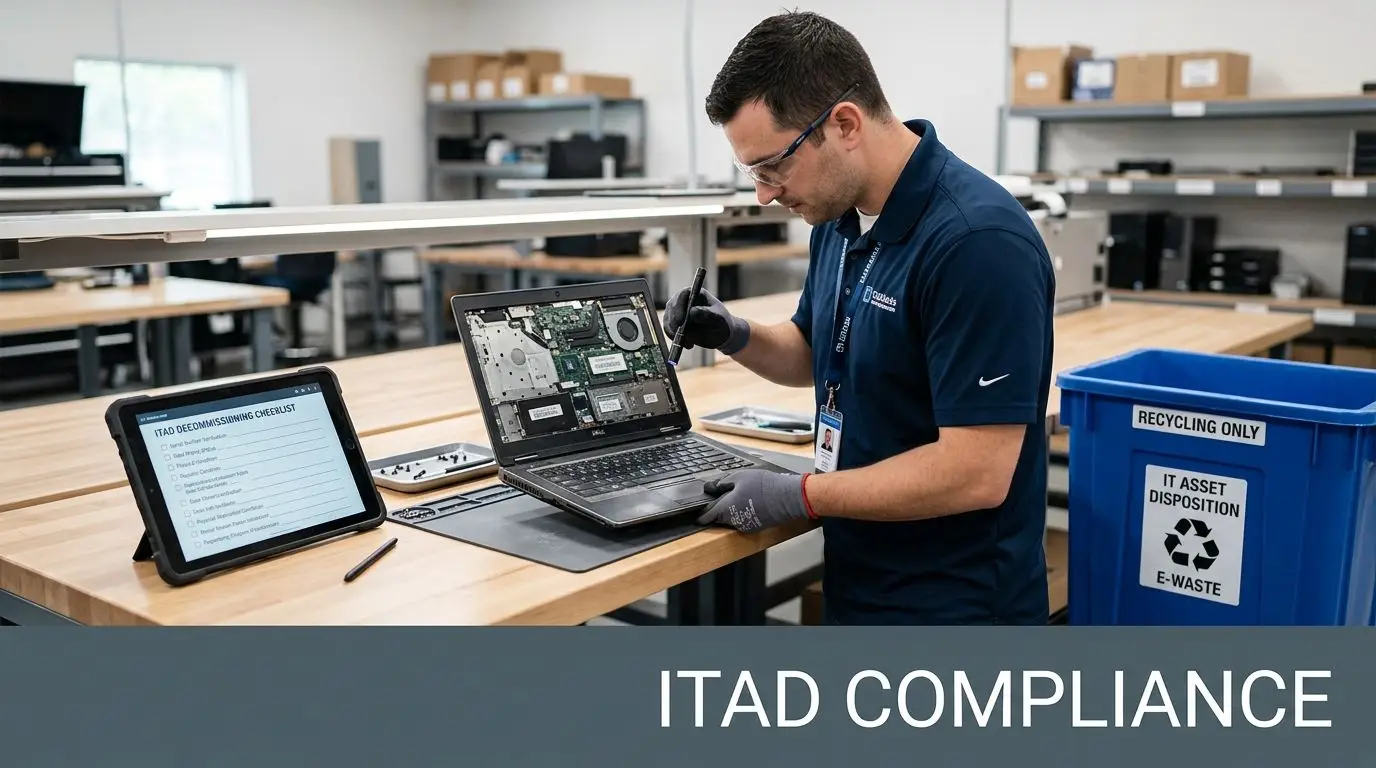
You understand the regulations and risks, but how does a busy Atlanta company implement a compliant universal waste disposal plan without disrupting core operations? The answer is to partner with a professional IT Asset Disposition (ITAD) provider like Beyond Surplus. An ITAD service acts as an expert extension of your team, managing the entire end-of-life process for your electronics securely and efficiently.
Navigating Complex Georgia State Rules
As covered, federal EPA rules are just the starting point. A premier ITAD partner stays current with the complex web of state-level regulations in Georgia. They understand which rules apply to batteries, lamps, and other electronics, ensuring your business remains compliant with local laws. This expertise is invaluable for companies operating across multiple locations, as your ITAD partner assumes the regulatory burden.
Managing Embedded and Integrated Components
Modern electronics are complex. Laptops contain powerful lithium-ion batteries, servers have intricate power supplies, and older equipment may hide mercury-containing components. An ITAD specialist is trained to identify and segregate these universal waste items during the decommissioning process for services like computer recycling, laptop disposal, and medical equipment disposal. This expert handling prevents compliance violations that occur when untrained staff overlook regulated materials, ensuring every component is directed to the correct recycling stream.
"A professional ITAD service is more than a disposal vendor; it's a single-source solution that de-risks the entire process, from secure electronic waste pickup and data destruction to final environmental compliance reporting."
Providing an Ironclad Chain of Custody
Perhaps the most critical function of an ITAD partner is providing the airtight chain-of-custody documentation that legally transfers liability away from your company. This is where a service like Beyond Surplus becomes your legal shield for Atlanta electronics recycling. We explain this in detail in our guide on what IT Asset Disposition is.
A certified provider delivers:
- Serialized Asset Tracking: Every device is inventoried and tracked by serial number, creating an unbroken audit trail from pickup to final disposition.
- Secure Logistics: Our dedicated fleet and secure protocols ensure your assets are protected during transport, preventing loss or data breaches.
- Certificates of Recycling and Destruction: These final documents serve as your official proof of compliance, confirming responsible recycling and secure data destruction.
By partnering with an ITAD expert, you gain a strategic partner dedicated to protecting your business from the risks of universal waste disposal and IT asset management.
Answering Your Universal Waste Questions
When it comes to universal waste, a few common questions always pop up. Business owners and facility managers often find the rules a bit confusing, but getting a handle on them is key to staying compliant. Let's clear up some of the most frequent points of confusion.
How Long Can We Keep Universal Waste On-Site?
For most businesses, the magic number is one year. Federal rules allow both Small and Large Quantity Handlers of Universal Waste (SQHUW and LQHUW) to store these materials on-site for up to 365 days.
That one-year clock starts ticking the very second the first item—be it a dead battery or a burnt-out fluorescent tube—goes into a collection bin. This is why labeling your containers with the start date isn't just good housekeeping; it's a fundamental compliance step. If you go past that year, those materials can get reclassified under the much stricter (and more expensive) hazardous waste regulations. Always double-check your state's rules, as some have even shorter time limits.
What Happens If Universal Waste Ends Up in the Regular Trash?
Tossing a laptop battery or a few fluorescent bulbs into the company dumpster might seem harmless, but it's a serious misstep. Mixing universal waste with your everyday trash is legally considered improper disposal of hazardous materials.
If an inspector finds this during a visit, or if the waste is traced back to your business from a landfill, the fallout can be significant. You could be looking at:
- Hefty Fines: The penalties for improper disposal can be financially painful.
- Triggered Audits: A single violation often prompts a much deeper dive into all of your company's waste handling practices.
- Environmental Liability: If contamination occurs, your business could be on the hook for the cleanup costs.
The best defense is a good offense. Set up a solid internal collection program with clearly marked bins and make sure your team is trained on what goes where. It’s a simple system that prevents a world of trouble.
Are Certificates of Recycling Actually Required by Law?
This is a great question. While the law might not explicitly demand a "Certificate of Recycling" or "Certificate of Data Destruction" for every item, these documents are your ultimate legal safeguard. They are your proof of diligence.
This paperwork is your official record, proving you handed off regulated materials to a certified partner for proper handling. It's the final piece of the chain-of-custody puzzle, effectively transferring liability from your shoulders to theirs.
Without a certificate, you have no way to prove you did the right thing. If improperly dumped e-waste is ever traced back to your company, the lack of documentation means the liability could swing right back to you. For any business that's serious about managing risk, getting and keeping these certificates isn't just a best practice—it's essential.
Contact Beyond Surplus for certified electronics recycling and secure IT asset disposal in Atlanta, Georgia. We provide ironclad documentation and ensure your universal waste disposal process is fully compliant, protecting your business from risk. Schedule your nationwide pickup now.