
Navigating universal waste disposal is critical for modern businesses, streamlining the management of common hazardous items like batteries and fluorescent lamps under a simplified regulatory framework. This system acts as a compliance express lane for facility and IT managers, making it easier and more cost-effective to responsibly recycle specific hazardous materials by reducing the stringent requirements of full hazardous waste management.
For businesses across the United States, mastering these rules is not just about environmental responsibility—it's about operational efficiency and risk management. Beyond Surplus provides expert guidance and certified services to ensure your commercial universal waste disposal program is compliant, secure, and seamlessly integrated into your IT asset disposition (ITAD) strategy.
What Is Universal Waste and Why Does It Matter for Your Business?
The U.S. Environmental Protection Agency (EPA) established the Universal Waste Program to streamline the management of specific, widely generated hazardous wastes. This is a crucial regulation for commercial enterprises, particularly those managing large facilities or extensive IT infrastructure. The program offers a more manageable framework for handling items that, while containing hazardous components, pose a relatively low risk when managed correctly.
The primary objective is to divert these materials from municipal landfills, preventing harmful substances like mercury, lead, and cadmium from contaminating soil and water. For a business, this transcends environmental stewardship; it is fundamental to smart, safe, and legally compliant operations. Failure to adhere to these regulations can result in significant fines, create workplace safety hazards, and inflict serious damage on your company’s reputation.
The Business Impact of Universal Waste Generation
Daily business operations generate more universal waste than many managers realize. Consider these common commercial scenarios:
- A facility-wide lighting upgrade results in hundreds or thousands of used fluorescent bulbs requiring disposal.
- A data center refresh produces pallets of decommissioned servers, each containing a motherboard battery.
- Retiring a fleet of corporate laptops generates thousands of lithium-ion batteries that must be managed properly.
Each of these items is regulated as universal waste. Without this specialized program, your business would be forced to manage them under the complex and costly Resource Conservation and Recovery Act (RCRA) hazardous waste regulations. The universal waste system simplifies everything from on-site storage and labeling to transportation, making compliance achievable for any commercial organization.
By understanding and correctly applying universal waste rules, facility managers and IT professionals can transform a complex compliance challenge into a routine operational task, ensuring safety and avoiding costly penalties.
The scale of waste generation underscores the importance of these programs. The world generated 2.56 billion tonnes of solid waste in 2022, a figure reached ahead of projections due to increasing consumption. This trend places immense pressure on disposal systems, especially for electronics dense with hazardous materials.
To build a compliant program, you need the right tools from the start. Our guide on available universal waste systems can help you organize collection and storage efficiently. Proper management is the first step toward responsible disposal.
Common Universal Waste Categories in a Business Environment
A clear understanding of what constitutes universal waste is essential for identifying these items in your workplace. The EPA defines the federal standard, but be aware that individual states may add other materials to their lists.
Here is a breakdown of common universal wastes found in most commercial settings.
| Waste Category | Description | Common Business Examples |
|---|---|---|
| Batteries | Includes most commercial battery types, such as lithium-ion, nickel-cadmium (Ni-Cd), and sealed lead-acid. | Laptop batteries, UPS backup batteries, server motherboard batteries, and batteries from cordless power tools. |
| Lamps | Bulbs containing hazardous materials like mercury. | Fluorescent tubes, compact fluorescent lamps (CFLs), high-intensity discharge (HID) lamps, and neon lamps from signage. |
| Mercury-Containing Equipment | Devices or components that contain elemental mercury. | Thermostats, pressure gauges, and mercury switches in older industrial and laboratory equipment. |
| Pesticides | Suspended, canceled, or recalled pesticides being collected for proper disposal. | Unused pesticides from facility maintenance or landscaping operations, often stored in maintenance closets. |
| Aerosol Cans | Cans that are not completely empty of propellant or product. (Added by the EPA in 2020). | Cans of compressed air duster, cleaning sprays, lubricants, and paint used by maintenance and IT staff. |
This table serves as a starting point for identifying universal waste within your commercial facility. Recognizing these items is the critical first step toward implementing a safe and compliant disposal process.
Navigating Federal and State Universal Waste Rules
Compliance with universal waste regulations requires understanding a two-tiered system. The U.S. Environmental Protection Agency (EPA) establishes the baseline standards for the entire country. However, these are minimum requirements, and the regulatory landscape is often more complex at the state level.
While the EPA’s regulations provide a solid foundation, individual states have the authority to adopt these rules or implement stricter ones. This is a critical point for any business, especially those with multi-state operations. A compliant practice in one state could result in a violation and hefty fine in another.
The Federal Baseline vs. State-Specific Requirements
The federal Universal Waste Rule was designed to facilitate the recycling of certain hazardous wastes. However, "facilitate" does not mean "standardize." States frequently use the federal rule as a starting point and add their own requirements.
For example, a state might:
- Expand the list of universal wastes to include items like electronic devices (e-waste).
- Impose shorter accumulation deadlines, requiring businesses to ship waste off-site more frequently than the one-year federal limit.
- Lower quantity thresholds, causing a business to be classified as a Large Quantity Handler with less accumulated waste.
- Mandate additional record-keeping or specific labeling that goes beyond EPA requirements.
Because of this variability, a business cannot assume that following federal rules alone is sufficient. It is imperative to research and adhere to your specific state regulations to avoid compliance gaps.
What Is Your Generator Status?
A cornerstone of universal waste management is determining your "generator status," which the EPA refers to as your handler category. This classification is based on the total amount of universal waste your business accumulates on-site at any one time.
The two federal categories are:
- Small Quantity Handler of Universal Waste (SQHUW): Your business falls into this category if it accumulates less than 5,000 kilograms (approximately 11,000 pounds) of total universal waste at any time.
- Large Quantity Handler of Universal Waste (LQHUW): Your business is classified as an LQHUW if it accumulates 5,000 kilograms or more of total universal waste.
Knowing your status is paramount because it dictates your specific compliance obligations. The moment your accumulation crosses the 5,000 kg threshold, you become an LQHUW, and the rules become more stringent. This includes formally notifying the EPA of your activities and maintaining detailed shipping records.
A common oversight is underestimating the rate of waste accumulation. A single pallet of used UPS batteries from a data center refresh can easily exceed 1,000 kg, pushing a business toward the LQHUW threshold much faster than anticipated.
For a deeper dive, learn more about managing your specific obligations for universal waste and ensuring your business remains compliant.
Adhering to Time and Quantity Limits
For most businesses operating as Small Quantity Handlers, the rules are manageable. You can typically accumulate universal waste on-site for up to one year. This timeframe provides ample flexibility to coordinate efficient transportation and disposal without requiring constant pickups.
However, once a business is classified as a Large Quantity Handler, the administrative burden increases. While the one-year accumulation clock still applies, LQHUWs face stricter tracking and documentation requirements. You must be able to prove how long waste has been stored, which typically means labeling every container with the date the first item was placed inside. Ignoring these time and quantity limits can lead to serious penalties. The key to a successful program is routine monitoring of accumulation areas and a constant awareness of your generator status.
Step-by-Step Guide to Handling and Storing Universal Waste
Knowing the regulations is only half the equation; effective implementation on your facility floor is what ensures compliance. A successful universal waste program is built on safe, methodical procedures for handling and storage, creating a workflow that mitigates risk and protects your business.
Proper handling is not merely about logistics—it is about preventing accidents. A single broken fluorescent lamp can release mercury vapor, creating an immediate health hazard. Similarly, a mishandled lithium-ion battery can short-circuit, posing a significant fire risk.
Safe Handling Protocols for Common Universal Wastes
Your team must be trained on the correct handling procedures for each waste type. The primary goal is to maintain the integrity of the items and prevent any release of hazardous materials.
- Batteries: Handle batteries in a manner that prevents short-circuiting. Protect terminals by taping them, placing each battery in an individual non-conductive bag, or keeping them in their original packaging.
- Lamps: To prevent breakage, handle fluorescent tubes and other mercury-containing lamps with care. Place them directly into sturdy, structurally sound containers, such as fiberboard boxes designed for lamp recycling.
- Mercury-Containing Equipment: It is crucial to keep these devices intact. If a thermostat or switch breaks and releases mercury, it becomes a hazardous waste spill, subject to far stricter cleanup and reporting protocols.
- Aerosol Cans: Do not intentionally puncture or drain aerosol cans. While the universal waste rule simplifies disposal, tampering with cans can still cause them to rupture or release contents dangerously.
Mastering these hands-on procedures is the first line of defense in operating a safe universal waste program.
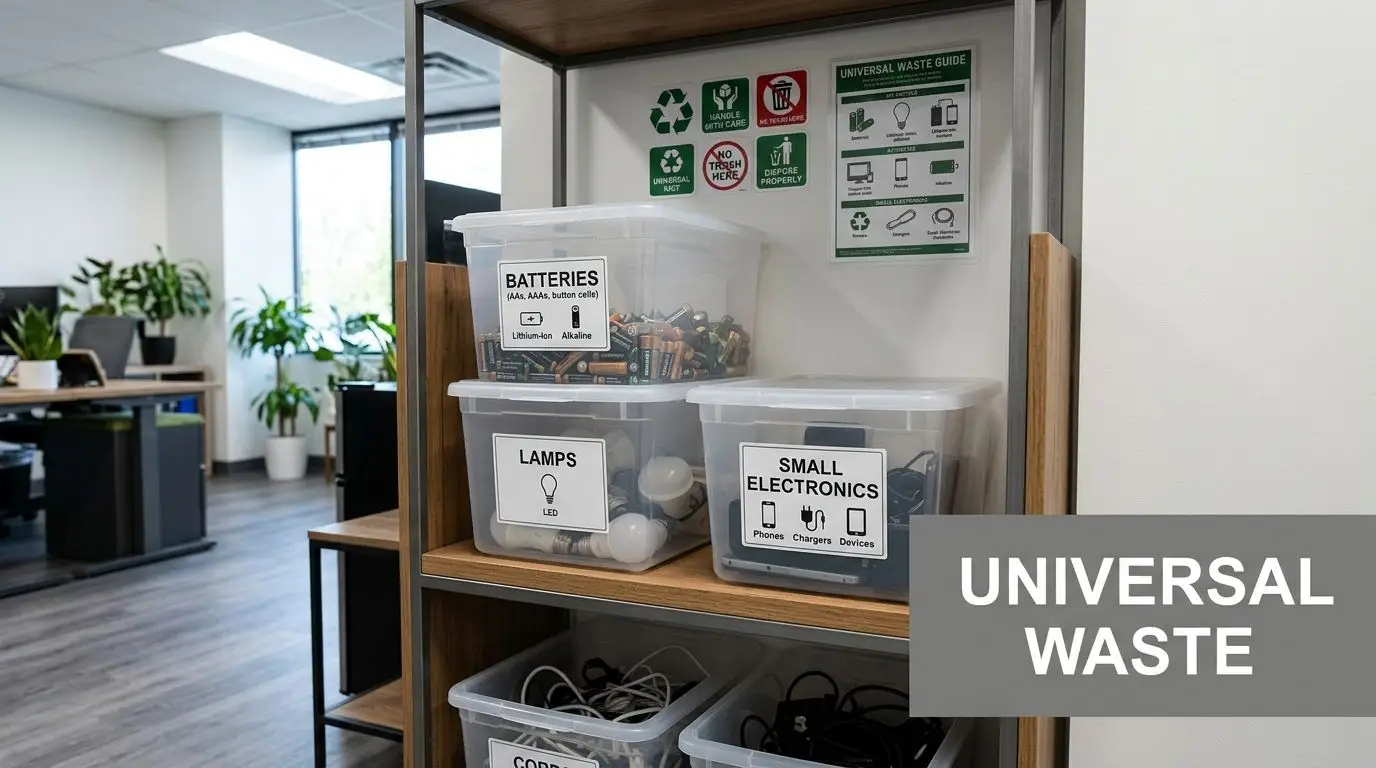
Setting Up a Compliant Accumulation Area
Once handled, universal waste must be stored in a designated accumulation area until it is shipped off-site. This cannot be an arbitrary corner of your facility; it must meet specific requirements for safety and compliance.
First, select a secure location away from high-traffic zones to prevent accidental damage. The area must be clearly marked with signs identifying it as a "Universal Waste Accumulation Area."
Next, use appropriate containers. All containers must be:
- Structurally sound and capable of holding the waste without breaking or leaking.
- Compatible with the waste being stored. For example, do not store batteries with the potential to leak in a cardboard box that could degrade.
- Closed, unless waste is actively being added or removed. This simple measure is key to preventing spills and containing potential vapors.
If a spill or leak occurs, you must have a response plan. Immediately contain the release and transfer the contaminated material, including cleanup supplies, into a separate container that must be managed as hazardous waste. This underscores the importance of preventative handling.
The diagram below illustrates the flow of waste from your facility to its final destination, showing the distinct paths for small and large quantity handlers.
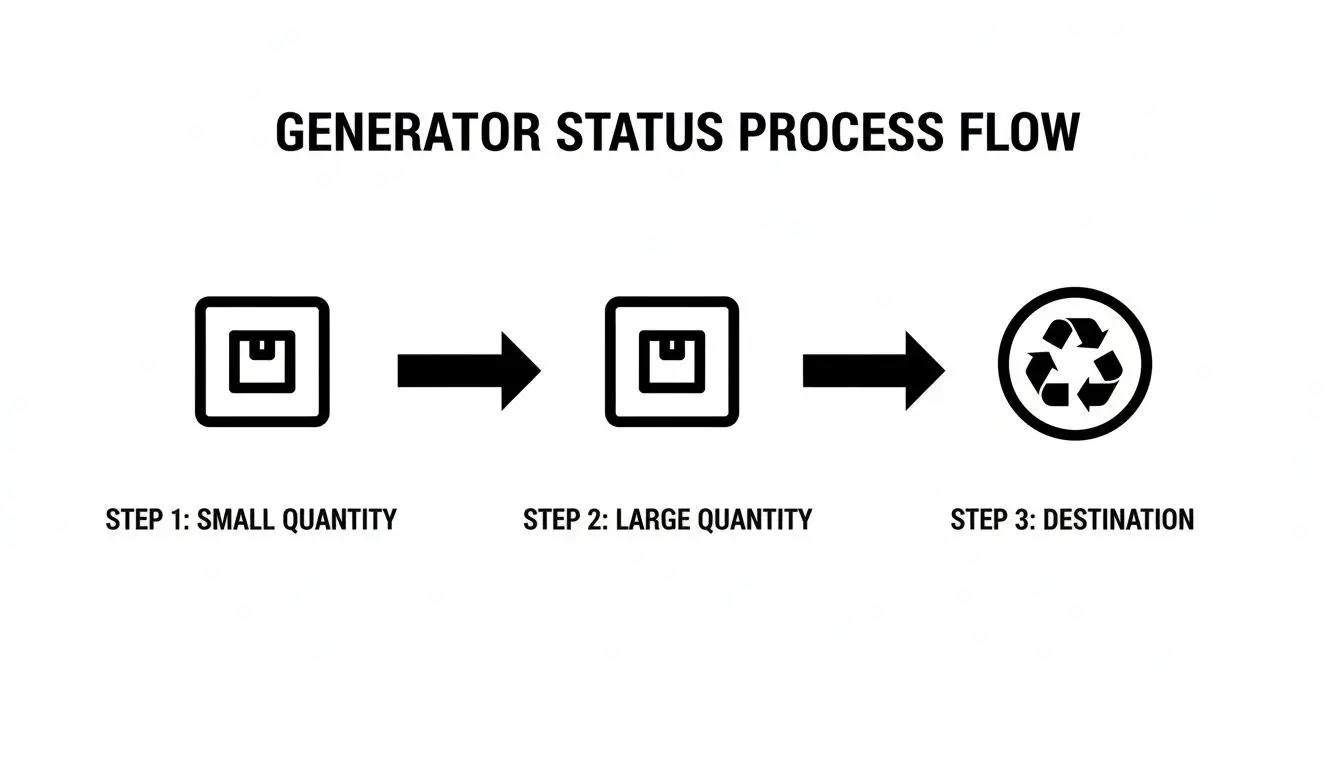
This visual clarifies that regardless of generator status, all universal waste must ultimately go to a certified facility for proper recycling or disposal.
Labeling and Tracking Accumulation Time
Clear labeling is a non-negotiable cornerstone of compliance. Every container holding universal waste must be marked to identify its contents. This is a federal requirement.
Your label must clearly state one of the following phrases:
- "Universal Waste—[Type of Waste]" (e.g., "Universal Waste—Batteries")
- "Waste [Type of Waste]" (e.g., "Waste Lamps")
- "Used [Type of Waste]" (e.g., "Used Thermostats")
Additionally, you must be able to prove how long the waste has been accumulating. The standard method is to mark the container with the date the first piece of waste was placed inside. This "accumulation start date" initiates the one-year compliance clock. Maintaining a log or a clear date on each container is critical for demonstrating compliance during an inspection.
These practices are more important than ever given the sheer volume of waste being generated. The 2026 Global Waste Index reported that the United States produces 951 kilograms of municipal solid waste per person annually, with nearly half ending up in landfills. For IT managers, this is a stark reminder of how quickly obsolete electronics contribute to the problem if not managed through a proper universal waste program. You can find more insights about U.S. waste generation on BioCycle.net.
Choosing a Certified Partner for Universal Waste Transport and Disposal
Once your universal waste is properly contained and labeled, the final step is transferring it off-site to a certified facility. Selecting a partner for transport and disposal is a critical business decision that directly impacts your company's liability and environmental standing.
Your responsibility does not end when the truck leaves your loading dock. An error by your chosen vendor, such as improper disposal, can trace back to your company, resulting in significant fines and reputational damage. This is why thorough due diligence is non-negotiable.
Your Options for Off-Site Management
The EPA outlines several clear pathways for moving universal waste off your property. You can send it to:
- A universal waste transporter, who will deliver it to a permitted facility.
- Another universal waste handler, such as a consolidation facility.
- A destination facility, which is the final point for recycling or disposal.
Each partner in this chain has a specific role. Your responsibility is to ensure that any vendor you engage is fully permitted and certified to handle your specific waste types in accordance with all federal, state, and local regulations.
Verifying Credentials and Protecting Your Business
Never assume a vendor is compliant based on a professional website or a low quote. True due diligence requires a deep dive into their credentials, operational history, and compliance record.
The greatest risk in universal waste management is selecting an uncertified or unqualified vendor. A low price often masks the true cost of non-compliance, leaving your business exposed long after the waste is gone.
This vetting process is crucial. A certified vendor ensures your materials are processed correctly and responsibly. A comprehensive vendor due diligence checklist outlines the key questions to ask. Working with an integrated provider like Beyond Surplus can simplify this entire process, especially when universal waste is part of a larger IT asset disposal project.
The Power of Documentation and Chain of Custody
A qualified partner will provide a clear and unbroken chain of custody. This documentation is your proof that the waste was handled properly at every stage, from pickup to final disposition. It should detail who possessed the waste, when it was transferred, and its final destination.
Upon completion, you should receive a Certificate of Recycling or Certificate of Disposal. This is your official record, the document that transfers liability from your company and confirms your compliance. Without this paperwork, you have no defense in the event of a regulatory audit.
Integrating Universal Waste into Your ITAD Program
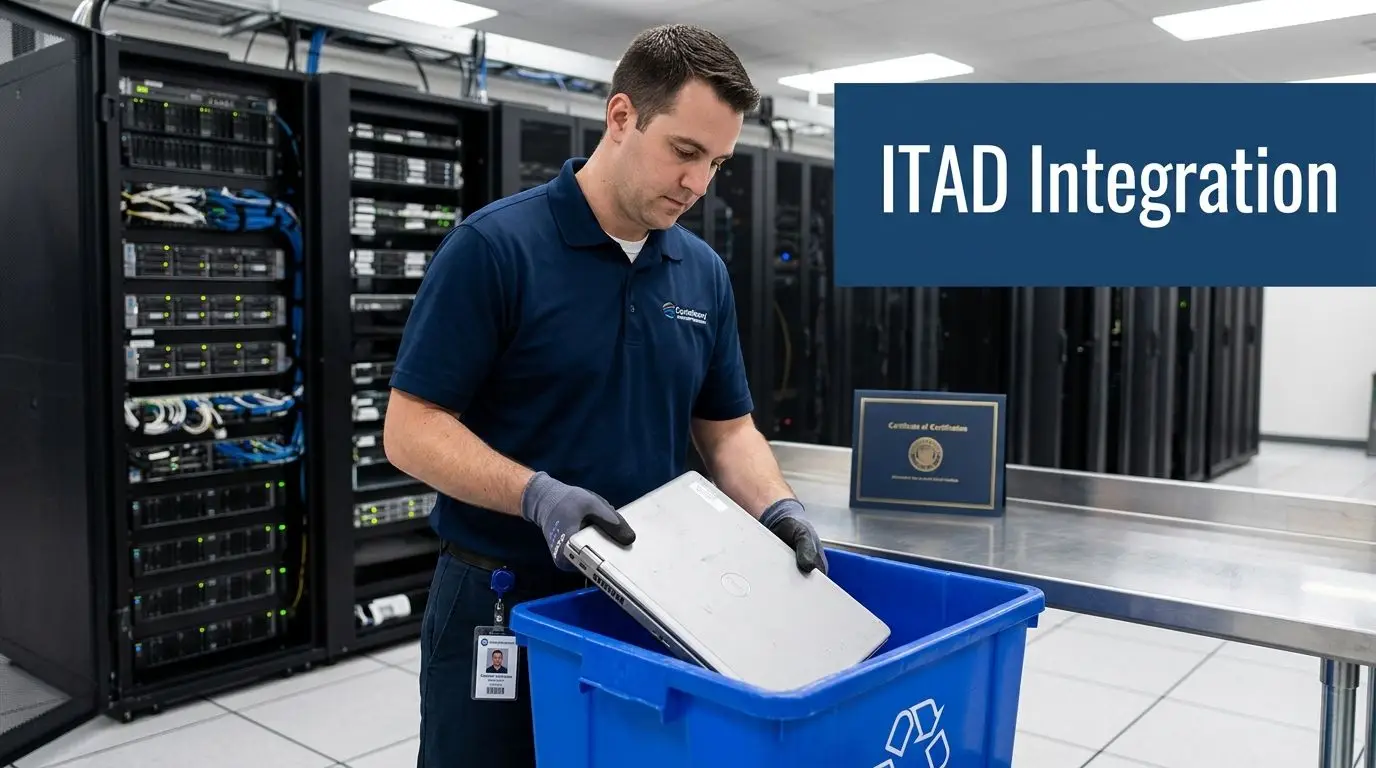
A modern IT Asset Disposition (ITAD) strategy is incomplete without a robust universal waste management component. Nearly every piece of technology your business retires—from laptops and projectors to the UPS systems in your data center—contains universal waste.
Ignoring this fact is a significant compliance vulnerability. Integrating universal waste disposal directly into your ITAD program closes this gap, creating a single, secure, and streamlined process for managing end-of-life technology assets.
Why an Integrated Approach Is Superior
Consider a data center decommissioning project. A fragmented approach would involve juggling separate vendors for data destruction, hardware recycling, and universal waste disposal. This creates a logistical nightmare of multiple contracts, conflicting schedules, and disjointed documentation.
An integrated ITAD program consolidates all these services with a single, certified partner. This one vendor can manage every aspect:
- Securely sanitize data on all storage media, on-site or at their facility.
- Responsibly recycle servers, networking gear, and other hardware.
- Identify and remarket assets with remaining value.
- Properly manage all universal waste, from motherboard batteries to large-scale UPS units.
This unified approach provides a seamless, low-risk process from start to finish. You gain a single point of contact, one set of compliance documents, and one clear chain of custody. As detailed in our guide, a comprehensive IT Asset Disposition (ITAD) program is built on this principle of streamlined accountability.
For companies moving electronics across borders, knowing the correct laptop HS code classification is also essential for clearing customs without delays. A good integrated partner with global logistics experience will manage these details for you.
The Value of Unified Documentation
A primary benefit of an integrated program is consolidated documentation. Instead of tracking paperwork from multiple vendors, you receive a single, comprehensive Certificate of Recycling and Data Destruction.
This unified certificate is your ultimate proof of compliance. It covers every aspect of the disposition process—from data sanitization according to standards like the NIST 800-88 guidelines for media sanitization to the responsible management of universal waste—providing a complete and auditable record that protects your business from liability.
This single document simplifies record-keeping and provides irrefutable proof of due diligence for any audit, which is critical for businesses in regulated industries like healthcare, finance, and government contracting.
Comparing Standalone vs. Integrated Waste Management
The difference between managing these processes separately and using an integrated partner is stark. A single-vendor approach is more efficient, less risky, and more cost-effective. The table below illustrates the key advantages.
| Factor | Standalone Management (Multiple Vendors) | Integrated ITAD & Universal Waste (Single Vendor) |
|---|---|---|
| Vendor Management | High overhead; requires vetting and managing multiple contracts. | Simplified; one relationship and one point of contact. |
| Logistics | Complex; involves coordinating multiple pickups and shipments. | Streamlined; one coordinated pickup for all assets and wastes. |
| Chain of Custody | Fragmented; multiple handoffs create potential gaps and increase risk. | Unified; a single, unbroken chain of custody for all items. |
| Compliance | Difficult to track; requires collecting and reconciling documents from several sources. | Centralized; one Certificate of Recycling and Data Destruction for all services. |
| Cost | Often higher due to multiple vendor fees and administrative burden. | More cost-effective through bundled services and operational efficiencies. |
By choosing an integrated partner, you transform a series of complex, disconnected tasks into one smooth, compliant solution. It’s a strategic decision that saves time and money while providing the best possible protection against risk.
Your Universal Waste Compliance Checklist
Developing a compliant universal waste program is about building a smart, repeatable system that protects your business, your employees, and your brand. This checklist outlines the critical steps for creating a robust and efficient program.
Foundational Steps for Program Setup
Before collecting the first battery or lamp, lay the groundwork for compliance. This initial phase focuses on inventory, regulations, and infrastructure.
Identify Waste Sources: Conduct a thorough walkthrough of your facility, including offices, data centers, and maintenance areas, to inventory all potential universal waste streams and estimate volumes.
Determine Generator Status: Use your inventory to estimate the total weight of universal waste you will accumulate on-site at any time. This determines if you are a Small Quantity Handler (<5,000 kg) or a Large Quantity Handler, which dictates your specific compliance duties.
Establish a Designated Accumulation Area: Select a secure, low-traffic area for waste storage. It must be clearly marked with signage and equipped with appropriate, structurally sound containers for each waste type.
Daily Operations and Team Readiness
With the infrastructure in place, the focus shifts to day-to-day management, safe handling, and accurate documentation.
Train Employees on Safe Handling: All personnel who may handle universal waste must be trained on proper procedures to prevent breakage, short-circuiting, and spills.
Implement Proper Labeling Protocols: Enforce a strict policy that every container is immediately labeled with the words "Universal Waste—[Type of Waste]" and the accumulation start date (the date the first item was placed inside).
Track Accumulation Time: Regularly monitor the start dates on your containers to ensure all waste is shipped for disposal well before the one-year deadline.
Vendor Management and Documentation
The final component is selecting certified partners and maintaining meticulous records to prove due diligence.
A complete and auditable paper trail is your most effective defense against liability. Your documentation should tell the entire story of your waste's journey, from your facility to its final, responsible destination.
Vet and Contract a Certified Disposal Partner: Thoroughly vet your e-waste and universal waste vendors. Verify their certifications (e.g., R2 (Responsible Recycling) or e-Stewards), review their compliance history, and confirm they provide a complete chain of custody.
Maintain Records for at least Three Years: Retain all shipping manifests, bills of lading, and Certificates of Recycling and Data Destruction. These documents are your official proof of compliance.
Frequently Asked Questions About Universal Waste
Even with a solid plan, questions always pop up when you're managing universal waste day-to-day. Here are some clear, straightforward answers to the most common questions we hear from businesses, helping you handle tricky situations and stay compliant.
What Happens If My Business Exceeds Accumulation Limits?
Going over your accumulation limits—either the one-year time limit or the 5,000 kg quantity threshold for Small Quantity Handlers—is a big deal. If you cross that 5,000 kg mark, your business is immediately reclassified as a Large Quantity Handler of Universal Waste (LQHUW). This change comes with stricter rules, like having to notify the EPA of your activities and keeping much more detailed shipping records.
If you blow past the one-year storage limit, that waste might have to be managed as fully regulated hazardous waste. Trust us, that's a world of complexity and cost you want to avoid. The best defense is a good offense: keep a close eye on your accumulation start dates and waste volumes so you can schedule pickups long before you get close to those limits.
What Is the Real Difference Between Universal and Hazardous Waste?
Think of universal waste as a special, easier-to-handle subcategory of hazardous waste. While all universal wastes are technically hazardous, the EPA created these streamlined regulations to encourage recycling by making them less of a headache to manage.
The real difference is in the rulebook. Managing something as universal waste means simpler labeling, storage, and transport rules. It lets you skip the burdensome "cradle-to-grave" manifesting and tracking required for other hazardous wastes. But there's a catch: if you mismanage it—say, by breaking mercury lamps and not cleaning them up correctly—it loses its special status and must be handled as fully hazardous waste.
How Can I Verify a Recycler's Certifications?
Choosing a certified partner for your electronics and universal waste isn't just a good idea; it's essential for protecting your business from liability. Don't just take a vendor’s word for it. You need to ask for proof and check it yourself.
Request Copies of Certifications: Ask to see their current R2 (Responsible Recycling) or e-Stewards certificates. These are the gold standards for the electronics recycling industry.
Verify with the Certifying Body: Head over to the official R2 or e-Stewards websites. They both have directories where you can confirm a vendor's certification is active and in good standing. This simple step is your best protection against fraudulent claims.
Check for Environmental Permits: Your recycling partner should also have no problem providing copies of their state and federal permits to operate as a waste handler or destination facility.
Due diligence is your best defense. A few minutes spent verifying credentials can save you from major financial penalties and a hit to your reputation. Any reputable partner will be happy to provide the documentation you need to prove they're compliant.
By staying on top of these details, you can ensure your universal waste program is a well-managed part of your business, not a source of risk.
For professional management of your company's technology assets, including compliant universal waste disposal, trust the experts. Contact Beyond Surplus to schedule a pickup or learn more about our nationwide ITAD services.