
A server room refresh often leaves the same problem behind. Pallets of spent UPS batteries, boxes of fluorescent lamps from a lighting retrofit, and older devices that may contain mercury components all need to move out of the building without creating a compliance problem.
That is where universal waste labeling requirements matter. If your labels are correct, visible, and dated, you can usually manage common hazardous waste streams under a simplified framework instead of falling into full hazardous waste rules. If your labels are vague, missing, or inconsistent across sites, an otherwise routine pickup can turn into an enforcement issue.
For facility managers, IT teams, and operations leaders, the practical task is simple. Identify what qualifies, label it correctly, track the accumulation date, and make sure your process still works when waste moves across state lines. A useful starting point is this overview of the universal waste definition.
Introduction to Universal Waste Management for Businesses
Universal waste rules exist for businesses that generate the same regulated materials again and again but do not need the full burden of traditional hazardous waste management for every lamp, battery, or mercury device.
The reason this matters in corporate environments is operational. Office consolidations, data center decommissions, branch closures, and maintenance projects create recurring waste streams that someone has to package, mark, store, and ship. If that process depends on tribal knowledge, mistakes show up fast.
Where businesses usually get stuck
Businesses often do not struggle with the idea that batteries and lamps need control. They struggle with execution.
Common trouble spots include:
- Mixed storage areas where batteries, lamps, and general e-waste end up on the same pallet
- Informal wording such as “bad bulbs” or “scrap batteries”
- Missing dates because staff assume the pickup vendor will handle that later
- Multi-site inconsistency when one facility labels containers one way and another facility does something different
What good management looks like
A workable system is not complicated. It is repeatable.
Tip: Treat universal waste labeling like a receiving process, not a cleanup task. The label should go on when the item becomes waste or enters the designated accumulation container, not the day before pickup.
In practice, that means a dedicated storage area, approved label language, a date field, and a simple review before transportation. That approach keeps inspections shorter and internal handoffs cleaner.
Decoding Universal Waste Regulations
The EPA created universal waste rules because too many commonly generated hazardous wastes were ending up in municipal solid waste landfills. Under 40 CFR Part 273, the framework was designed to promote collection and recycling while reducing the regulatory burden on generators, allowing organizations to manage these materials without automatically triggering full hazardous waste generator status, as described in this summary of EPA universal waste rules and the underlying explanation from BLR on universal waste regulations.
That purpose matters. The program is not a loophole. It is a structured simplification.
The five federal categories
Federal universal waste rules recognize five categories:
- Batteries
- Pesticides
- Mercury-containing equipment
- Lamps
- Aerosol cans
For most commercial IT and facilities teams, the first, third, and fourth categories appear most often. Think UPS batteries, emergency lighting batteries, fluorescent lamps, HID lamps, thermostats, switches, and older devices with mercury components.
What does not belong in the universal waste bucket
A frequent mistake is calling all obsolete electronics “universal waste.” That is not how the rule works.
A laptop, desktop, switch, or server is not automatically universal waste because it is electronic. The universal waste question usually turns on whether a specific component falls into one of the recognized categories, such as a battery or mercury-containing device.
Why the simplified system helps
The rule reduces friction in several ways:
- Simpler labels than standard hazardous waste labeling
- Less reporting burden for qualifying handlers
- Easier collection and recycling workflows for recurring waste streams
That is why businesses use the universal waste framework whenever it fits. It makes compliance more manageable without removing the need for accurate identification.
Federal Universal Waste Labeling Requirements
Federal labeling rules are straightforward, but they are not optional. The label must identify the waste type clearly enough that employees, transporters, and inspectors know exactly what is being managed.

What the label needs to do
At the federal level, the label should do five jobs:
- State that it is universal waste
- Identify the specific waste type
- Remain visible
- Stay legible during storage and handling
- Work on the item or on the container, depending on how the waste is accumulated
The biggest practical error is using shop-floor slang. Under 40 CFR § 273.34, large quantity handlers must use precise wording such as “Universal Waste-Battery(ies)” or “Universal Waste-Mercury Containing Equipment.” Improper wording, including generic phrases like “bad bulbs,” can trigger reclassification as fully regulated hazardous waste. EPA enforcement cases have included $50,000+ fines for unlabeled lamps due to mercury release risks, as reflected in the regulatory discussion at 40 CFR 273.34.
Required text for federal universal waste labels
| Waste Type | Required Label Text |
|---|---|
| Batteries | Universal Waste-Battery(ies), Waste Battery(ies), or Used Battery(ies) |
| Lamps | Universal Waste-Lamp(s), Waste Lamp(s), or Used Lamp(s) |
| Mercury-containing equipment | Universal Waste-Mercury Containing Equipment, Waste Mercury Containing Equipment, Used Mercury Containing Equipment, or for thermostats Universal Waste-Mercury Thermostat(s) |
| Pesticides | Universal Waste-Pesticide(s) |
| Aerosol cans | Universal Waste-Aerosol Can(s) or Universal Waste-Aerosol Cans |
Container versus individual item labeling
You do not always have to place a separate label on every single item. In many cases, the compliant approach is to label the container, tank, drum, box, or pallet wrap that holds the waste. But the label has to match how the waste is managed.
A few examples:
- Battery bucket in a maintenance room. Label the container with approved battery wording.
- Gaylord box of spent lamps. Label the outer container with approved lamp wording.
- Single mercury thermostat awaiting consolidation. Label the item or the container that holds it.
- Mixed universal waste in one box. Usually a bad idea. Separate by waste type so the label is clear and the downstream recycler does not have to guess.
What works in the field
A compliant label is only useful if staff can find it quickly.
Use these operating habits:
- Place labels on the outward-facing side of the container
- Keep old markings covered or removed so no one sees conflicting descriptions
- Use durable stock that stays attached during storage and loading
- Standardize wording across all facilities so one site is not writing “used batteries” while another site invents its own terms
A practical reference point for facilities building a consistent program is to standardize around one approved set of universal waste signage.
Key takeaway: Federal compliance is usually lost on small details. The wrong noun on the label can undo the benefit of the universal waste rule.
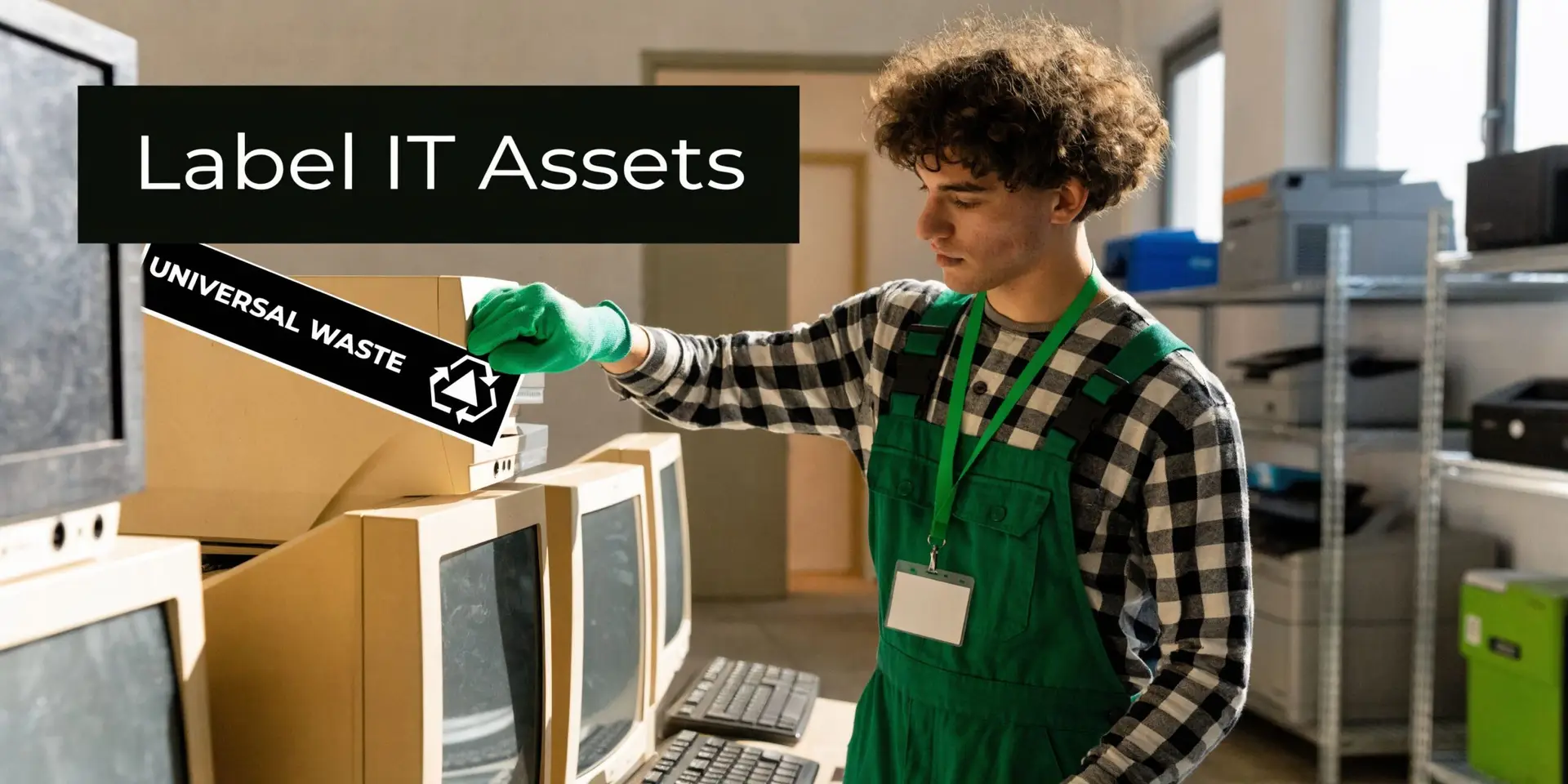
Labeling E-Waste and IT Assets in Practice
Theory becomes useful when it reaches the storage cage, loading dock, and decommission room.
Server room battery projects
A UPS replacement often generates several battery chemistries at once. The safest move is not to mix them casually just because they came from the same room.
Store batteries in compatible containers, protect terminals where needed, and label the outer container with the approved battery wording. If pallets are used, the visible exterior should still carry the correct label. Staff should not have to cut wrap to identify the contents.
Lamp changeouts in office and warehouse space
Lamp projects fail when teams focus on packing but ignore breakage risk. Lamps should go into boxes, fiber drums, or other protective containers designed for fragile material. The outer container needs the approved lamp language, visible before it reaches the truck.
What does not work is a trash cart holding loose fluorescent tubes with a handwritten note taped to the side. That creates breakage, confusion, and a bad inspection narrative.
Mercury devices buried inside old equipment
Most IT hardware is not universal waste by default. But some older support equipment, controls, thermostats, and switches may include mercury-containing components.
That means your disposition process should include one simple question during segregation: does this device contain a regulated subcomponent that needs to be removed and managed separately? If yes, label that device or the collection container using the correct mercury-containing equipment wording.
A practical floor-level routine
The facilities that stay organized usually rely on a short routine:
- Segregate first by waste type before anyone labels containers
- Use preapproved labels instead of handwritten improvisation
- Inspect before pickup so the dock team catches missing or damaged labels
- Train both IT and maintenance staff because either group may generate the waste
Tip: If your team needs to explain a label verbally, the label is not doing its job.
Managing State-Specific Labeling Differences
Federal rules are the baseline, not the whole map. Multi-state companies run into problems when they build one labeling standard and assume every state will accept it without adjustment.

Why the state layer matters
States can adopt the federal framework and still impose stricter details. For companies shipping waste from branch offices, hospitals, campuses, distribution centers, or decommissioned data rooms in different jurisdictions, that creates a planning problem.
One site may be fine under a straightforward federal-style label. Another may require a more specific marking convention or retention of original product labeling for certain waste streams.
Examples that change operations
State-specific labeling variances are a major compliance gap. Wisconsin requires individual battery labeling even on pallets using “Waste Batteries,” while California requires original labels on recalled pesticides. According to the cited summary of state issues, 25% of non-compliance issues in universal waste shipments were tied to mismatched state labels, which is a serious problem for nationwide ITAD logistics, as noted in the Wisconsin reference document at WA-1900 guidance and state variance discussion.
That kind of mismatch affects real workflows:
- Centralized label printing may not work for every destination state
- Shared SOPs need state-specific exceptions
- Interstate shipments need someone to verify that the label language still holds up after transfer
What national operators should do
If you manage waste in more than one state, do not rely on a single laminated cheat sheet forever. Review your active states and map out the stricter requirements.
A practical approach is to build a tiered process:
| Operating situation | Better approach |
|---|---|
| Single-state operation | Align labels with that state’s adopted rules and train one team |
| Regional operation | Build a standard format plus state add-ons |
| Nationwide pickups | Verify labels at origin and again before transport across state lines |
The trade-off is simple. A national standard is easier to deploy. A state-aware standard is safer.
Compliance Beyond the Label Timelines and Recordkeeping
A correct label does not complete compliance. Universal waste also carries a firm storage clock, and your documentation has to support that timeline.
The one-year accumulation clock
The one-year accumulation time limit is one of the most important parts of the rule. Handlers can track waste age by marking the individual item, marking the container with the date the first item was placed inside, or maintaining an inventory system. Small quantity handlers have lighter obligations, while large quantity handlers must document off-site shipments using logs, invoices, or bills of lading, as summarized in the UCCS overview of the universal waste rule.
That requirement changes how a facility should store material. You are not building a permanent warehouse. You are controlling a temporary accumulation stream that must be dated and moved.
Small quantity versus large quantity handling
The dividing line matters operationally.
- Small quantity handlers usually face simpler paperwork expectations
- Large quantity handlers need stronger shipment documentation and tighter internal controls
- Both categories still need a defensible way to show when accumulation began
If your facility scales up seasonally during renovation, closure, or equipment replacement, check whether your process still fits the same handler category throughout the project.
Recordkeeping that holds up in an audit
The best systems are boring. They create a dated label, tie it to a container or inventory line, and keep shipment records where an inspector can retrieve them without digging through email.
Useful records include:
- Container start dates
- Pickup dates
- Bills of lading or invoices
- Internal inventory logs
- Receiving records when waste transfers between handlers
For teams moving equipment and regulated materials through broader logistics networks, it also helps to watch adjacent transportation and documentation shifts. International operators, for example, may find these customs clearance regulatory changes useful because they show how paperwork changes can ripple through logistics workflows.
A related point often missed by facility teams is that universal waste transportation does not use the same paperwork structure as fully regulated hazardous waste in routine situations. That distinction becomes clearer when comparing universal waste handling with a universal hazardous waste manifest.
Key takeaway: If you cannot prove the date and movement history of universal waste, the label alone will not protect you.
Avoiding Common Violations and Partnering for Compliance
Most universal waste violations are not exotic. They are basic process failures repeated over time.

The violations that show up most often
Watch for these problems:
- Missing dates on containers or pallets
- Wrong wording that does not match approved universal waste terms
- Old labels left in place after a container is reused
- Mixed waste streams packed together under one generic label
- Storage beyond the allowed accumulation period
The consequences are not minor. The 1-year accumulation limit is strictly enforced through generation and receipt date tracking. A missing date can void universal waste status and trigger full hazardous waste protocols, with generator fees averaging over $10,000 annually. Wisconsin cases also showed non-date-labeled pallets leading to reclassification and $25,000 in penalties, according to the compliance discussion at Hazardous Waste Experts on labeling and storage requirements.
What Prevents Violations
The strongest prevention methods are procedural, not theoretical:
- One approved label library for every site
- A designated accumulation area instead of ad hoc storage
- A weekly visual check for labels, dates, and container condition
- A pre-shipment review before waste leaves the facility
Organizations that do not want to build that infrastructure internally often hand the disposal workflow to a qualified specialist with established processes, transportation controls, and documentation support. For businesses comparing options, a universal waste disposal company should be able to explain labeling expectations, chain of custody, and what records the facility should retain after pickup.
Frequently Asked Questions about Universal Waste Labeling
Do labels have to include the exact words Universal Waste
Yes. The safest approach is to use the approved wording that identifies both the universal waste status and the waste type. Informal labels create avoidable risk.
Can I label the box instead of each individual item
Often yes, if the waste is accumulated inside a clearly marked container and the label remains visible. But some state programs may be stricter for specific waste streams, so container-only labeling is not a universal answer everywhere.
Can one container hold different universal waste types
That is usually a bad operating choice. Even when teams think they are saving space, mixed containers create confusion at pickup, increase sorting errors, and make compliant labeling harder. Separate containers by waste type whenever possible.
Do old laptops need a universal waste label
Not automatically. A laptop is not universal waste because it is electronic. The question is whether a component being removed or managed separately falls into a recognized universal waste category, such as a battery.
What should staff do with damaged lamps or leaking batteries
Do not treat damaged items casually. Isolate them, prevent releases, and evaluate whether the material still fits within universal waste handling or requires management under more stringent hazardous waste rules. Damaged material often needs a more careful review than intact items in routine storage.
How visible does the label need to be
Visible enough that a worker or inspector can identify the waste without moving containers around or opening them. A correct label buried behind shrink wrap or placed on the hidden side of a box is a practical failure even if the wording itself is right.
What is the easiest way to stay consistent across multiple facilities
Use a standard label set, a simple written SOP, and one review step before shipment. The businesses that avoid repeat mistakes usually reduce discretion. Staff should choose from approved labels, not compose their own.
Do pickups remove the need for internal tracking
No. A vendor pickup does not erase your duty to label and date waste properly while it is under your control. Your facility should be able to show when the waste was accumulated and how it was managed before departure.
If your organization needs secure, compliant help with end-of-life IT equipment, batteries, lamps, and related regulated materials, contact Beyond Surplus. Their team supports businesses with electronics recycling, IT asset disposition, nationwide pickup coordination, and documentation that helps reduce compliance risk.