

Think of universal waste management as a streamlined, express lane for recycling specific business waste. It’s a special set of rules from the U.S. Environmental Protection Agency (EPA) designed for common but potentially hazardous items like old electronics and batteries. This system creates a more efficient process for your business, encouraging proper disposal without burying you in the complex paperwork of traditional hazardous waste management. This guide is specifically for business owners, IT managers, and facility professionals managing commercial electronics and IT equipment.
What Is Universal Waste and Why It Matters to Your Business
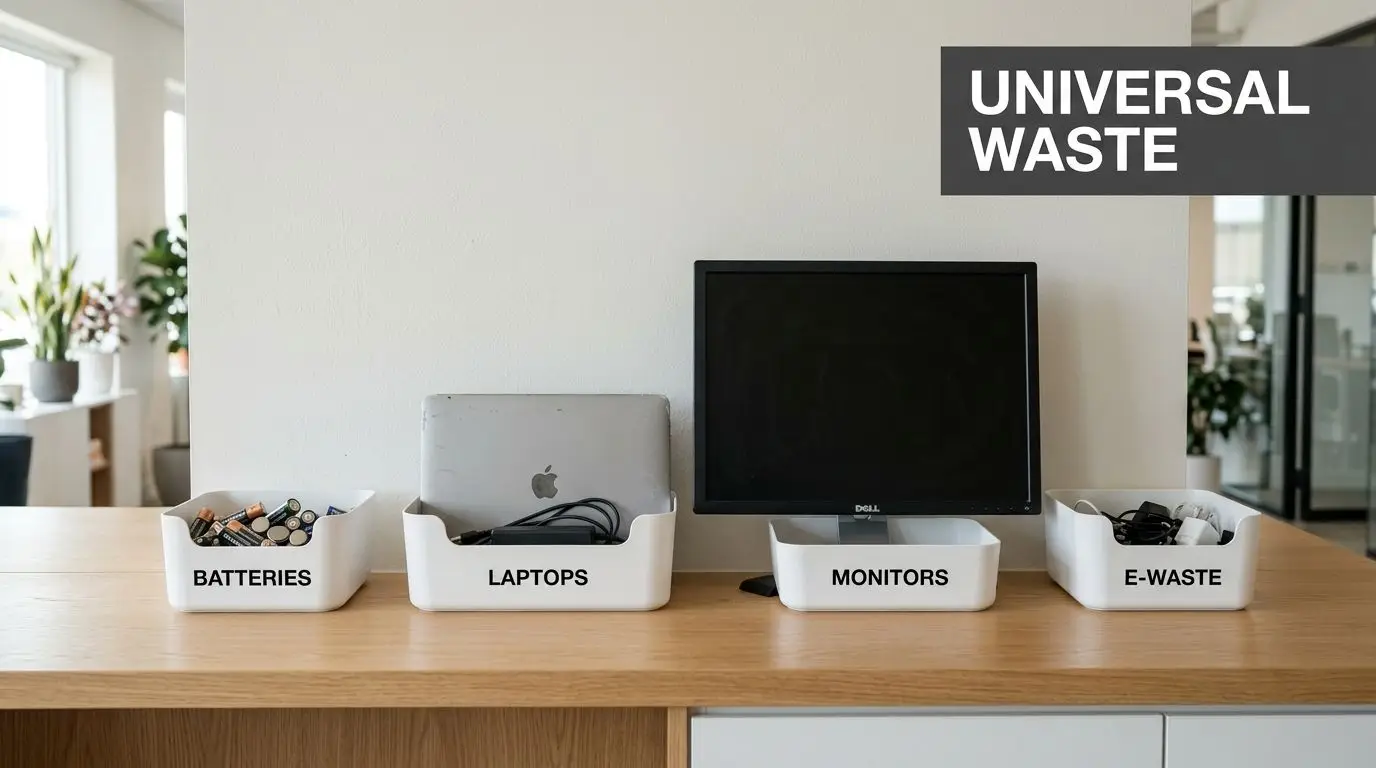
The concept of universal waste was created to solve a practical problem for businesses. Many everyday items—from batteries and fluorescent bulbs to old IT hardware—contain materials like lead and mercury that are seriously harmful if they end up in a landfill.
If every business had to manage these items under the same strict, "cradle-to-grave" regulations as highly hazardous industrial waste, the cost and complexity would be a nightmare. This barrier would likely lead to improper disposal, posing significant environmental and health risks.
To address this, the EPA created the Universal Waste Program. It’s a set of simplified rules that make it easier and more cost-effective for businesses like yours to collect, store, and transport these items to a certified recycling facility. This program is designed for commercial generators and explicitly excludes residential or household waste.
The Business Case for Compliance
For any IT, facilities, or procurement manager, getting universal waste right isn’t just about environmental responsibility—it's about smart risk management and protecting the bottom line. Non-compliance can lead to severe consequences for your business.
- Significant Financial Penalties: Fines for improper disposal can be substantial, often calculated on a per-item, per-day basis until the violation is corrected.
- Environmental Liability: If your company's waste causes environmental contamination, you could be held liable for cleanup costs, which can be financially crippling.
- Brand and Reputation Damage: News of regulatory violations or environmental carelessness can quickly erode customer trust and damage your brand's reputation.
A robust universal waste management plan is your business's best defense against these risks. It demonstrates due diligence and ensures your retired assets are handled securely and responsibly. With global municipal solid waste expected to reach 3.8 billion tonnes by 2050 and management costs soaring past $640 billion annually, an efficient, compliant strategy is more critical than ever for enterprises.
To get you started, we've put together a table of the most common universal waste items you'll find in a corporate setting. For a deeper dive into setting up a program for your enterprise, explore our guide on comprehensive universal waste systems.
Common Universal Waste Items in a Business Environment
This table provides a quick reference to the main categories of universal waste businesses encounter, especially those with significant IT infrastructure like data centers, laboratories, and medical facilities.
| Waste Category | Common Examples in IT & Facilities | Reason for Regulation |
|---|---|---|
| Batteries | Lithium-ion (laptops, phones), lead-acid (UPS systems), NiCad, alkaline | Contain heavy metals like lead, cadmium, and lithium, which can leach into soil and groundwater. |
| Lamps | Fluorescent tubes, compact fluorescent lamps (CFLs), HID lamps | Contain small amounts of mercury, a potent neurotoxin that is hazardous if released. |
| Mercury-Containing Equipment | Thermostats, switches, medical devices, laboratory equipment, barometers | Devices intentionally manufactured with elemental mercury for their operation, common in specialized commercial equipment. |
| Pesticides | Canceled or suspended pesticides that are recalled or collected | Highly toxic chemicals that pose a direct threat to human health and ecosystems if not managed properly. |
| Aerosol Cans | Cans that are not empty and still contain propellants or product | Regulated due to being ignitable, corrosive, or toxic, and for their potential to explode under pressure. |
| Electronics (State-Specific) | Computer monitors, circuit boards, televisions, CPUs, medical equipment, lab equipment | Often added by states; contain lead, mercury, cadmium, and other valuable but hazardous materials requiring secure e-waste management. |
Recognizing these items in your commercial inventory is the first step toward building a compliant and responsible disposal process for your enterprise.
Identifying Universal Waste in Your IT Inventory
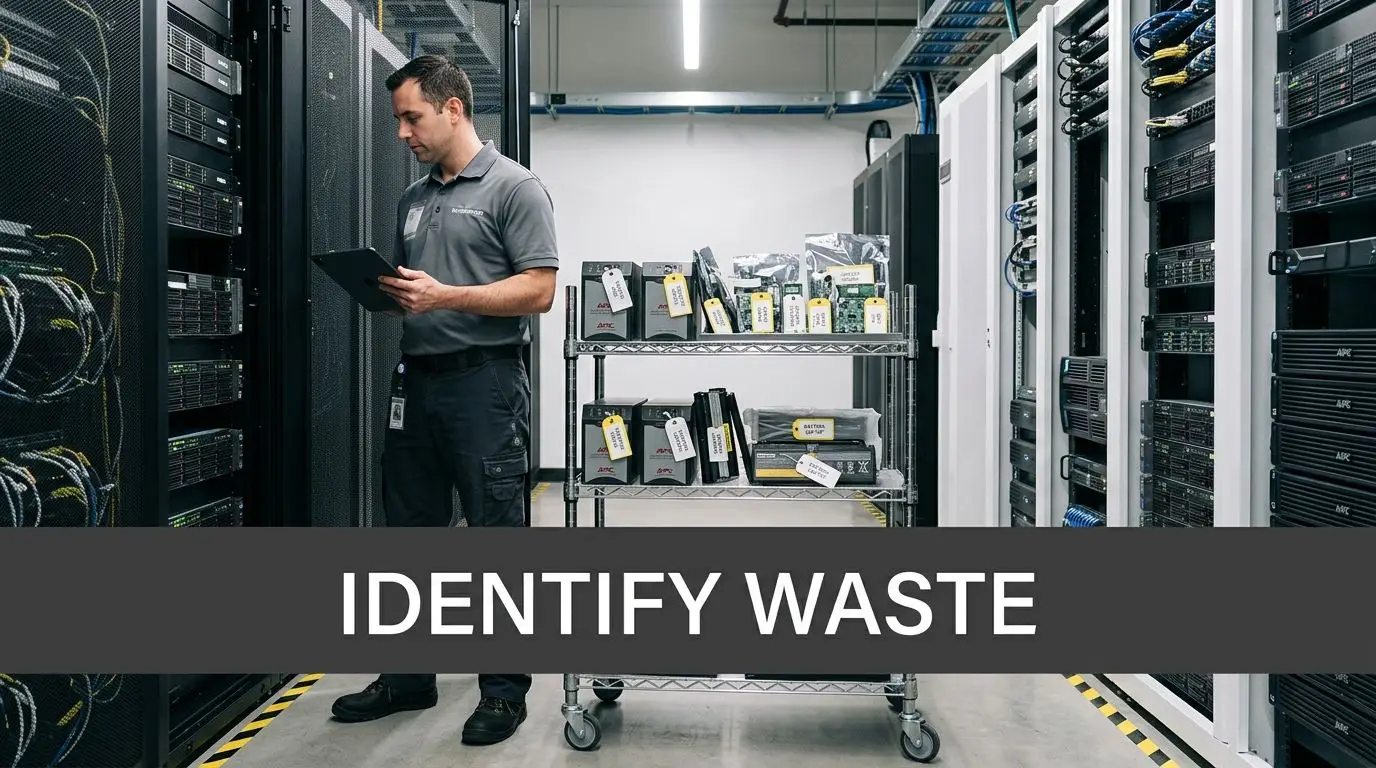
Moving from theory to practice means auditing your server room, storage closets, and data centers. Identifying what qualifies as universal waste in your IT inventory is about knowing which assets require special handling under universal waste management rules.
A thorough audit prevents regulated items from being improperly disposed of, shielding your company from hefty fines and environmental liability. This is a crucial step in any IT asset disposal (ITAD) or data center decommissioning project.
Core Universal Waste in Corporate IT Environments
While the EPA sets the baseline, the most common items for most businesses are batteries and mercury-containing devices.
Here’s a breakdown of what you'll find in a typical commercial setting:
- Batteries: This is the most widespread category in any business. It includes lithium-ion batteries in corporate laptops and smartphones and the heavy-duty lead-acid batteries powering the uninterruptible power supply (UPS) units in your data centers.
- Lamps: While often managed by facilities, IT departments frequently oversee specialized lighting. The long fluorescent tubes and CFLs in server rooms and office spaces contain mercury, making them universal waste.
- Mercury-Containing Equipment: Beyond lamps, older technology can contain mercury. This includes certain legacy switches, relays, and early flat-panel LCD monitors that used mercury backlights before LEDs became standard. Laboratory and medical equipment are also common sources.
Key Takeaway: Shift your perspective. An old laptop is not just one item; it's a collection of components, including a universal waste battery and potentially state-regulated electronic components, each requiring a specific, secure disposal path.
The Gray Area: State-Regulated Electronics (E-Waste)
This is a critical area where many businesses fall short. Federal rules are just the starting point; many states have expanded their universal waste programs to include entire electronic devices, a category often called "e-waste." This is especially relevant for computer recycling, laptop disposal, and medical equipment disposal.
This means items not officially universal waste at the federal level might be regulated under similar rules in your state. This streamlines the disposal process for a broader range of equipment, including:
- Cathode Ray Tubes (CRTs): Obsolete, bulky monitors are filled with lead, making them a top priority for state regulators.
- Circuit Boards: The printed circuit boards (PCBs) from servers, networking gear, and lab equipment are rich in valuable metals but also contain hazardous materials like lead and cadmium. Learn how these are managed in our guide on computer component recycling.
- LCD and LED Monitors: While lead-free, these screens can still contain mercury in their backlights or other regulated materials in their electronic components.
Understanding global classifications like the laptop HS code for international shipping highlights the complexity of these devices.
The tech boom drives this conversation. The global waste management market is projected to hit $2,155.83 billion by 2033, growing at a 6% CAGR, fueled largely by e-waste. In the U.S. alone, the market is on track to reach $265.3 billion in 2025. These numbers underscore that a compliant process for every piece of retired hardware isn't just good practice—it's a financial and environmental necessity for your business.
Understanding Your Responsibilities as a Waste Generator
Once you've identified universal waste in your facility, the next step is understanding your legal duties as a commercial generator. Knowing what to do with the waste is what keeps your business compliant and protected from risk.
The EPA created the universal waste program to simplify disposal for businesses, but “simplified” doesn’t mean unregulated. Strict rules still apply. Failure to follow them can lead to serious fines and may cause your waste to be reclassified as fully hazardous, creating a much more complex and expensive problem.
Small vs. Large Quantity Handlers
Your company’s classification depends on a single number: 5,000 kilograms (about 11,000 pounds). This is the total amount of universal waste you have on-site on any given day, not an annual total.
Small Quantity Handler of Universal Waste (SQHU): If your business never stores more than 5,000 kg of universal waste at one time, you’re an SQHU. This applies to the vast majority of companies, including most offices, retail locations, and small-to-medium enterprises.
Large Quantity Handler of Universal Waste (LQHU): If your facility ever crosses that 5,000 kg threshold, even for one day, you become an LQHU. This is more common for large-scale operations like manufacturing plants, major data center decommissioning projects, or specialized waste collection sites.
Correctly identifying your status is essential, as the rules for LQHUs are significantly more stringent, involving formal EPA notifications and meticulous record-keeping.
Key Insight: Pinpointing your generator status is the first step in building a compliant universal waste management program. A miscalculation can lead to a cascade of regulatory errors.
Core Generator Responsibilities
Whether you are an SQHU or an LQHU, several core duties apply from the moment an item is designated for disposal until it is picked up by your certified vendor.
Proper Storage and Accumulation
You must store universal waste in a way that prevents leaks or spills. This means using structurally sound containers made of a material compatible with the waste (e.g., no corroding containers for batteries) and keeping them closed. Establish a dedicated, clearly marked area for this waste to prevent it from being mixed with general trash or other recyclables.
Accurate Labeling
This is a simple but critical requirement. Every container, or each individual item, must be clearly marked. The label must identify the type of waste and the date you started collecting it.
Acceptable labels are straightforward:
- "Universal Waste—Battery(ies)"
- "Waste Lamp(s)"
- "Universal Waste—Mercury-Containing Equipment"
Inspectors almost always check for these labels first, making this a non-negotiable step.
Strict Time Limits
The clock starts ticking the moment an item is generated. You can only keep universal waste on-site for a maximum of one year. The accumulation start date on the label proves your compliance. This rule prevents businesses from becoming unpermitted long-term storage facilities. For more on timelines, see our guide on navigating electronics recycling regulations.
Employee Training
You must ensure that any employee who handles your universal waste knows the proper procedures and emergency response actions. For SQHUs, this can be informal, on-the-job training. For LQHUs, training requirements are typically more formal and must be documented.
SQHU vs. LQHU Generator Requirements at a Glance
This table compares the key compliance obligations for Small and Large Quantity Handlers of Universal Waste.
| Requirement | Small Quantity Handler (SQHU) | Large Quantity Handler (LQHU) |
|---|---|---|
| Accumulation Limit | Never exceeds 5,000 kg (11,000 lbs) | Accumulates 5,000 kg or more |
| EPA Notification | Not required | Must submit a formal notification to the EPA |
| Labeling Waste | Required | Required |
| Accumulation Time Limit | 1 year | 1 year |
| Employee Training | Must inform employees of proper handling | Must ensure employees are thoroughly familiar with procedures |
| Tracking/Recordkeeping | Not federally required (but highly recommended) | Must maintain records of shipments sent and received |
| Response to Releases | Must immediately contain and clean up spills | Must immediately contain and clean up spills |
As you can see, crossing the 5,000 kg threshold adds a significant administrative burden. It is always best to know exactly where your business stands.
Your Step-by-Step Compliance Checklist for Business
A clear, repeatable process—a standard operating procedure (SOP)—is essential for effective universal waste management. This checklist helps you build a process that removes guesswork and ensures compliance from the moment an old laptop or fluorescent bulb is retired.
Create a Central Accumulation Area
First, establish a specific, secure location exclusively for universal waste. This cannot be an afterthought; it must be a designated, controlled environment.
- Location: Choose a spot away from daily traffic but easily accessible for your staff. It must be under a roof and protected from the elements.
- Segregation: Within this area, create clearly marked sections for different waste streams (e.g., a bin for batteries, a pallet for monitors, a box for lamps). This prevents cross-contamination and simplifies labeling.
- Security: The area should be locked or otherwise secured to prevent unauthorized access and ensure items are not accidentally discarded with regular trash.
Use Proper Containers and Labels
Next, acquire the right equipment. Containers must be sturdy and appropriate for the type of waste they will hold.
For example, use a strong, sealable drum for batteries to contain potential leaks. For fluorescent bulbs, use long, reinforced cardboard boxes. Every container must be clearly marked with the words "Universal Waste," the specific contents (e.g., "Universal Waste—Batteries"), and the accumulation start date.
This flowchart illustrates the critical process every business must follow to determine its handler status.
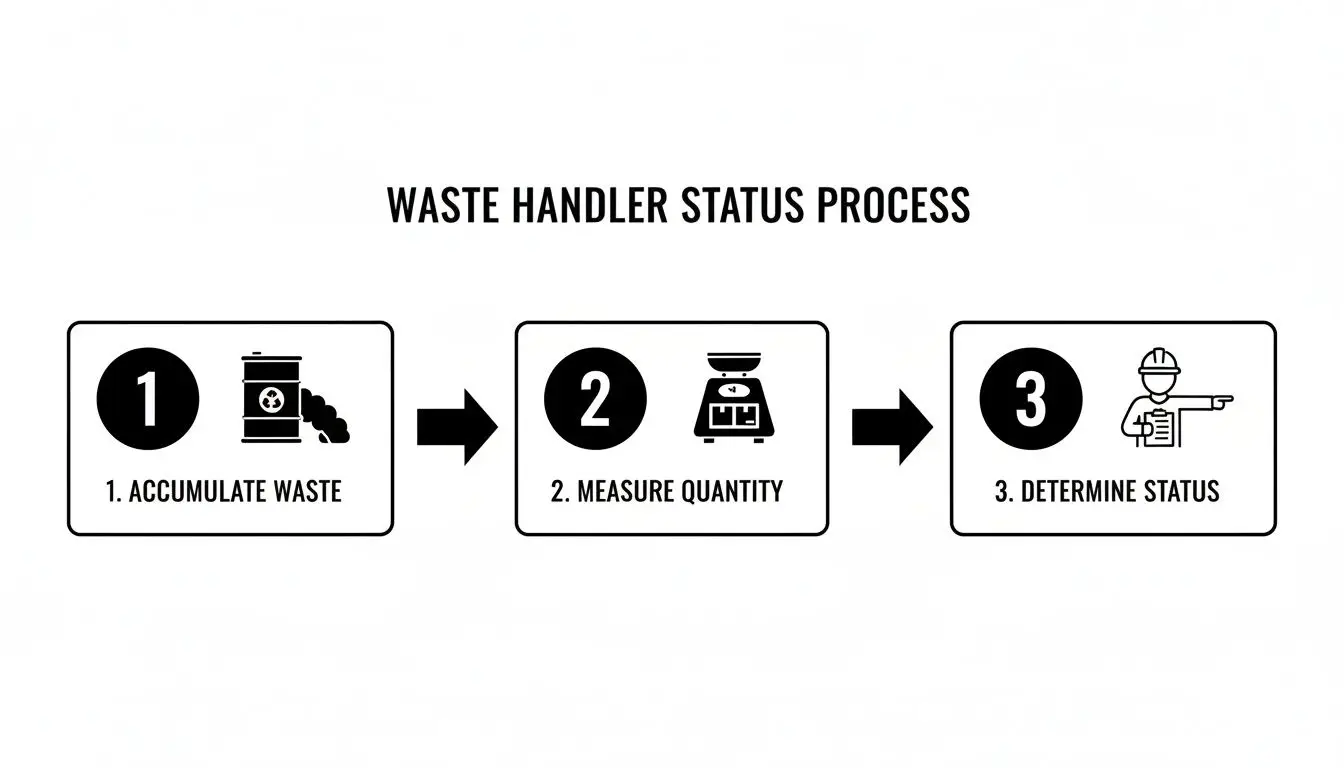
As shown, regularly monitoring your accumulated waste is the only way to maintain compliance with either SQHU or LQHU rules.
Maintain a Log and Train Your Team
To track the one-year storage limit, an accumulation log is non-negotiable. This can be a simple spreadsheet or a log sheet taped to the container. It should track:
- Waste Type: What’s in the container.
- Container ID: A unique identifier for tracking.
- Accumulation Start Date: The day the first item was added.
- Scheduled Pickup Date: Your target for removal, set well before the one-year deadline.
Training is equally crucial. Every employee who may handle these materials must know the location of the accumulation area, how to identify and label waste, and who to contact with questions.
Secure Your IT Assets and Obtain Proof of Destruction
For IT assets, the first step is secure data destruction. A device is a data liability until its data has been completely and permanently destroyed. Your process must include a certified data wiping or physical shredding step before an asset is moved to the accumulation area. For guidance, see our year-end IT equipment disposal checklist.
The job isn't done until the paperwork is in your hands. Your certified vendor must provide a Certificate of Recycling and, for IT assets, a Certificate of Data Destruction. These documents are your legal proof of proper disposal and officially transfer liability from your company to the vendor.
This diligent tracking is more important than ever. In 2026, the United States remains a top global waste generator, producing 951 kilograms of municipal solid waste per person annually. With only about 30% being recycled, partnering with certified disposal experts is critical for responsible business operations.
How to Choose a Certified Universal Waste Partner

Selecting the right partner for your universal waste management is the most critical decision in your compliance strategy. This isn't just about hauling away old electronics; it's about entrusting your company's legal liability and reputation to a qualified vendor.
A low-ball price from an uncertified vendor often hides serious risks like data breaches or environmental fines that can come back to haunt your business. A true partner acts as a risk management shield, providing an auditable paper trail from pickup to final disposition for all your commercial electronic waste, including services like IT asset recovery and product destruction.
Look for Key Industry Certifications
Certifications are non-negotiable credentials that prove a vendor has passed rigorous, third-party audits of their environmental, security, and safety processes. They are your best guarantee of best practices.
- R2 (Responsible Recycling): This leading certification covers environmental protection, worker health and safety, and data security throughout the recycling and refurbishment process. An R2-certified partner ensures your assets will not be illegally exported or landfilled.
- e-Stewards: Often considered the gold standard, e-Stewards enforces a strict, zero-tolerance policy against exporting hazardous e-waste to developing nations. It signifies the highest level of environmental and social responsibility.
- NAID AAA: For data security, this is the paramount certification. A NAID AAA certified vendor has undergone extensive background checks and unannounced audits of their secure data destruction processes.
Always ask potential partners for copies of their current certifications and verify their status directly with the certifying body to ensure they are active and in good standing.
Essential Questions for Potential Vendors
Once you have a shortlist of certified vendors, it’s time to conduct your due diligence. A professional partner will provide transparent answers and documentation without hesitation.
Key Insight: The vendor you choose becomes an extension of your company's risk management team. Their competence, or lack thereof, directly impacts your legal and financial exposure. Choose a partner whose processes you can trust implicitly.
Here are the critical questions to ask:
- Can you document your entire downstream recycling chain? They must be able to prove where every component goes, from circuit boards to batteries.
- What are your insurance coverage limits? Request a Certificate of Insurance. Look for sufficient general liability, pollution liability, and errors & omissions coverage to protect your business.
- What reporting and documentation will I receive? A quality vendor provides serialized asset tracking, Certificates of Recycling, and Certificates of Data Destruction for every pickup.
- Do you handle all logistics, or do you use third-party contractors? You must know who is physically handling your assets at all times to ensure a secure chain of custody from your facility to theirs.
Vetting your universal waste vendor is an investment in your company’s security and compliance. To streamline this, use our detailed vendor due diligence checklist to make a safe and informed decision.
Frequently Asked Questions About Universal Waste
Even with a solid plan, questions arise. Here are common "what-if" scenarios from IT and facility managers, with straightforward answers to help you navigate universal waste management in a commercial setting.
Can we just put old laptops in the e-waste bin?
No. This practice creates an unacceptable data security risk. A corporate laptop is not just e-waste; it is a data-bearing device containing sensitive company, employee, or customer information. Additionally, its lithium-ion battery is regulated as universal waste and poses a fire hazard if damaged.
A proper IT Asset Disposition (ITAD) process is required. This must include:
- A secure chain of custody from the moment the device leaves your control.
- Certified data destruction, through professional wiping or physical shredding, to guarantee complete data eradication.
- Responsible recycling of the remaining components.
Tossing a laptop into an open bin exposes your company to data breach liability. A certified partner provides Certificates of Data Destruction and Recycling, legally transferring that risk away from your business.
What is the real difference between universal and hazardous waste?
Think of it as an express lane at the airport versus the standard security line. Universal waste regulations are the "express lane," designed for common items like batteries and lamps to make recycling easier for businesses with less paperwork.
Regular hazardous waste is the standard security line—tracked from "cradle-to-grave" with much stricter rules. However, if you mismanage your universal waste (e.g., store it for over a year, fail to label it, or dispose of it improperly), it loses its express lane status. It instantly becomes fully regulated hazardous waste, and your business is on the hook for much more complex and expensive compliance.
Our state has different rules than the EPA. Which do we follow?
You must always follow the stricter rule. Federal EPA standards set the minimum baseline, but your state has the right to enact more stringent regulations. This is a common point of confusion for businesses operating in multiple locations.
For example, many states, including California and Minnesota, add all electronics to their universal waste list, even though they are not covered federally. If your state says all e-waste is universal waste, you must follow your state's more protective rule.
Important Reminder: This becomes even more complex for nationwide enterprises. It is absolutely critical to work with a partner like Beyond Surplus who understands the specific universal waste management rules for each state to ensure your compliance everywhere you operate.
What happens if we don’t label our universal waste correctly?
Missing or incorrect labels are a major red flag for regulators and one of the quickest ways to receive a fine. A proper label identifies the contents and marks the accumulation start date, which starts the one-year compliance clock.
An unlabeled container suggests to an inspector that you may be storing unknown, potentially hazardous materials indefinitely. Fines can be significant, and a simple labeling violation often triggers a wider, more disruptive audit of your facility's entire waste program. Correct labeling is an easy and inexpensive way to demonstrate due diligence. Reviewing common electronics recycling queries can help your team stay prepared.
Can we crush our own fluorescent lamps to save space?
Absolutely not. You should never intentionally crush fluorescent lamps. So-called "drum-top crushers" are highly regulated machines requiring special permits, air-filtering systems, and extensive training. When a lamp is crushed, it releases mercury vapor—a powerful neurotoxin—directly into the workplace air.
Improperly crushing lamps instantly changes them from universal waste into fully regulated hazardous waste. It creates a serious health risk for employees and exposes your company to severe EPA violations. The only safe and compliant method is to store bulbs whole in their designated, labeled boxes and have them managed by a certified professional.
For certified electronics recycling and secure IT asset disposal that ensures compliance with all federal and state regulations, contact Beyond Surplus. Our services are designed for businesses, data centers, and enterprises across the United States. Schedule your nationwide electronic waste pickup at https://sonitechllc.com.

![7 Universal Waste Examples Businesses in [City], [State] Need to Know in 2026](https://sonitechllc.com/wp-content/uploads/2026/04/universal-waste-examples-doodle-frame-768x431.webp)