
When your Atlanta business is trying to figure out "where can I sell old computers," the decision involves more than just recovering value. It requires a strategic approach to data security, logistics, and compliance. For most companies in Atlanta, GA, the main options boil down to specialized IT Asset Disposition (ITAD) firms with buyback programs, online marketplaces, or local computer resellers. The right choice depends on the volume and condition of your equipment and your company's risk management policies.
Your Quick Guide to Selling Old Business Computers
For IT managers and business owners in Atlanta, retiring old computers isn't just a cleanup task—it's a strategic component of IT asset management. Deciding where to sell those old machines is a lot like deciding how to offload a fleet of company cars. You could sell them to a specialized dealer for a quick, secure, bulk transaction, or you could try selling them one by one for a potentially higher return, but with a lot more risk and hassle. Each path has its own set of trade-offs.
A professional ITAD provider, like Beyond Surplus, offers a complete, all-in-one solution built for businesses. This approach prioritizes security and efficiency, handling everything from secure pickup and certified data destruction to valuation and payment. It's the ideal choice for companies with a large volume of hardware or those that must adhere to strict compliance regulations like HIPAA or the FTC Disposal Rule. To get a better feel for how this works, check out our guide on how to sell your used computers near you.
On the flip side, online marketplaces give you direct access to buyers, which can sometimes mean a higher price for each computer. But this path requires a serious commitment of your team's time and resources. Your internal staff would be responsible for:
- Wiping every single hard drive to an auditable standard.
- Testing, cataloging, and photographing each machine.
- Writing detailed listings, answering questions from potential buyers, and managing payments.
- Packing and shipping every computer, which becomes a major logistical challenge with bulk quantities.
Local resellers are a middle ground, often purchasing smaller batches of equipment. While more convenient than selling online yourself, they may not offer the same level of certified data security or be equipped to handle a large-scale enterprise equipment refresh. In the end, the decision comes down to your organization's priorities. This flowchart helps visualize the two main paths for businesses.
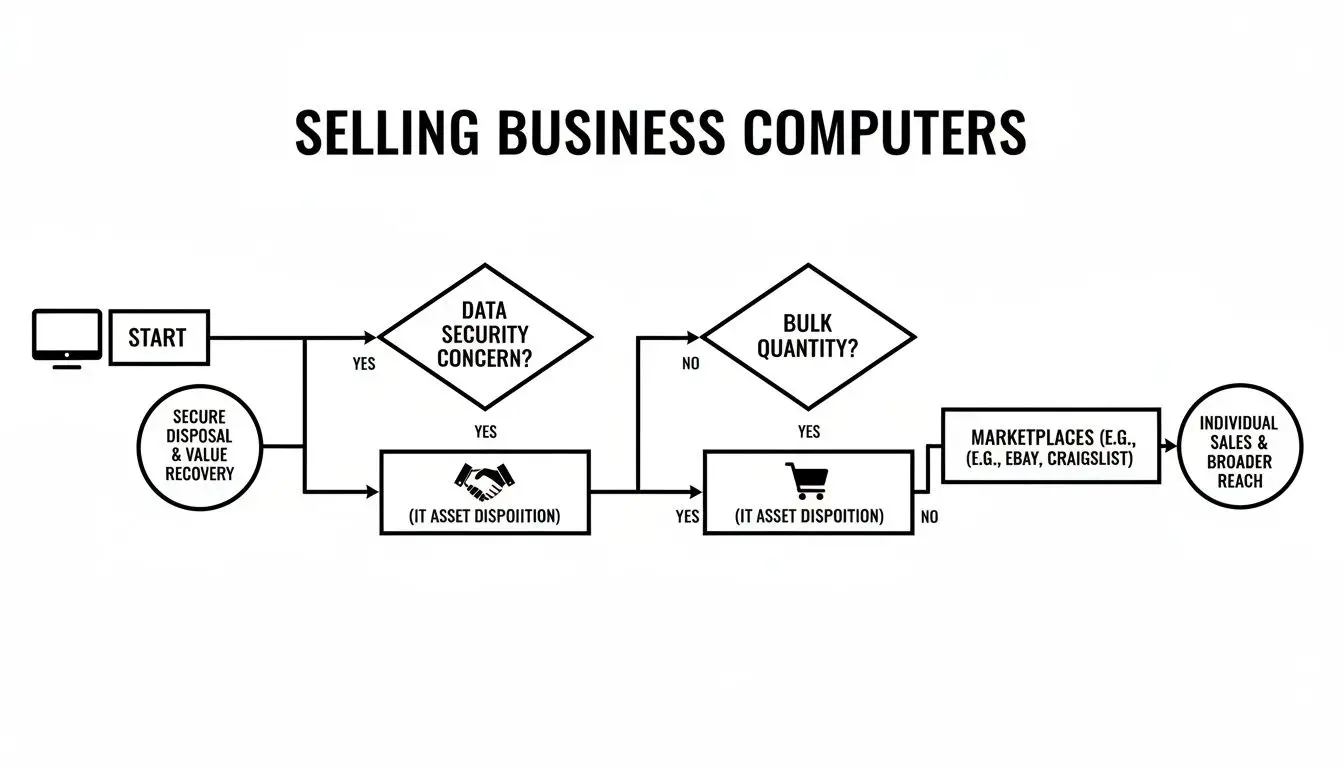
As the chart shows, the choice between an ITAD firm and a public marketplace is a trade-off between security, value, and convenience. To make this decision even clearer, the table below compares these options across the key factors that matter most to a business.
Comparing Your Options for Selling Used Business Computers
This table breaks down the most common methods for selling used business computers, highlighting the pros and cons for IT managers and business owners.
| Selling Option | Best For | Value Recovery | Data Security | Logistics | Compliance Support |
|---|---|---|---|---|---|
| ITAD Buyback Program | Businesses needing bulk disposal, guaranteed data security, and regulatory compliance. | Moderate to High | Very High (Certified) | Managed by Vendor | High (Certificates issued) |
| Online Marketplaces | Selling small quantities of high-value, recent-model computers. | Potentially High | Low (DIY, High Risk) | Self-Managed | None |
| Local Resellers | Quick sales of smaller batches of equipment with moderate value. | Low to Moderate | Varies (Often uncertified) | Self-Managed | Minimal to None |
Each channel has its place, but for commercial enterprises, the structured, secure, and compliant process offered by an ITAD partner provides the best balance of value and peace of mind.
How ITAD Buyback Programs Maximize Your Return
If your business is wondering where to sell its old computers, an IT Asset Disposition (ITAD) buyback program is the professional, industry-standard solution. This isn't just about selling a few devices; it's a comprehensive service designed to manage your entire technology lifecycle from start to finish in one secure, organized process.
Think of it as engaging a single, expert partner. They will evaluate your entire inventory of retired equipment, provide fair market value for valuable assets, and then responsibly manage the secure disposal of everything else.
This approach turns a logistical and security challenge into a revenue recovery opportunity. Unlike attempting to sell equipment on consumer platforms, ITAD specialists are equipped to handle hundreds or thousands of enterprise-grade laptops, servers, and network gear at once. The entire project—from pickup and logistics to certified data destruction—is managed under one roof.
The Valuation Process Unpacked
Every business wants to know, "What are my old computers actually worth?" An ITAD professional answers that by analyzing a combination of factors. These variables determine the fair market value and, ultimately, the financial return to your company.
Here are the primary drivers of value:
- Age and Generation: Newer equipment, typically within three to five years of its purchase date, retains the most value. A laptop with a 7th generation Intel Core i5, for example, is worth significantly less than a 12th generation model.
- Brand and Model: Enterprise-class equipment from major brands like Dell (Latitude, OptiPlex), HP (EliteBook, ProBook), and Lenovo (ThinkPad, ThinkCentre) consistently commands higher prices due to its reliability and strong demand on the secondary market.
- Configuration and Specifications: The internal components are critical. Devices with more RAM, larger Solid-State Drives (SSDs) instead of older Hard Disk Drives (HDDs), and higher-end processors will always fetch a better return.
- Condition and Completeness: Equipment that is functional, cosmetically clean, and complete with all parts (like power adapters) is far more valuable than damaged or incomplete assets.
- Quantity: A large, uniform lot of the same model often increases the total payout, as it simplifies the refurbishment and resale process for the ITAD vendor.
A professional ITAD partner will provide a detailed inventory report and a transparent quote based on these factors, giving you a clear picture of your potential return.
From Logistics to Payment A Seamless Workflow
The primary benefit of an ITAD buyback program is its efficiency. Instead of your IT team spending weeks wiping drives, cataloging gear, and negotiating with buyers, the ITAD provider manages the entire process. You can explore a more detailed breakdown of what to look for when you evaluate IT Asset Disposition companies.
A typical workflow looks like this:
- Initial Assessment: You provide an inventory list, and the ITAD partner gives you an estimated quote.
- Secure Logistics: The provider arranges for secure on-site packing and transport of all assets from your location.
- Auditing and Testing: Back at their secure facility, every device is tested, its specs are verified, and it’s graded for cosmetic condition.
- Certified Data Destruction: All storage devices undergo certified data sanitization that meets standards like NIST 800-88. You'll receive a Certificate of Destruction for your compliance records.
- Final Valuation and Payment: A final value is calculated based on the detailed audit, and payment is sent directly to your company.
This type of service is expanding as the secondary market grows. The global computer recycling market is projected to hit USD 13,634.26 million in 2025 and jump to USD 22,981.53 million by 2033. In North America, computers account for a massive 35% of the electronics recycling market value, creating more opportunities than ever to recover capital from retired IT assets. You can read more about the trends in the global computer recycling market to see the potential.
This process not only maximizes your financial return but also guarantees that your company's data is secure and that every piece of hardware is handled in an environmentally responsible manner.
Selling Manually Through Marketplaces and Resellers
It’s easy to see why some businesses consider selling their high-value computers individually. The prospect of achieving a higher price per unit on a platform like eBay or through a local reseller is certainly appealing.
However, this path trades the security and convenience of a professional service for a significant investment of your team's time and considerable risk. What starts as a simple idea quickly transforms a single transaction into dozens, or even hundreds, of separate projects. For any company with more than a few computers, the hidden costs often negate any potential financial gains.
The True Cost of a Do-It-Yourself Approach
When you decide to sell computers manually, the entire burden lands on your team. The process is much more than just posting a listing online; it's a detailed, step-by-step effort that must be repeated for every single computer.
Consider what this truly involves:
- Data Wiping: Your staff is now responsible for sanitizing every hard drive. This requires using certified software and methods to ensure data is irretrievable. A single mistake could lead to a catastrophic data breach.
- Testing and Inventory: Each machine must be tested, its specifications recorded, and its condition carefully graded. This is vital for creating an accurate sales listing but is incredibly time-consuming for a large batch of computers.
- Listing and Sales Management: You'll need to create detailed online listings for every device, complete with photos and descriptions. This is followed by fielding a constant stream of inquiries from potential buyers, many of whom are not serious.
- Packing and Shipping: After a sale is made, each computer must be packed securely to prevent damage and then shipped. This introduces its own set of logistical challenges, from calculating shipping costs to handling disputes if an item arrives broken.
For any business that handles sensitive corporate, customer, or employee data, the do-it-yourself sales model is a major security gamble. All liability for protecting that data remains with you until the buyer has the device in their hands—a risk that professional ITAD services are specifically designed to eliminate.
Data Security and Compliance: The DIY Gamble
The single greatest drawback to selling old computers yourself is the immense pressure it puts on your company to protect sensitive data. Professional ITAD providers like Beyond Surplus offer certified data destruction and provide a Certificate of Destruction, which legally transfers that liability away from you. When you sell on a marketplace, that liability is all yours.
If a hard drive isn't wiped correctly and sensitive files are later recovered, the consequences fall directly on your business. This includes heavy fines, legal action, and severe damage to your reputation.
This manual approach is almost never practical for businesses disposing of equipment at scale. While it might seem like a good way to get top dollar for a few high-end machines, the labor costs and security risks almost always outweigh the benefits. If you're weighing your options, our article on who buys used computers provides more detail on the different types of buyers.
Ultimately, for any organization that prioritizes security, compliance, and efficiency, partnering with a professional ITAD provider is the only logical choice.
Why Secure Data Destruction Is Non-Negotiable
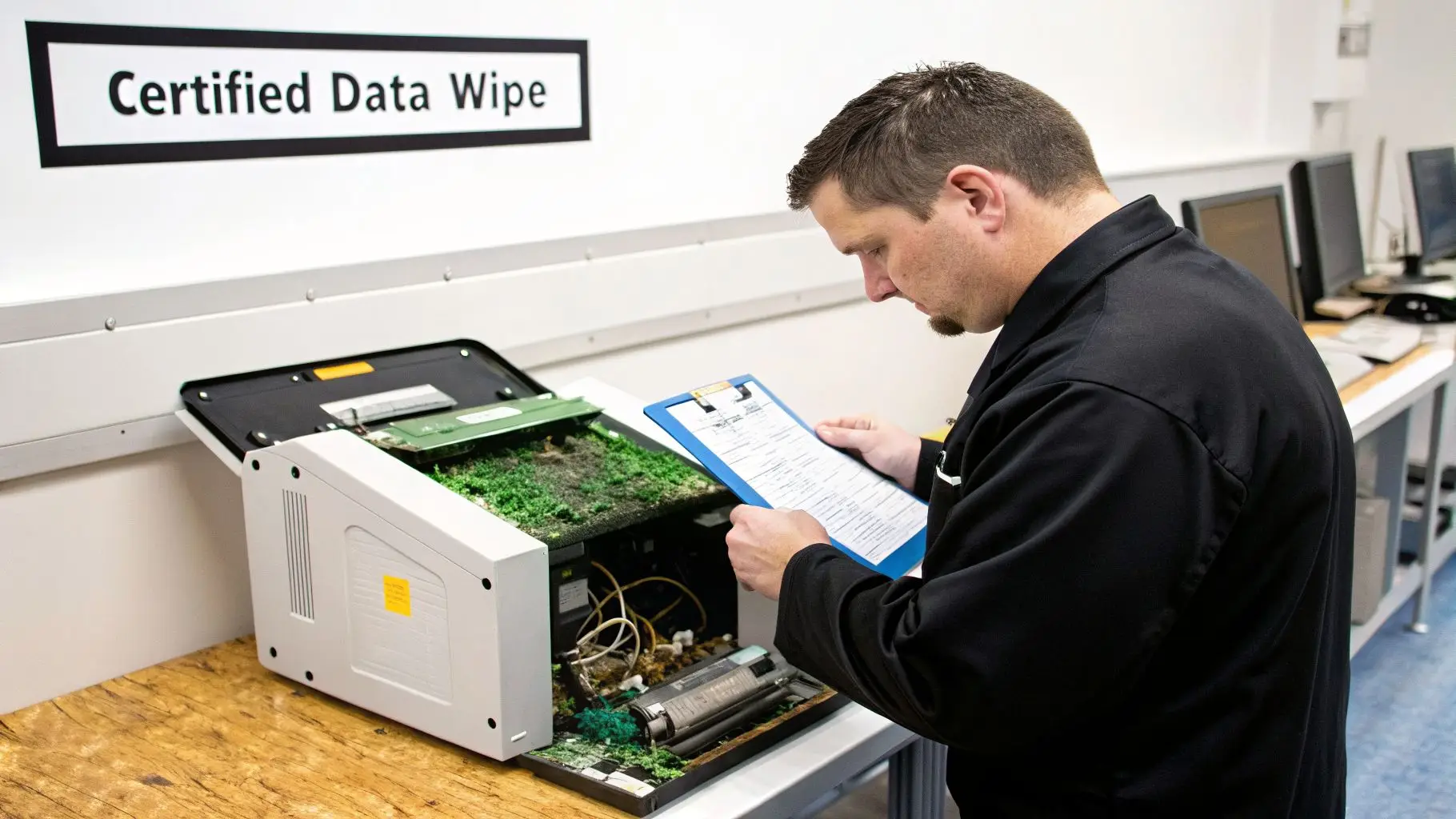
Before your business sells a single old computer, it is critical to address the most important step in the entire process: data security. Handing over used IT hardware without completely destroying the data is like giving away your company's filing cabinets without shredding the sensitive documents inside. It’s a massive liability that no organization can afford.
Many people mistakenly believe that formatting a hard drive or deleting files is sufficient. That is a dangerous assumption. A standard "delete" command only removes the pointer to the data, leaving the actual files behind and easily recoverable with simple software. For a business, that is not a security plan—it’s a data breach waiting to happen.
Professional data destruction is the only way to ensure your company's private information does not become a public headline. This involves methods that either repeatedly overwrite the entire drive with random data or physically destroy the drive itself.
The Gold Standard of Data Sanitization
The industry benchmark for permanent data eradication is the NIST 800-88 standard, issued by the National Institute of Standards and Technology. This framework provides clear guidelines for media sanitization, categorizing it into three levels: "Clear," "Purge," and "Destroy."
- Clear: This method uses software to overwrite data in all user-addressable locations. It is often effective but not suitable for highly sensitive information, as sophisticated laboratory equipment could potentially recover some data.
- Purge: This level uses physical or logical techniques that make data recovery infeasible, even with the best lab tools. Methods include overwriting, block erasing, and cryptographic erasure.
- Destroy: This is the ultimate security method. It renders the storage media completely unusable by disintegrating, pulverizing, melting, incinerating, or shredding it into tiny pieces.
For any business subject to compliance regulations, achieving the "Purge" or "Destroy" levels of NIST 800-88 is not just a best practice—it’s mandatory. If you want to better understand these protocols, you can learn more about how Beyond Surplus implements the NIST SP 800-88 standard.
Chain of Custody and Your Proof of Compliance
How do you prove that data was handled securely and destroyed after you hand over your old computers to a vendor? This is where two critical elements come into play: the chain of custody and the Certificate of Data Destruction.
A secure chain of custody is a paper trail that documents every touchpoint your assets go through, from the moment they leave your office until final disposition. It tracks who handled the equipment, where it was, and the actions performed. This unbroken accountability is key to demonstrating due diligence.
Once the data sanitization process is complete, a certified ITAD partner like Beyond Surplus issues a Certificate of Data Destruction. This is a legally binding document that serves as your official record and proof that your data was destroyed according to industry standards.
This certificate is your ultimate protection. It officially transfers the liability for the data from your company to the ITAD vendor. Without this documentation, your business remains liable if a data breach occurs later.
The consequences for failing to properly destroy data can be devastating and often include:
- Financial Penalties: Fines for non-compliance with regulations like HIPAA, the FTC Disposal Rule, or GDPR can easily reach millions of dollars.
- Reputational Damage: A public data breach can shatter customer trust and cause permanent harm to your brand.
- Legal Action: Your company could face lawsuits from customers, employees, or partners whose information was exposed.
When you're evaluating where to sell old computers, a simple promise of data destruction is not enough. You need a partner who provides a documented, certified, and auditable process that protects your business from every angle. It’s the one step you cannot negotiate, ensuring your asset disposal project is a secure success, not a future liability.
Managing Computers with No Resale Value
Not every retired computer is a valuable asset. So, what happens when your business is ready to sell old computers, only to discover they have zero resale value? This is a common situation with aging, damaged, or obsolete hardware. However, simply disposing of them in a dumpster is never the correct or legal option.
Improperly disposing of these zero-value assets is not just environmentally harmful; it’s often illegal. Strict local and federal e-waste regulations are in place for a reason. These devices contain hazardous materials like lead and mercury, and their hard drives can still hold sensitive data that is surprisingly easy to recover. This is where certified electronics recycling becomes a non-negotiable part of any responsible IT asset disposition strategy.
The Role of Certified Electronics Recycling
Certified electronics recycling is the process of safely and securely dismantling IT equipment that has reached the end of its useful life. Instead of ending up in a landfill, these assets are broken down into their base materials—such as plastics, metals, and glass—which are then reintroduced into manufacturing to create new products.
A certified recycler provides documentation to prove every device was handled in full compliance with environmental laws. This paper trail is crucial for protecting your business from hefty fines and the reputational damage associated with improper disposal. To see what that process looks like in detail, check out our guide on how to properly recycle a computer.
This responsible approach is more critical than ever. Globally, e-waste is projected to exceed 60 million metric tons in 2025, yet documented recycling rates are expected to fall to just 20% by 2030. The US generated 6.92 million metric tons of e-waste in 2021, but only 15% was verifiably recycled. These statistics highlight the urgent need for certified partners to handle these assets correctly. You can discover more about the growing e-waste challenge and see why professional services are so vital.
The True Value of an Integrated ITAD Partner
This is where engaging a comprehensive ITAD partner like Beyond Surplus provides significant value. Dealing with zero-value assets should not be a separate, complicated task. A true ITAD provider handles your entire inventory—the valuable, the non-valuable, and the obsolete—in one streamlined process.
This integrated approach means:
- One Vendor, One Process: The same partner purchasing your valuable equipment will also responsibly recycle your worthless items.
- Simplified Logistics: You avoid the complexity of managing multiple vendors for buybacks, recycling, and data destruction.
- Guaranteed Compliance: Every asset, regardless of its value, is handled securely, compliantly, and in an environmentally sound manner.
By partnering with a full-service ITAD firm, your business transforms a complex disposal problem into a single, managed transaction. You receive payment for what’s valuable and get certified proof that everything else was recycled responsibly, all with one pickup.
Making Pickup and Logistics Run Smoothly
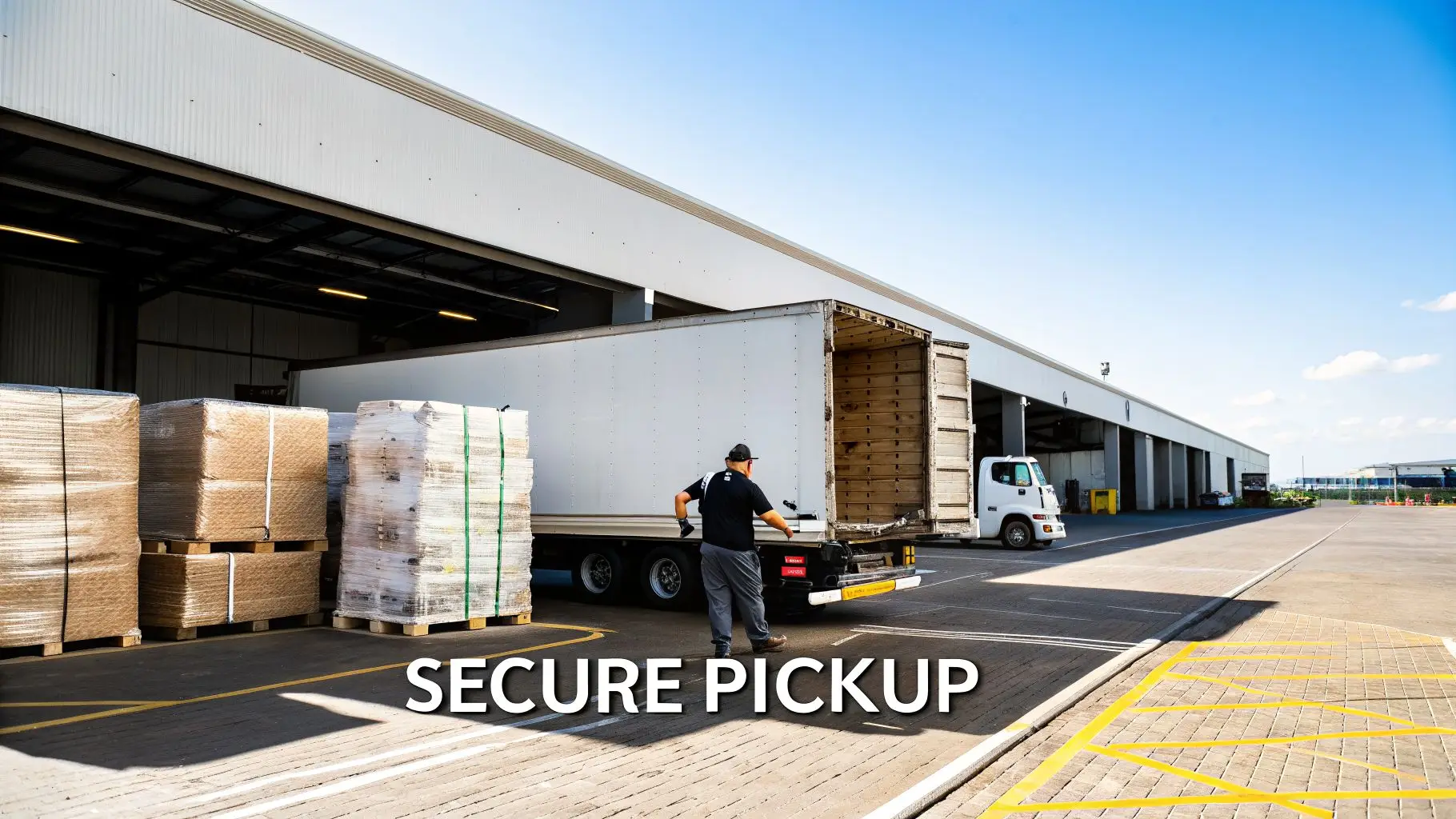
Transporting a large volume of old computers from your office to a processing facility is a greater challenge than it appears. This final logistical phase is where many businesses falter, underestimating the complexity of moving bulk IT equipment securely and efficiently. It’s far more involved than calling a standard freight company; it requires a meticulous process to protect your assets and data from the moment they leave your premises.
The journey begins with on-site inventory and de-installation. A professional ITAD service can dispatch a team to your location to disconnect servers, desktops, and networking gear. This crucial step ensures every asset is accounted for before it is moved. For larger projects, using one of the best WMS systems can dramatically improve how you handle and track IT assets from pickup to final disposition.
Why Secure Transportation Matters
Once inventoried, the equipment must be securely palletized. This involves carefully stacking the gear, shrink-wrapping it, and preparing it for transport in a manner that prevents damage. The most critical decision is selecting a transportation partner. Relying on third-party freight carriers introduces a significant security risk, as they rarely have the specialized protocols needed for handling sensitive IT hardware.
This is precisely why partnering with an ITAD provider like Beyond Surplus, which operates its own nationwide logistics, is a game-changer. A dedicated fleet and trained staff eliminate the vulnerabilities associated with handing valuable assets to unvetted carriers. This approach creates a seamless, secure chain of custody from your facility directly to the processing center.
A secure chain of custody isn't just about moving boxes; it's about having documented, verifiable control over your assets at every stage. When an ITAD provider uses its own trucks and staff, the number of handoffs is minimized, drastically reducing the chances of data exposure or asset loss.
White-Glove Services for More Complex Jobs
For more complicated projects, such as a data center decommissioning or office liquidation, white-glove removal services transform a massive physical task into a smooth, fully documented handoff. This premium service includes:
- On-site de-installation: Safely disconnecting and removing all equipment from racks and workstations.
- Professional packing: Using appropriate materials to protect sensitive electronics during transit.
- Secure transport: Moving assets in dedicated, GPS-tracked vehicles.
- Detailed documentation: Providing serial-numbered reports that confirm every item was received.
The electronics recycling market is on track to hit USD 22,210 million in 2025, with computers comprising about 35% of that value, largely driven by enterprise IT refreshes. For businesses in the US, which face strict disposal rules and export bans, professional logistics and certified recycling are not just best practices—they are absolutely essential for managing large-scale asset retirement without risking penalties.
By choosing an ITAD partner that manages its own logistics, you can be confident that your old computers are moved securely, compliantly, and with full accountability from start to finish.
Frequently Asked Questions About Selling Old Computers
If you are responsible for selling your company's old IT hardware, you likely have questions about maximizing value, ensuring data security, and managing logistics. We frequently hear the same questions from IT managers and business owners. Obtaining clear answers is the first step toward making a smart, confident decision about where to sell your old computers.
What Types of Computers Have the Best Resale Value?
You will typically find the highest resale value in business-class laptops and desktops from major brands like Dell, HP, and Lenovo. Equipment that is 3-5 years old is generally in the "sweet spot," as it remains powerful enough for many modern business applications.
Several factors can affect the final price:
- Configuration: Computers with more RAM, larger Solid-State Drives (SSDs), and faster processors will always be worth more.
- Condition: A complete, working system with only minor cosmetic wear will fetch a much better price than a broken or incomplete one.
- Enterprise Gear: Do not overlook other assets. Enterprise-grade equipment like servers, networking switches, and storage arrays can also be very valuable on the secondary market.
A professional ITAD partner can provide an exact valuation after auditing your specific inventory.
Is It Better to Sell Our Computers in Bulk or Individually?
For almost any business, selling used computers in bulk to a certified ITAD company is the most prudent approach. While you might achieve a higher price per machine on sites like eBay, that method incurs significant hidden costs in labor, time, and serious security risks.
If you attempt to sell everything individually, your team is suddenly responsible for:
- Securely wiping the data on every single device.
- Testing, photographing, and creating detailed listings for each computer.
- Answering inquiries from dozens of potential buyers.
- Packing and shipping every single order.
Most importantly, the DIY route places all responsibility for data security and compliance squarely on your shoulders. A single mistake could lead to a costly data breach. An ITAD partner manages everything in one secure process, provides certified data destruction, and handles all logistics, yielding a strong net return without the associated risks.
How Can I Guarantee My Company's Data Is Destroyed?
The only way to be absolutely certain your company’s sensitive data is permanently destroyed is to work with a certified ITAD vendor who provides a Certificate of Data Destruction. This legal document is your official proof that all data was destroyed according to strict standards like NIST 800-88.
Reputable partners will offer secure options like on-site physical shredding or certified software wiping. Simply formatting a hard drive is not sufficient—data can still be recovered with basic software. That certificate is your key to proving compliance and transferring liability away from your organization.
What Should I Do with Computers That Are Too Old to Sell?
Even if your old computers have no remaining resale value, you must still dispose of them responsibly to comply with environmental laws and protect your data. These devices are filled with hazardous materials like lead and mercury, and their hard drives could still contain sensitive information.
Disposing of them in a dumpster is often illegal and is always environmentally irresponsible. The best course of action is to work with a certified electronics recycler who will ensure the devices are handled ethically and all data is securely destroyed. A good ITAD partner will manage both your valuable and zero-value assets in a single pickup, making the entire end-of-life process simple and straightforward.
When your Atlanta business needs a trusted partner for commercial electronics recycling and IT asset disposal, Beyond Surplus provides a secure, compliant, and profitable solution. We offer certified IT asset disposition services, including buyback programs and secure e-waste management for companies across the United States. Contact Beyond Surplus today to get a quote for your used IT equipment.