
Retired laptops under a desk. A rack of decommissioned servers waiting in a back room. Network switches boxed after a refresh. Most companies treat that pile as a cleanup project.
It isn’t.
For a business, e-recycle is part of a larger control process around data exposure, hazardous material handling, audit readiness, and value recovery. If old equipment sits too long, risk compounds. Drives still hold data. asset records go stale. Equipment loses resale value. Internal teams lose chain-of-custody clarity.
Your Storeroom of Old Tech is a Strategic Liability
An overloaded storeroom usually means one of three things is happening. IT is too busy to process retired assets, leadership is waiting for a one-time purge, or no one wants to make the wrong call on data-bearing equipment.
That hesitation is understandable. It’s also expensive in ways that don’t show up on a simple disposal invoice.
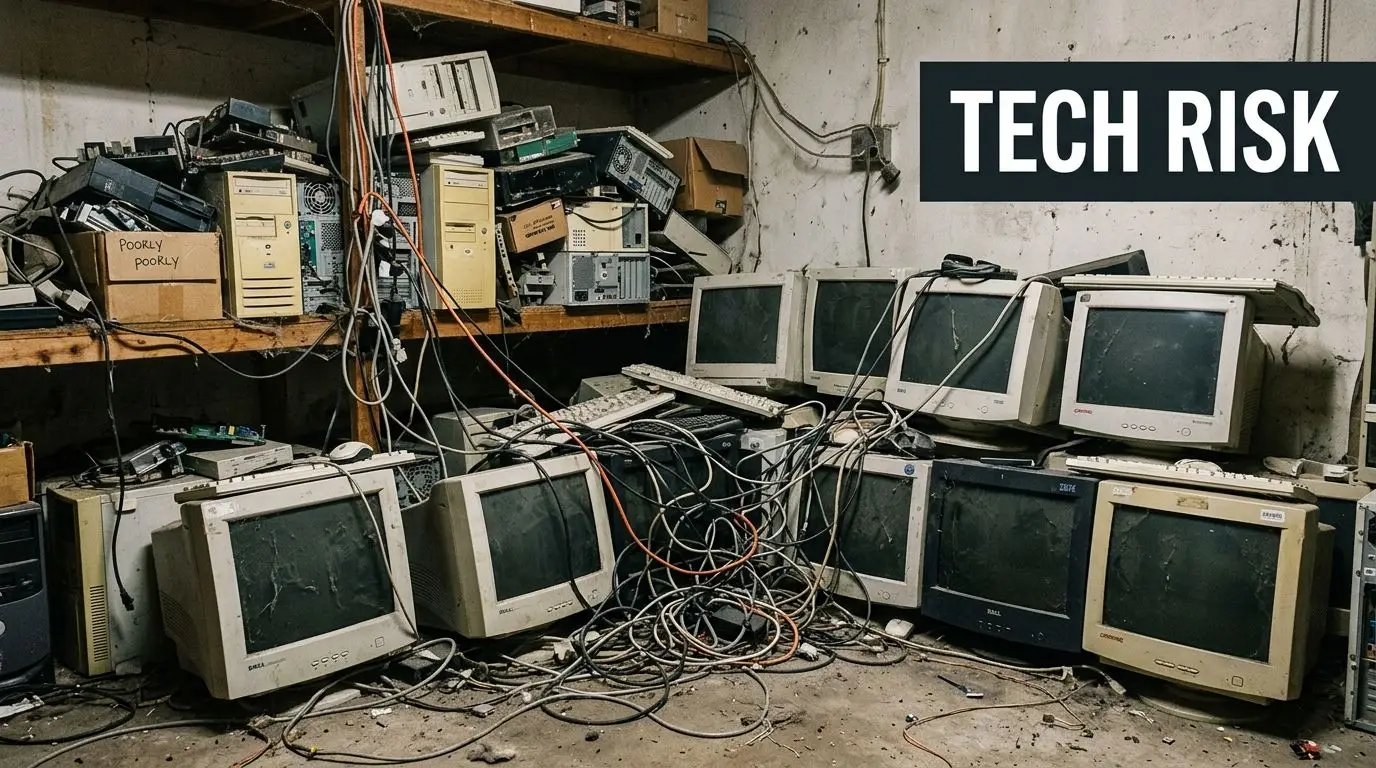
What looks like clutter is concentrated risk
Every retired device creates multiple obligations at once. Someone has to verify ownership, confirm whether data remains, determine reuse potential, and document final disposition. If any step is informal, the business keeps the liability.
Global volume shows why this can’t be treated casually. Global e-waste is projected to reach 82 million tonnes by 2030, a 32% increase from 2022, and the official recycling rate is expected to fall to 20% according to global e-waste projections. That’s not just an environmental signal. It tells business leaders that disposal pressure is rising faster than formal processing capacity.
Why e-recycle alone is too narrow
The phrase “e-recycle” sounds simple. For commercial environments, it’s incomplete. Recycling is only one endpoint. Before any material recovery happens, a business has to control data, document custody, and decide whether equipment should be redeployed, resold, destroyed, or broken down.
A better starting point is to treat retired electronics as regulated assets, not trash.
Practical rule: If a device ever touched customer data, employee data, financial records, health information, or internal credentials, it should move through a documented disposition workflow, not a general recycling pickup.
That’s why many organizations move from ad hoc recycling to a formal e-waste recycling process for business assets. The point isn’t just to be green. The point is to reduce uncertainty.
Understanding the IT Asset Disposition Framework
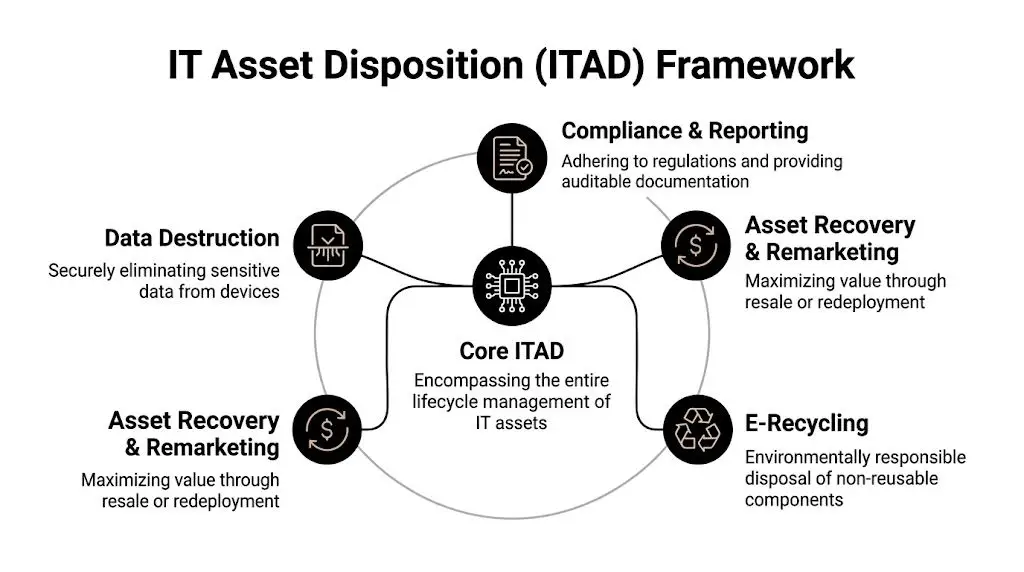
IT Asset Disposition, or ITAD, is the business framework that turns e-recycle into an auditable operational process. Recycling sits inside ITAD. It does not replace it.
The four parts that matter
Most business projects break into four tracks:
- Secure logistics means assets are inventoried, packaged, moved, and received under documented control.
- Data destruction covers wiping, shredding, or other approved sanitization methods based on device type and policy.
- Asset recovery determines whether equipment should be refurbished, redeployed, or sold into secondary markets.
- Responsible recycling handles anything that has no reuse path or fails testing.
Why this distinction changes decisions
If a company asks only for e-recycle, it often skips the higher-value questions. Is that server still marketable? Can those laptops be wiped and resold? Should failed drives be shredded on-site while chassis move off-site for processing? A narrow recycling request tends to flatten all assets into one category.
That creates two common mistakes:
- Functional equipment gets destroyed too early.
- Data-bearing assets leave the site without enough documentation.
Compliance sits over all of it
A mature ITAD program is built around records. You want serialized inventory, disposition status, data destruction records, and final reporting that an auditor can follow without guesswork.
Strong ITAD programs don’t rely on verbal assurances. They rely on documents that connect each asset to a final outcome.
If your team needs a clearer baseline, this overview of what IT asset disposition includes is the right framing. It separates recycling from the larger controls that protect the organization.
The End-to-End Secure ITAD Process
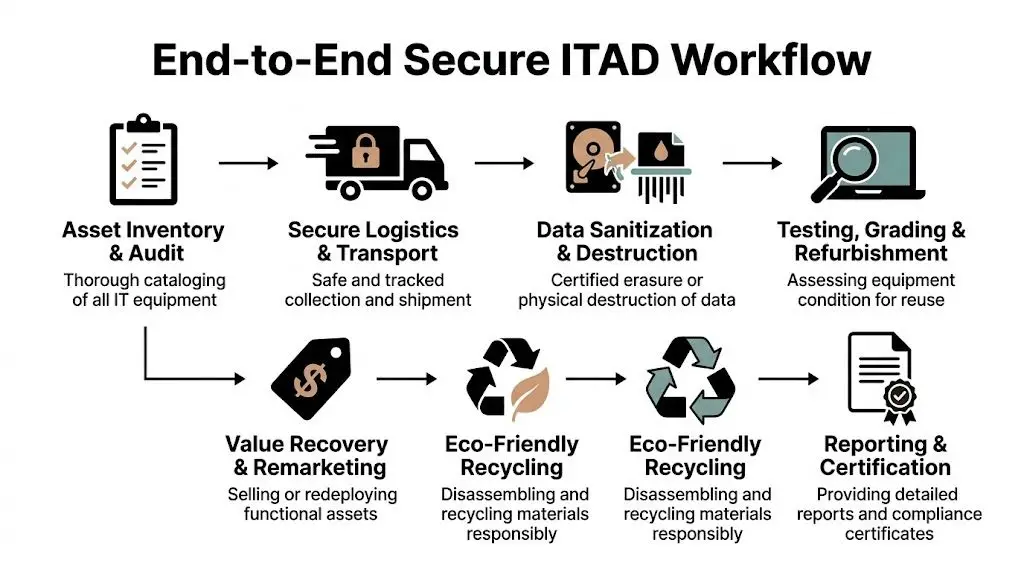
When clients ask what happens after pickup, they usually want one answer: can we prove every asset was handled correctly? A secure ITAD workflow is built to answer that.
Intake and chain of custody
The process starts before a truck is loaded. Assets should be inventoried by type, quantity, and where possible by serial number. Pickup paperwork should match what leaves the facility.
From there, chain of custody matters more than speed. Containers, pallets, or loose equipment should move under documented transfer. If a provider can’t explain who had possession at each step, the process is weak.
Data destruction comes before downstream value decisions
Devices are then triaged by media type and risk level. Some equipment can be sanitized and reused. Some requires physical destruction. Some needs both internal policy review and legal signoff.
Here’s a practical comparison.
| Method | Process | Security Level | Best For |
|---|---|---|---|
| Data wiping | Software-based erasure following approved standards | High when supported by verification | Reusable laptops, desktops, servers, and storage media that pass wipe requirements |
| Degaussing | Magnetic disruption of data on compatible media | High for applicable magnetic media | Legacy magnetic media where reuse is not required |
| Physical shredding | Drives or media are mechanically destroyed | Highest for final destruction | Failed drives, highly sensitive data, and policy-driven destruction workflows |
Teams that align their sanitization decisions to NIST SP 800-88 data destruction guidance usually avoid the biggest mistake in e-recycle projects, which is using one destruction method for everything.
Testing and grading separate value from scrap
After sanitization, reusable equipment gets tested. This step sounds routine, but it decides whether assets become revenue or commodity material. Enterprise servers, late-model laptops, networking gear, and some specialized hardware can still carry resale value if they’re complete, functional, and marketable.
Failed or obsolete items move into recycling streams instead.
If a provider can’t explain how they grade equipment for reuse versus scrap, they’re probably leaving value on the table or applying inconsistent standards.
Mechanical recycling is more technical than most buyers realize
Commercial recycling isn’t just “shred and sort.” Advanced facilities use large magnets to extract ferrous metals and eddy current systems to separate nonferrous metals like aluminum and copper, which helps produce material streams suitable for remanufacturing, as described in earth.org’s explanation of e-waste recycling technology.
That matters in data center work. Deinstalled racks often include heavy steel enclosures, copper-rich cabling, power components, and aluminum heat sinks. Recovery quality depends on how well those materials are separated after proper preprocessing.
Final reporting closes the loop
At the end, the client should receive a package of records, not a vague confirmation email. That package typically includes inventory reconciliation, data destruction documentation, and recycling or downstream disposition records.
The strongest workflows are boring in the best way. Every asset has a path. Every path has a record. Every record supports an audit.
Navigating Compliance and Transferring Liability
The business case for professional e-recycle becomes strongest when legal exposure enters the conversation, a point at which many internal cleanout efforts fall apart.
Liability doesn’t end when equipment leaves the building
If a company discards hardware containing sensitive data or hazardous components without proper handling, the problem doesn’t belong only to the hauler or downstream processor. Regulators and litigators look at what the original owner knew, required, and documented.
That’s why certificates matter. They are evidence that the business used a process designed to meet data security and environmental obligations.
Hazardous components raise the stakes
E-waste can contain up to 1,000 different substances, including neurotoxicants like lead and mercury. Certified ITAD providers are required to perform de-manufacturing to remove hazardous components before shredding, which prevents contamination and transfers legal liability from the client, according to the WHO fact sheet on electronic waste).
This point gets missed in many boardroom discussions. Companies often focus on the hard drive and ignore the environmental chain. But if a recycler handles batteries, boards, or mercury-containing components improperly, your vendor selection process becomes part of the story.
What to insist on
For compliance-heavy sectors, the baseline should include:
- Documented data destruction tied to assets or batches
- Chain-of-custody records from pickup through processing
- De-manufacturing controls for hazardous components
- Certificates that support internal audits and external inquiries
A proper certificate of destruction isn’t a marketing extra. It’s part of your due diligence file.
The real product in certified ITAD is not transportation or shredding. It’s defensible documentation that shows your organization acted responsibly.
Turning Retired IT into a Revenue Stream
Many finance teams assume e-recycle is a pure expense. That’s only true when every asset is treated like scrap.
Reuse beats commodity recovery when the asset qualifies
The best value recovery happens before material processing. If equipment is still functional, complete, and commercially viable, refurbishment and remarketing usually outperform raw material recovery. That’s why triage matters so much.
In practical terms, the strongest candidates are often:
- Recent laptops and desktops with marketable specs
- Enterprise servers removed during refresh cycles, not after catastrophic failure
- Networking gear with current demand in secondary channels
- Bulk homogeneous lots that are easier to test, image, and resell
Buyback and revenue share are different models
Some providers purchase assets outright. Others process, sell, and return a share of proceeds after fees. Neither model is automatically better. The right one depends on your accounting preference, asset mix, and tolerance for timing.
A buyback gives certainty. Revenue share may return more on strong equipment, but it also depends on market conditions and grading discipline.
Ask how value is preserved
Residual value drops fast when equipment sits in storage, loses components, or arrives without chargers, rails, caddies, or matching accessories. The organizations that recover more value usually do three things well:
- Retire on schedule instead of warehousing for years
- Keep asset sets complete so resale is simpler
- Separate reusable assets from destruction-only lots before pickup
For organizations that want a dedicated resale path, asset recovery services in Georgia are one example of how providers structure buyback and remarketing around secure disposition controls.
How to Select a Certified ITAD Partner
A vendor can sound credible and still expose your business. Selection should come down to proof, process, and transparency.

Why trust is the real issue
US organizations aren’t wrong to hesitate. In the US, 31% of people admit to hoarding electronic clutter, and over 50% keep unused devices, often because of data-breach fears and a lack of trustworthy recycling options, according to analysis of electronic clutter and recycling barriers. In business settings, that same hesitation shows up as locked closets full of retired assets.
The answer isn’t blind trust. It’s a vetting process.
Questions worth asking in every bid review
- What certifications do you hold for recycling and downstream management?
- How do you document chain of custody from pickup through final disposition?
- Which data destruction methods do you offer, and when do you recommend each one?
- Do you provide serialized reporting, batch reporting, or both?
- How do you manage downstream vendors for commodities and specialized material streams?
- What insurance coverage applies to transport, data incidents, and environmental claims?
- Can you support multi-site pickups under one reporting structure?
Red flags buyers should take seriously
Low price by itself is not a win if the process is vague. Be cautious if a provider:
- avoids detailed answers about downstream handling
- can’t explain how failed drives are controlled
- offers “recycling certificates” without inventory support
- mixes business disposition with a generic public drop-off model
- treats all equipment as scrap without discussing remarketing
One commercial option is Beyond Surplus, which provides business pickup, secure data destruction, asset recovery, and certificates tied to documented processing. That kind of scope matters because clients often need one partner that can handle both value recovery and destruction-only assets under the same chain of custody.
Choose the provider that gives your security team, legal team, and finance team enough evidence to say yes for different reasons.
Frequently Asked Questions for Business E-Recycling
What’s the difference between on-site and off-site hard drive shredding
On-site shredding destroys media at your facility, so your team can witness the process before assets leave the premises. Off-site shredding happens in a secure processing environment after documented transport. Both can be appropriate. The choice usually depends on internal policy, sensitivity of the data, and whether witness requirements matter.
Can our company get paid for old IT equipment
Yes, if the equipment still has residual market value. Functional laptops, servers, storage, and networking gear often qualify for buyback or remarketing programs. Equipment that is obsolete, incomplete, damaged, or locked into destruction-only policy usually moves to recycling instead.
How should we handle multi-location pickups
Use one ITAD provider that can coordinate logistics under a unified reporting model. That keeps chain of custody, destruction records, and final certificates consistent across offices, clinics, warehouses, and data centers. Fragmented local pickups create reporting gaps.
What documents should we expect after processing
At minimum, expect an asset inventory or reconciliation report, a certificate of data destruction where applicable, and a certificate of recycling or disposition. If the project includes resale, ask for reporting that distinguishes remarketed assets from recycled assets.
Is wiping enough, or should we always shred drives
Neither method is automatically right for every asset. Wiping is appropriate when media can be sanitized to your standard and the asset still has reuse value. Shredding is the better fit for failed media, highly sensitive environments, or policies that require physical destruction.
What’s the biggest mistake companies make with e-recycle
Waiting too long. Delay reduces resale value, weakens inventory accuracy, and increases the odds that untracked devices remain in storage without clear ownership or final disposition records.
If your organization needs a documented path for secure electronics recycling, data destruction, and IT asset recovery, contact Beyond Surplus to discuss a compliant e-recycle and ITAD program built around chain of custody, certificates, and liability transfer.