
For business owners and IT managers in Atlanta, GA, that stack of old servers, laptops, and hard drives in your storage closet isn't just taking up space—it's a ticking time bomb. Each retired device represents a potential multi-million dollar liability for your enterprise. It’s a hidden risk that can unravel a company's security, compliance, and reputation if not handled with absolute precision through professional IT asset disposal (ITAD) services.
Neglecting proper disposal is a direct path to a catastrophic data breach.
The Hidden Risk in Your Retiring IT Assets
Every piece of retired IT equipment, from a data center server to a single corporate smartphone, contains a history of sensitive information. Customer lists, financial records, intellectual property, and employee data remain on these devices long after they are decommissioned by your business.
Simply deleting files or reformatting a hard drive creates a dangerous illusion of security. The reality is, that underlying data is often easily recoverable with basic software tools.
This lingering data is a prime target for bad actors. A single forgotten hard drive that ends up in the wrong hands can lead to devastating consequences. The story is all too common: a company disposes of old computers, assuming they are clean, only to find their confidential data for sale on the dark web months later.
The fallout extends far beyond the initial breach.
The Staggering Cost of Inaction
When a data breach happens, the financial and reputational damage can be immense. Beyond the immediate cost of fixing the problem, businesses face regulatory fines, legal fees from lawsuits, and a long-term loss of customer trust that’s nearly impossible to win back.
Understanding the numbers makes the risk crystal clear. The costs aren't theoretical; they are real, documented, and growing every year. Professional data destruction is an investment in protecting your bottom line.
The Financial Impact of a Data Breach (2026)
| Metric | Global Average Cost | Financial Sector Cost |
|---|---|---|
| Per Incident | $5.00 million | $6.25 million |
| Per Record | $175 | $250 |
| Post-Breach Impact | 2-3 years | 3+ years |
These figures show why secure disposal is a fundamental part of modern business security. The cost of prevention is a tiny fraction of the cost of a single incident.
Ignoring end-of-life data is no longer a viable option. The question isn't if a breach will happen with improper disposal, but when—and how much it will cost. Secure data destruction is not an IT expense; it's a fundamental pillar of corporate risk management.
To get a handle on the vulnerabilities in your retiring IT assets, a great starting point is this complete guide to risk security management. It can help you identify and mitigate threats across your organization, including those tied to data.
Understanding the security risks of delayed data destruction is the first step toward building a solid IT asset disposition (ITAD) strategy. This guide will provide a clear path forward, explaining the methods, compliance rules, and how to choose the right partner to turn that ticking time bomb into a neutralized, documented, and secure asset.
Understanding Secure Data Destruction Methods
So, you’ve decided to retire your old IT assets. Great. But now comes the most important part: making sure the sensitive data on them is gone for good. This isn't just about hitting "delete." We're talking about certified, professional methods that leave no trace behind for your business.
Choosing the right approach depends on your company's risk tolerance, any compliance rules you have to follow, and what you plan to do with the physical hardware afterward.
Think of it like this: you have a top-secret document you need to get rid of. You could meticulously white-out every word, use a powerful chemical to dissolve the ink, or just feed it into a cross-cut shredder. Each method works, but you wouldn't use them interchangeably. The same goes for your data.
The path from old, forgotten IT gear to a full-blown data breach is shorter than you think. It's a direct line to serious financial and reputational damage, which is why getting destruction right is non-negotiable for commercial and enterprise clients.

As you can see, retired equipment sitting in a closet is a ticking time bomb—a direct vulnerability that can lead to devastating business consequences.
Data Wiping or Erasure
Data wiping, often called data erasure, is the digital equivalent of scrubbing a drive clean. It’s a software-based process that overwrites every single bit of a hard drive with random ones and zeros. This isn't a one-and-done pass; it's repeated multiple times to meet strict standards like NIST 800-88.
Just deleting a file or formatting a drive is a huge mistake. That only removes the roadmap to the data, leaving the information itself perfectly intact and easy to recover. Certified wiping, on the other hand, completely sanitizes the drive, making the original data impossible to get back.
This method is perfect for:
- Asset Reuse and Resale: Wiping keeps the hard drive physically intact and functional. This means it can be safely resold, donated, or redeployed, helping your enterprise recover value from your old IT assets.
- Leased Equipment: If you're returning leased computers, you're often required to return them in working condition. Wiping lets you meet that contractual obligation without handing over your company’s data.
- Internal Redeployment: Need to move a computer from the finance department to marketing? A secure wipe ensures no sensitive information accidentally goes with it.
Degaussing
Degaussing is the heavy-hitter for magnetic storage like traditional hard disk drives (HDDs) and old-school data tapes. This process zaps the device with an incredibly powerful magnetic field, which completely scrambles and neutralizes the magnetic particles on the drive's platters where your data lives.
Imagine holding a giant industrial magnet next to a cassette tape. The recording is instantly garbled into useless noise. That's degaussing. The drive is toast—completely inoperable—but the data is gone forever. Keep in mind, this only works on magnetic media; it has no effect on solid-state drives (SSDs). You can learn more about degaussing in our detailed guide.
Degaussing offers absolute certainty for destroying data on magnetic drives. While it destroys the hardware, it ensures the data can't be put back together by any known forensic technology.
Physical Destruction or Shredding
When you need undeniable, visual proof that your data is gone, nothing beats physical destruction. We’re talking about industrial-grade shredders that pulverize hard drives, SSDs, smartphones, and other devices into tiny, confetti-like fragments.
This is the ultimate security measure. There's no reassembly, no high-tech recovery attempt—just a pile of metal and plastic. It's the most definitive end for a piece of data-bearing media.
Shredding is the go-to choice for:
- Maximum Security Needs: If you're in finance, healthcare, or government, or you're protecting priceless intellectual property, shredding provides peace of mind that no other method can.
- Damaged or Obsolete Media: Got a drive that's already dead and can't be powered on to be wiped? Shredding is the only way to guarantee the data is destroyed.
- End-of-Life Assets: When hardware has zero resale value and your only goal is eliminating risk, shredding is the most direct and efficient path.
Working with a certified partner like Beyond Surplus ensures that whichever method you choose is done right. You'll get a Certificate of Destruction as a legal record, proving you met your compliance and due diligence obligations.
Navigating Data Privacy and Disposal Regulations
For any business that handles sensitive information, proper data destruction isn't just a good idea—it's the law. Letting retired IT assets pile up without securely wiping them can open the door to massive fines and legal trouble. Figuring out the rules for data disposal is a critical job for any company serious about managing risk.
These aren't just empty legal threats; they have real teeth. A single mistake can cost millions and permanently tarnish your company's reputation. Getting a handle on these regulations is the first step toward building an IT asset disposition (ITAD) plan that will stand up to scrutiny.
The Key Regulations Your Business Must Know
Several federal laws form the backbone of data privacy and disposal requirements. While this isn't a complete list, these are the heavy hitters that most businesses need to pay close attention to when retiring old electronics.
- Health Insurance Portability and Accountability Act (HIPAA): This law is the gold standard for protecting sensitive patient health information (PHI). If you're a healthcare provider, insurer, or one of their business partners, HIPAA requires that PHI on old computers, servers, or medical devices be made completely unreadable and impossible to recover. Just deleting the files is a clear violation—you need certified destruction.
- The FTC Disposal Rule: As part of the Fair and Accurate Credit Transactions Act (FACTA), this rule affects almost any business that deals with consumer credit information. It requires companies to take "reasonable measures" to prevent unauthorized access to this data. The FTC considers physical destruction (like shredding) or certified data wiping to be reasonable measures.
- Sarbanes-Oxley Act (SOX): Publicly traded companies have to follow SOX, which mandates strict controls over all financial records. This rule extends to how you dispose of digital records on company hardware. Proper data destruction ensures that financial data can't be leaked, which protects the integrity of your reporting and helps prevent fraud.
These regulations create a powerful legal and financial reason to use professional secure data destruction services. The rules are only getting tighter, especially with global standards like GDPR and state-level laws like the CCPA adding more pressure. This intense focus on privacy has turned secure data destruction into a vital compliance tool for everyone from banks to hospitals. To get a sense of this trend, you can explore the latest analysis on the secure data destruction market.
Turning Compliance into a Defensible Strategy
So, how do you prove you did everything right? This is where a professional ITAD partner becomes essential. They don't just destroy your data; they give you the paperwork that acts as your legal shield if an auditor or investigator ever comes knocking.
A rock-solid, defensible strategy is built on two key documents: a complete Chain of Custody record and a Certificate of Destruction.
A Certificate of Destruction is more than a receipt; it is a legally binding document that formally transfers liability from your organization to your certified vendor. It serves as undeniable proof that you took the necessary steps to protect sensitive information in compliance with all applicable regulations.
This official documentation creates a clean, auditable paper trail that proves you did your due diligence. For instance, if a hospital retires computers that held patient data, a Certificate of Destruction listing the serial numbers and the shred date proves it met its HIPAA obligations. When a financial firm gets rid of old hard drives, that same certificate confirms it followed the FTC Disposal Rule.
Ultimately, these documents are your peace of mind. For a deeper dive into the technical methods that make this possible, check out our guide on NIST SP 800-88 standards, which set the official guidelines for certified data sanitization.
On-Site vs. Off-Site Destruction: A Decision Framework
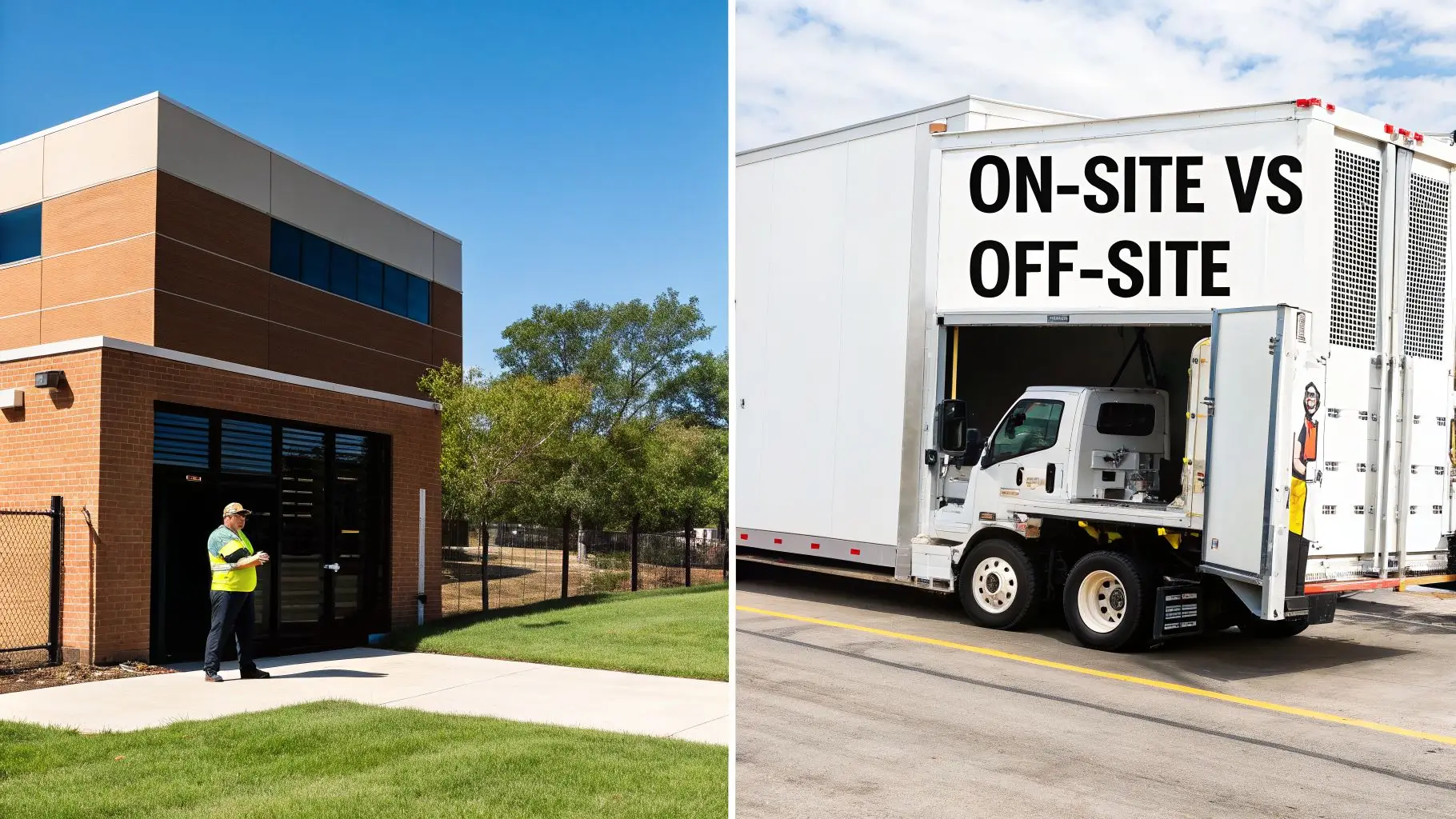
When it comes to secure data destruction services in Atlanta, one of the first decisions you'll make is where the destruction happens. Choosing between on-site and off-site services is a big deal, balancing your needs for security, budget, and convenience. Each model has its own pros and cons, and understanding them is the first step toward picking the right fit for your company’s IT asset disposition plan.
This isn't just a logistics choice. It's a strategic move that directly affects how you manage risk and prove compliance.
The Case for On-Site Destruction
On-site destruction, often called mobile shredding, brings the entire process right to your office or data center in Atlanta. A specialized, high-security truck with industrial-grade shredders pulls up, and your hard drives, SSDs, and other media are destroyed on the spot—right in front of you.
This method delivers the ultimate peace of mind.
- Unbroken Chain of Custody: Your assets never leave your sight until they are turned into tiny, useless fragments. This completely removes any risk of loss or theft during transport.
- Immediate Verification: You and your team can witness the destruction firsthand. This gives you instant, physical proof that your data is gone for good.
- Maximum Security: For organizations with the highest security requirements—think government agencies, financial institutions, or healthcare providers handling sensitive health information—on-site destruction is often non-negotiable.
If even the smallest chance of a data breach during transit is too much risk, this hands-on approach is the gold standard.
The Advantages of Off-Site Destruction
Off-site destruction offers a more budget-friendly and efficient solution, particularly for large-scale projects like data center decommissioning. With this model, trained and vetted technicians securely collect your IT assets from your Atlanta location. The assets are then transported in locked, GPS-tracked vehicles to a secure, access-controlled facility for destruction.
This approach is all about efficiency and scale.
While on-site shredding provides immediate visual confirmation, off-site services deliver the same level of certified destruction with added logistical convenience and cost benefits, making it an ideal choice for large-volume IT retirement projects where efficiency is paramount.
The benefits are hard to ignore for many businesses:
- Cost-Effectiveness: Because the vendor processes materials from multiple clients in one central location, the cost per drive is usually much lower.
- Convenience and Scalability: Scheduling a pickup is easy and causes minimal disruption to your workday. This model can easily handle thousands of assets from a data center cleanout or a company-wide hardware upgrade.
- Comprehensive Security: Reputable vendors ensure security every step of the way with serialized asset tracking, secure transport, and 24/7 surveillance at their destruction facility.
To help you decide, here’s a direct comparison of the two service models. This table breaks down the key factors to consider based on your company’s security needs, budget, and compliance requirements.
On-Site vs. Off-Site Secure Data Destruction
| Factor | On-Site Destruction | Off-Site Destruction |
|---|---|---|
| Security | Maximum. Witnessed destruction, no transport risk. | High. Secure transport and facility, but introduces a chain of custody step. |
| Cost | Higher. Premium price for mobile service and dedicated resources. | Lower. More economical due to centralized processing and economies of scale. |
| Convenience | Moderate. Requires you to schedule and supervise the on-site visit. | High. Simple pickup process with minimal disruption to your operations. |
| Verification | Immediate. You see the assets destroyed in real-time. | Delayed. Verification comes via a Certificate of Destruction after the fact. |
| Best For | Highly sensitive data, strict compliance, and risk-averse organizations. | Large volumes, budget-conscious projects, and routine IT asset retirement. |
Ultimately, choosing between on-site and off-site destruction comes down to what matters most to your organization. Both methods, when performed by a certified vendor, will lead to complete and compliant data destruction.
No matter which method you pick, it's critical to Master Data Security Compliance to protect your organization. For businesses that want the highest level of security, learning more about the process of secure hard drive shredding can provide deeper insight. The best choice always comes from a careful review of your security needs, budget, asset volume, and internal policies.
The Critical Role of Chain of Custody and Certification
Destroying a hard drive is only half the job. You also have to prove it was destroyed correctly, by the right people, and at the right time. This is where the Chain of Custody becomes the backbone of any professional secure data destruction service.
Think about it like this: if you were sending a priceless piece of art to a museum, you'd want a detailed record of every person who touched it and everywhere it went. A proper Chain of Custody for your IT assets does the exact same thing. It’s the unbroken, documented trail that follows your sensitive data from your office all the way to its final destruction.

This isn’t just a casual agreement. It's a formal process that creates a paper trail you can actually audit, proving your devices were handled securely every step of the way.
What a Secure Chain of Custody Involves
A rock-solid Chain of Custody process has several layers of security. It’s not just about moving boxes from your building to ours; it’s a system designed to leave no room for error. Here’s what it typically includes:
- Serialized Asset Tracking: The moment we collect your equipment, every single hard drive, server, or laptop is scanned and logged by its unique serial number. This creates the initial master inventory list we reconcile at every checkpoint.
- Secure, GPS-Monitored Transport: Your assets are placed in locked containers and transported in vehicles that are tracked with GPS. We get a real-time log of the route, making sure there are no unauthorized stops or detours.
- Access-Controlled Facilities: When your equipment arrives at our destruction facility, it’s brought into a secure, camera-monitored area. Only background-checked and authorized team members are allowed to handle the assets.
This level of detail is your first line of defense if an auditor comes knocking. It shows you did your due diligence to protect your data while it was on the move, drastically reducing the risk of it getting lost or stolen.
The Certificate of Destruction: Your Legal Proof
Once the destruction process is finished—whether that’s shredding, wiping, or degaussing—the Chain of Custody ends with one final, critical document: the Certificate of Data Destruction.
This is far more than a simple receipt. It’s a formal legal document that serves as your undeniable proof of compliance. More importantly, it officially transfers the liability for that data from your organization to us, your certified ITAD partner. If anyone ever questions how you handled that data, this certificate is your proof.
A valid Certificate of Data Destruction is the final link in the security chain. It closes the loop on your asset's lifecycle, providing the auditable proof needed to satisfy regulatory bodies like those enforcing HIPAA, the FTC Disposal Rule, or SOX.
A legitimate certificate needs specific, detailed information to hold up in an audit. When you partner with a certified provider like Beyond Surplus, you get a document that outlines every detail of the service. You can learn more about what makes a Certificate of Destruction a legally defensible document and why it's so critical for your business.
A proper certificate will always include:
- A unique certificate number for tracking
- A list of all serialized assets that were destroyed
- The specific method of destruction used (e.g., shredding, NIST 800-88 purge)
- The date the destruction was completed
- A statement transferring custody and liability
Without this certified paperwork, you’re leaving a huge hole in your compliance strategy and exposing your business to risk that’s completely avoidable.
How to Choose Your Secure Data Destruction Partner
You’ve done the hard part of retiring your old IT assets. Now for the most critical decision you'll make: who do you trust to destroy the sensitive data left on them? This isn't just about hiring a vendor; it's about choosing a partner who will shield your business from a potential data breach.
Picking the wrong company can expose you to new risks, while the right one becomes a seamless extension of your security team. It’s a decision that requires looking past the price tag and digging into a vendor’s credentials, security practices, and compliance record. You need someone who protects you from every angle—legally, financially, and environmentally.
Essential Vetting Questions for Your ITAD Partner
When you start talking to potential data destruction vendors, you need to cut through the sales pitch and get straight to what matters. Your questions should zero in on their certifications, physical security, and environmental policies. These are the non-negotiables.
Use this checklist to guide your conversations:
Certifications and Compliance: "Are you NAID AAA or R2 Certified? Can I see your current certificate?" These aren't just fancy logos. They represent tough, ongoing audits by third parties that verify a vendor’s security and recycling processes. A non-certified vendor simply can’t offer the same proven level of protection.
Chain of Custody: "Can you show me an example of a complete, auditable chain of custody report?" A professional provider should be able to walk you through their entire serialized tracking process, from the first scan at your office to the final line item on the Certificate of Destruction.
On-Site Security: "What kind of access control and surveillance do you have at your facility?" Ask them about employee background checks, 24/7 camera monitoring, and whether they use segregated security cages for storing assets. You need to feel confident that your devices are locked down from the moment they arrive.
Insurance Coverage: "What type and amount of liability insurance do you carry?" A legitimate vendor must have specialized data breach and pollution liability insurance. Standard business insurance won't cut it if something goes wrong, and you need to know you're covered in a worst-case scenario.
Environmental Policy: "Are you certified for both secure destruction and environmentally responsible e-waste recycling?" Make sure they have a documented zero-landfill policy and can prove their downstream recycling partners are also certified. This is what protects you from environmental compliance headaches down the road.
Understanding the Market and Making Your Choice
Choosing the right partner is more important than ever. The global secure data destruction market is booming, projected to hit USD 12.50 billion by 2030. This growth is a direct response to a massive problem: while the world generated 62 million metric tons of e-waste in 2022, only 22.3% was properly collected and recycled. That leaves a staggering number of data-bearing devices out in the wild, completely vulnerable. To get a better handle on these trends, you can find more insights on the secure data destruction market.
Selecting a vendor is a risk management decision. The cost of a professional service is nothing compared to the multi-million dollar price tag of a data breach. Your choice should always be based on verified trust, not just the lowest bid.
By asking these sharp, direct questions, you can confidently select a true partner like Beyond Surplus—one that delivers not just destruction services, but auditable proof, legal protection, and genuine peace of mind.
Got Questions About Data Destruction? We’ve Got Answers.
Even after you’ve decided on a plan for your old IT gear, a few lingering questions often pop up. It’s completely normal. Here are some of the most common things we get asked about secure data destruction services, with straightforward answers from our team.
Is Formatting a Hard Drive Good Enough for Security?
In a word: no. Formatting a hard drive is like tearing the table of contents out of a book. The information is all still there, and anyone with basic recovery software can easily piece it back together. It only removes the quick pathways to your files, not the files themselves.
For true, permanent data removal, you need one of two things: specialized software that overwrites every inch of the drive multiple times, following standards like NIST 800-88, or complete physical destruction. Anything less leaves your business exposed.
What Actually Happens to My Devices After They’re Shredded?
This is a great question. Reputable vendors don't just stop at shredding. We operate with a strict zero-landfill policy, which means the process continues long after your drives are turned into tiny, unreadable fragments.
The shredded material is meticulously sorted and separated. From there, the raw materials are sent off for responsible recycling. This includes:
- Aluminum from the hard drive casings.
- Steel from various internal parts.
- Circuit boards, which hold small but valuable amounts of precious metals.
This approach ensures your sensitive data is gone for good while also managing the e-waste in an environmentally responsible way, helping you meet your corporate social responsibility goals.
How Much Should I Expect to Pay for Data Destruction?
The final cost really depends on a few key factors: the method you choose (wiping vs. shredding), the service model (on-site vs. off-site), how many devices you have, and any special logistical needs. For larger jobs, off-site services often end up being more budget-friendly because of the economies of scale.
While there’s a fee for any professional service, think of it as a small insurance premium. When you compare it to the average cost of a data breach—which can easily climb into the millions—it’s a tiny investment to protect against a catastrophic risk.
At the end of the day, the price of certified destruction is just a fraction of the potential fines, legal battles, and brand damage that come from a single data leak. It’s a non-negotiable cost of doing business securely.
Contact Beyond Surplus for certified electronics recycling and secure IT asset disposal in Atlanta. Contact us today to schedule your secure pickup.