
A telecom equipment buyback program stops retired network gear from sitting on a shelf as dead weight. That matters more than many finance teams realize. The telecom equipment market rebound includes Ericsson’s $1.63 billion share buyback program launched in 2026 and 4% year-over-year revenue growth in H1 2025 across key telecom segments, which is a useful reminder that network assets still carry real market value when managed correctly (telecom equipment market rebound data).
For a CFO, the question is simple. Are decommissioned routers, switches, PBX systems, transport gear, and VoIP platforms leaving the building as a cost center, or returning capital to the business as part of a controlled asset recovery process? For an IT Director, the question is tougher. Can that happen without creating a compliance problem, a data exposure issue, or an audit trail gap?
A well-run telecom equipment buyback program solves both.
Understanding the Telecom Equipment Buyback Program
A telecom equipment buyback program is the business version of trading in a fleet of company vehicles instead of abandoning them in a lot. The equipment may be retired from production, but that doesn’t mean it has no market value. If the gear still has demand in secondary channels, a buyback program converts it into cash recovery. If it has no resale demand, it moves into controlled recycling with documentation.
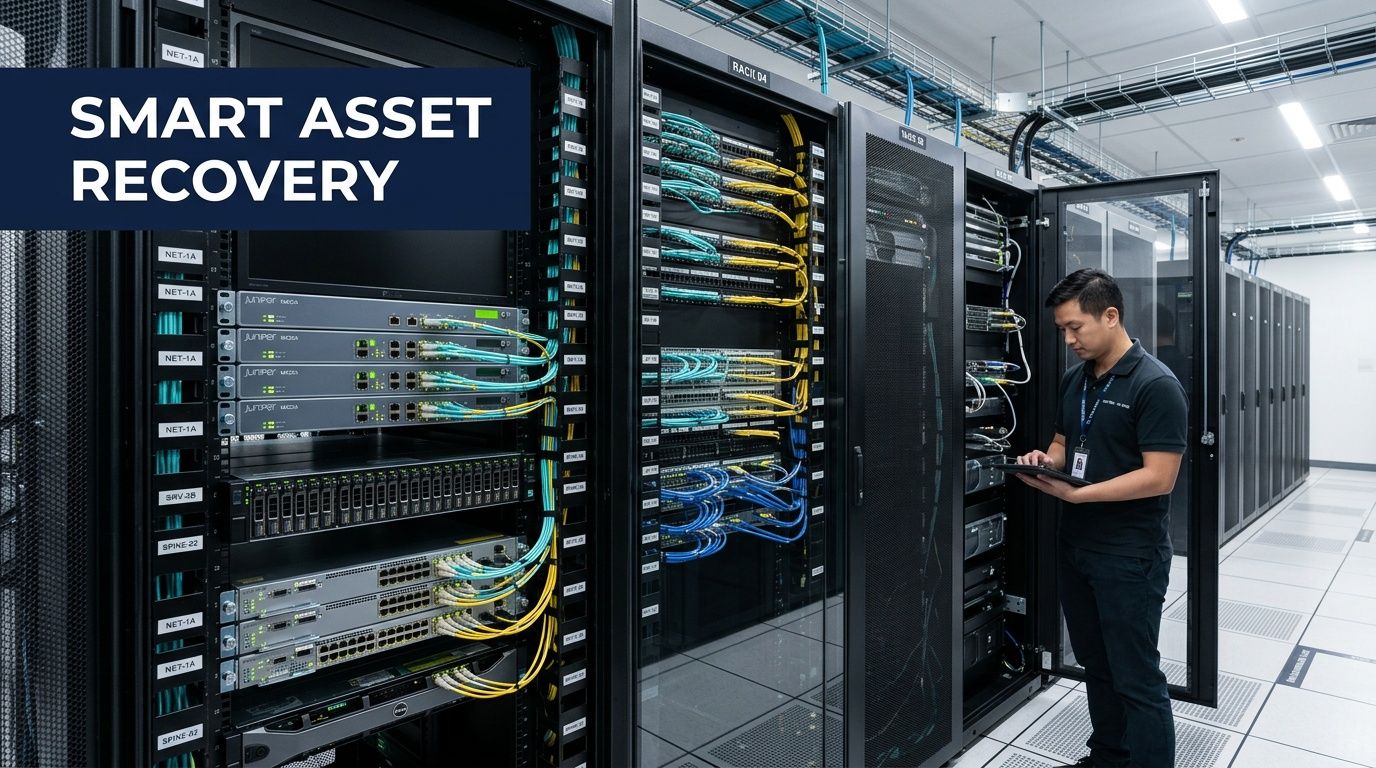
This is different from basic e-waste pickup. Standard recycling focuses on removal and downstream processing. A buyback program starts earlier and asks harder questions. What equipment still has resale value? What can be refurbished? What needs data destruction first? What should be liquidated now instead of after the market softens?
What usually qualifies
Organizations typically place these asset categories into a telecom buyback stream:
- Enterprise networking gear: Routers, switches, firewalls, and related modules.
- Voice infrastructure: IP phones, PBX systems, gateways, handsets, and conferencing hardware.
- Carrier and network equipment: Transport, access, and service provider gear removed during upgrades.
- Supporting hardware: Rack accessories, power components, and certain telecom-adjacent IT assets.
The best candidates are business-grade systems with established secondary demand. Older analog equipment and highly specialized platforms can still be processed, but valuation usually gets more selective.
Who benefits most
This model fits organizations that refresh infrastructure on a schedule or consolidate sites:
- Enterprises replacing office voice and network hardware
- Data centers decommissioning telecom-connected environments
- Service providers cycling out legacy equipment
- Healthcare, finance, and government teams that need proof, custody records, and controlled disposition
A telecom buyback also works well when procurement and facilities need one workflow for removal, accounting, and compliance. That’s where IT asset disposition workflows become useful. They frame retirement as a managed business process rather than a disposal event.
Practical rule: If equipment is sitting in storage because nobody wants to risk disposing of it incorrectly, you already have an asset recovery problem.
There’s also a planning angle. Commercial telecom teams increasingly align infrastructure decisions with revenue, brand, and service delivery. That’s one reason broader telecom leaders look at demand trends, buyer behavior, and market positioning more systematically. A useful outside reference is Fypion Marketing's playbook, not for ITAD details, but for understanding how telecom organizations are thinking strategically about value creation instead of treating every function as a back-office afterthought.
The Strategic Financial and Compliance Advantages
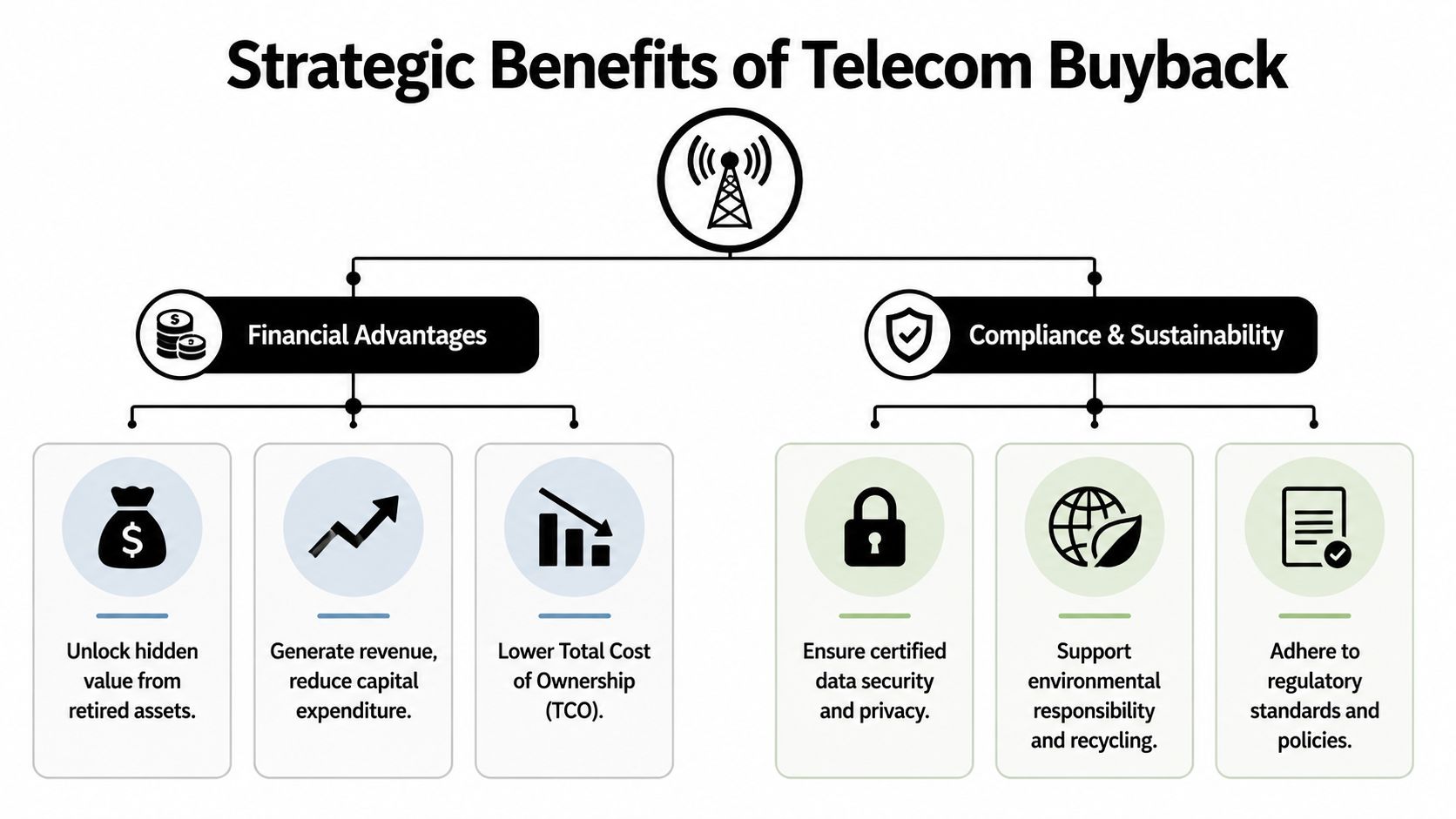
A telecom buyback program earns attention because it improves more than one line item at once. It can recover capital, reduce disposal friction, and tighten compliance controls in the same motion. That combination is rare.
Financial gain
The obvious benefit is value recovery. Retired telecom assets don’t need to be fully current to produce return. In a market projected to reach nearly $1.2 trillion by 2033, even mixed-condition retired telecom equipment can fetch up to 10% of original cost, according to telecom equipment resale market guidance.
That doesn’t mean every asset is worth recovering. Some equipment has stronger demand, some doesn’t, and condition matters. But the budget impact is real in three places:
- Recovered cash: Proceeds can offset refresh costs, migration work, or decommissioning labor.
- Lower carrying cost: Old hardware doesn’t keep consuming cage space, warehouse shelves, or internal handling time.
- Cleaner capital planning: Finance can account for residual asset value instead of treating retirement as pure write-off.
Compliance and risk mitigation
The bigger issue for many organizations isn’t money. It’s liability.
Telecom equipment can hold credentials, call records, customer information, network settings, and configuration data. When teams move gear out without documented controls, they create exposure for legal, audit, security, and procurement.
A structured buyback program fixes that by requiring:
- Verified data destruction
- Serialized tracking
- Chain-of-custody documentation
- Certificates that formalize liability transfer
A retired switch with stored credentials is a security asset until it’s sanitized and documented. After that, it becomes a financial asset.
Those controls matter most in regulated environments, but they also matter in ordinary corporate settings. A missed serial number or undocumented handoff becomes a problem fast when internal audit asks where the equipment went and who signed for it.
Operational efficiency and sustainability
A good program also removes internal friction. Instead of facilities, IT, procurement, and security all improvising separate steps, the organization uses one controlled workflow for collection, audit, packaging, transport, resale, and recycling.
That operational clarity supports sustainability goals too. Reuse and responsible recycling reduce waste while preserving usable equipment for secondary markets. The practical benefit isn’t abstract. Teams avoid last-minute cleanouts, unmanaged stockpiles, and emergency disposal decisions that usually cost more and document less.
Here’s what tends to work:
| Area | What works | What fails |
|---|---|---|
| Financial recovery | Early inventory review before refresh | Waiting until equipment value drops further |
| Compliance | Serialized asset tracking and destruction records | Spreadsheet-only handoffs with no custody trail |
| Operations | One coordinated pickup and audit process | Multiple vendors handling separate steps |
| Sustainability | Reuse first, recycling where needed | Bulk scrap decisions without valuation review |
Demystifying the Equipment Valuation Process
Most clients don’t distrust valuation because prices move. They distrust it because the method often feels hidden. A sound telecom equipment buyback program should make the pricing logic visible.
Commodity equipment versus niche equipment
The most useful starting point is the market classification model. Valuation often hinges on a dual-parameter analysis that classifies equipment as high-demand commodity products or lower-demand niche products. Commodity items can receive bids within 24 hours, while timing can affect recovery rates by 20% to 40% because the final offer reflects current market value (telecom valuation methodology).
That distinction explains why a standard enterprise switch may move quickly while a specialized legacy chassis takes longer to price and may return less. The item isn’t automatically worthless. It’s just supported by a narrower buyer pool.
What buyers actually look at
Valuation usually comes down to a combination of market demand and processing reality.
- Model and manufacturer: Enterprise-grade hardware from recognized vendors generally performs better than obscure or end-of-life niche systems.
- Condition: Tested working units, incomplete units, and parts-only assets won’t produce the same offer.
- Quantity: A clean batch of similar models is easier to liquidate than a mixed pallet of unrelated gear.
- Configuration: Optics, cards, licenses, rails, power supplies, and accessories influence resale outcome.
- Timing: If a model still has active secondary demand, moving it sooner usually helps.
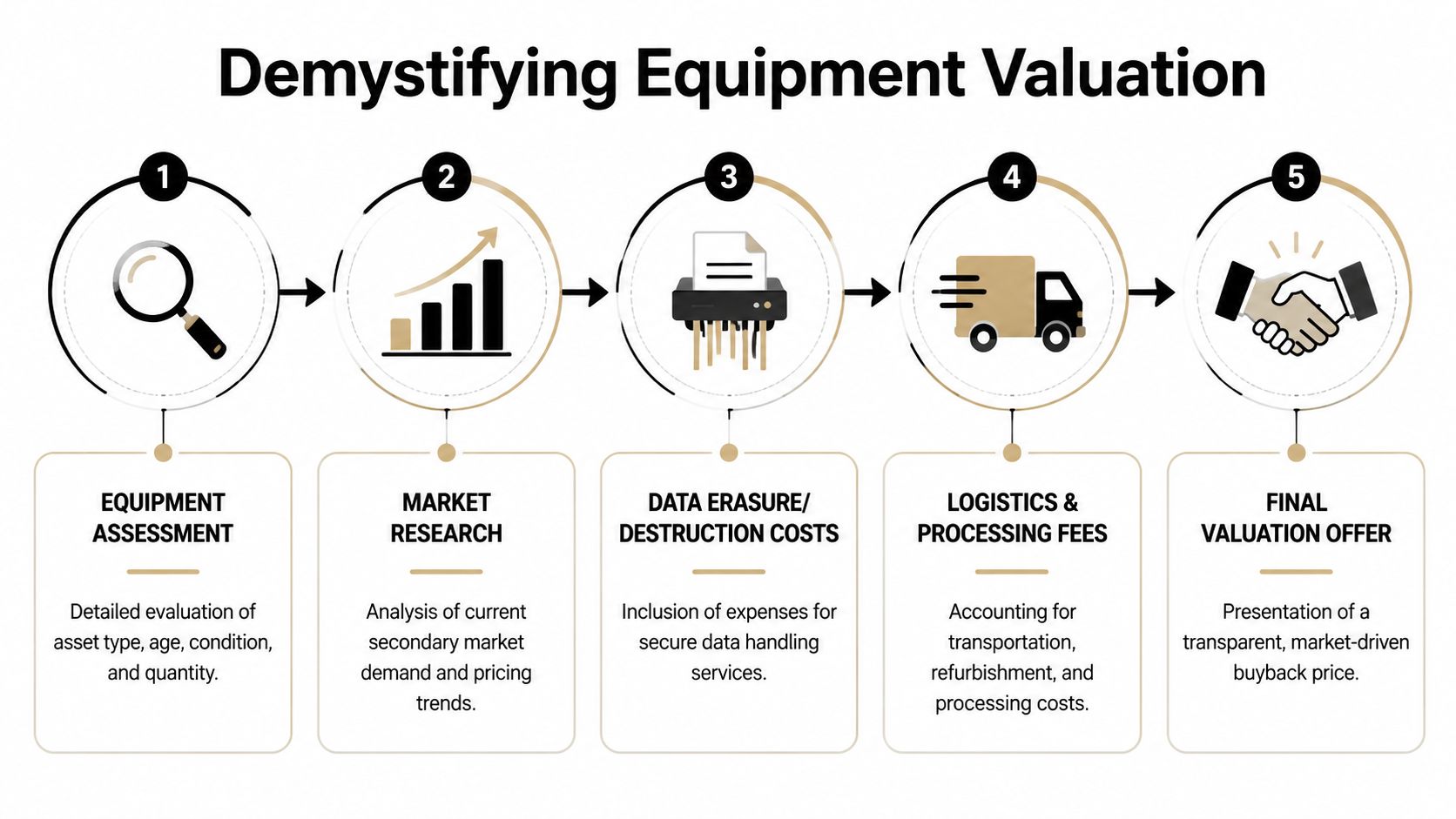
A serious partner should also explain any deductions tied to logistics, refurbishment, missing components, or secure data handling. If the quote appears out of nowhere with no supporting logic, that’s a warning sign.
Why transparent valuation beats black-box pricing
The most reliable process usually looks like this:
- Inventory review based on make, model, quantity, and condition
- Market check against current demand
- Processing analysis for testing, data work, packaging, or recycling
- Offer presentation with enough detail to show how the number was built
For organizations managing larger refreshes, telecom equipment liquidation planning finds its utility. It helps finance and IT align asset removal with market timing instead of treating retirement as an afterthought.
Don’t judge a buyback quote only by the top-line number. Judge whether the provider can explain how the number was reached, what assumptions were used, and what happens if the audit changes the inventory.
That’s how IT directors avoid two common mistakes. First, sending high-demand assets into scrap. Second, holding niche gear too long while expecting commodity pricing.
Secure Logistics and Certified Data Destruction
The asset leaves your floor before it leaves your risk profile. That’s why logistics and data destruction need to be part of the same controlled process.
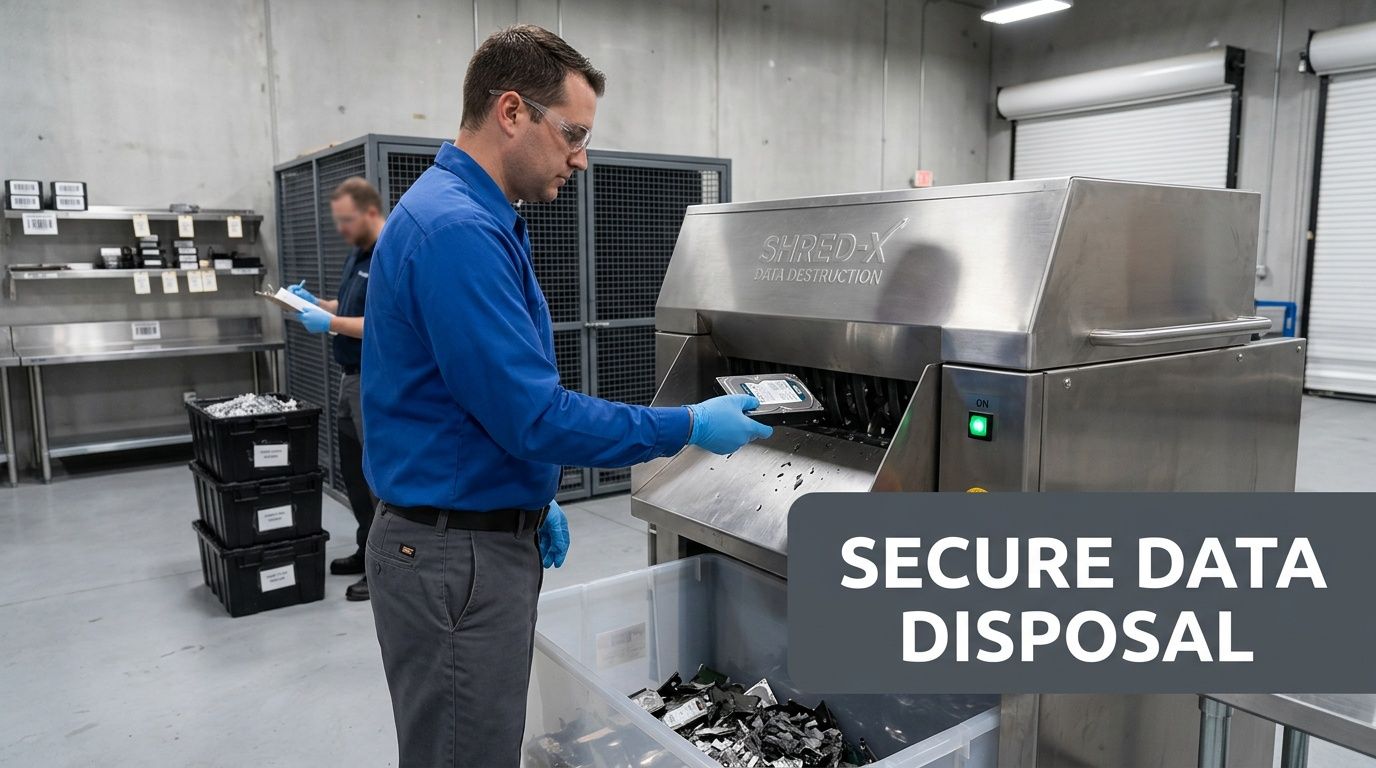
Leading ITAD providers must offer data destruction aligned with NIST/DOD standards, maintain certifications such as R2 and ISO, and provide a serialized chain-of-custody report that supports a Certificate of Data Destruction and FTC Disposal Rule compliance, according to certified buyback and ITAD requirements.
What the secure workflow should include
A proper telecom equipment buyback program doesn’t begin with a truck at the loading dock. It starts with control.
- Asset identification: Teams inventory what is being removed, where it came from, and which serial numbers must be tracked.
- Segregation by handling type: Some gear can be sanitized and resold. Some requires physical destruction of media. Some goes directly into recycling.
- Packing and transport: Equipment should be packed to preserve value and moved under documented custody.
- Processing and audit: Received inventory gets reconciled against the pickup record before resale or recycling decisions are finalized.
Wiping versus shredding
Not every device needs the same treatment. Some equipment can be sanitized through compliant data wiping. Other assets, especially those with damaged or non-removable media, may require shredding.
The right question isn’t which method sounds stronger. It’s which method fits the device, the data type, and the organization’s regulatory posture.
| Method | Best use | Main outcome |
|---|---|---|
| Data wiping | Reusable storage media that can be sanitized to standard | Preserves resale path |
| Physical destruction | Failed, damaged, or policy-restricted media | Eliminates reuse of the media itself |
For telecom environments, this often applies to storage modules, management appliances, integrated drives, and equipment with retained configuration data.
Why custody documentation matters
Without serialized custody records, the rest of the process becomes hard to defend. Internal audit, legal, and compliance teams don’t want a verbal assurance that “everything was handled.” They want documentation that shows each asset entered, moved through, and exited the process correctly.
One reason organizations use telecom equipment disposal services is to combine logistics, data security, and reporting into one auditable workflow instead of trying to stitch together separate vendors.
Audit note: If a provider can’t show you how serial numbers are tracked from pickup through final disposition, you don’t have chain of custody. You have hope.
That distinction matters most when a site closure, merger, or network upgrade involves multiple locations and multiple handoffs. The more complex the project, the less room there is for undocumented movement.
Calculating ROI with Real-World Scenarios
ROI in a telecom equipment buyback program doesn’t come from resale alone. It comes from combining recovered asset value with avoided disposal friction, reduced storage burden, and cleaner project closeout.
The market backdrop supports that approach. In a sector projected to reach nearly $1.2 trillion by 2033, mixed-condition retired telecom assets can fetch up to 10% of original cost, and RAN holds 33.02% market share, according to telecom resale market projections.
Scenario comparison
| Scenario | Typical asset mix | Where ROI comes from |
|---|---|---|
| Office voice refresh | IP phones, gateways, conferencing hardware | Cash recovery plus faster site cleanup |
| Network modernization | Switches, routers, modules, racks | Value recovery on in-demand models and avoided warehousing |
| Data center decommission | Mixed telecom and adjacent IT gear | Coordinated removal, resale, recycling, and documentation |
An office voice refresh is the easiest place to see the benefit. A company replaces an aging communications platform across several offices. If the old phones, gateways, and support gear are boxed and forgotten, they become a storage and accounting problem. If they are inventoried, tested, and routed into a buyback stream, the organization recovers cash and closes the project cleanly.
A network modernization project usually has a wider spread of values. Some switches and routers will still have active demand. Others may only hold parts value. The gain comes from separating those categories early instead of treating the whole lot as scrap.
The highest-return projects aren’t always the ones with the newest equipment. They’re the ones where the client sorted, documented, and moved assets before value eroded.
Data center decommissions tend to produce the clearest financial picture because the alternative is expensive confusion. Equipment sitting in racks delays closeout. Unsorted pallets create rework. Mixed-value inventory depresses recovery. A structured sales channel, paired with recycling for non-resalable units, lets finance see both recovered funds and avoided project drag.
For organizations planning refresh cycles, selling used telecom equipment for cash works best when the inventory is prepared in advance. Clean asset lists, known conditions, and complete accessories usually produce a more accurate and more defensible return.
How to Select the Right Buyback Partner
Most problems in telecom buyback projects don’t start at the final settlement. They start during vendor selection. A provider with vague controls can undervalue assets, mishandle logistics, or leave compliance gaps that surface later.
A short checklist filters most of that risk out.
Non-negotiable criteria
- Documented data security: The provider should define how devices are sanitized or destroyed and what proof you’ll receive.
- Serialized reporting: Asset-level tracking matters more than generic pickup receipts.
- Transparent valuation: You should understand how equipment is categorized and how condition affects pricing.
- Logistics capability: The provider must be able to manage pickup, packing, consolidation, and transport without improvisation.
- Downstream clarity: You need to know what gets resold, what gets recycled, and what documentation closes the loop.
If any of those answers sound fuzzy, the project will likely become fuzzy too.
Where AI-driven valuation creates risk
AI-assisted pricing tools are becoming more common, but they don’t eliminate the need for human review. Independent audits cited in analysis of AI valuation gaps in device recovery found 15% to 25% valuation discrepancies for legacy equipment, which is exactly the kind of issue that hurts telecom projects heavy in older Cisco, Nortel, or mixed-condition infrastructure.
That doesn’t mean automation has no place. It means automated estimates shouldn’t be the final word on specialized or legacy hardware. Telecom inventories often include exceptions, incomplete kits, odd revisions, and niche configurations that generic models don’t score well.
What a strong provider conversation sounds like
Ask direct questions:
- How do you classify commodity versus niche telecom equipment?
- What happens if the receiving audit differs from the pickup list?
- What custody records do you provide at the serial-number level?
- Which assets are wiped, which are shredded, and who decides?
- How are non-resalable items documented and processed?
One practical option businesses evaluate is telecom equipment buyers near me, where providers such as Beyond Surplus outline buyback intake, secure handling, and cash recovery for telecom hardware. The important point isn’t the marketing claim. It’s whether the provider can support a transparent, human-audited process from pickup through final reporting.
A fair offer with a complete audit trail beats a slightly higher headline offer that arrives with weak documentation and unexplained adjustments.
Frequently Asked Questions About Telecom Buybacks
Is there a minimum amount of equipment required for a buyback
That depends on the provider, the location, and the type of telecom gear. Some programs focus on palletized loads or enterprise quantities. Others will review smaller lots if the equipment has strong resale demand. The fastest way to qualify a project is to provide an asset list with model numbers, quantities, and whether the gear is tested, untested, or pulled from production.
What happens to equipment with no resale value
It should move into documented recycling, parts recovery, or material processing. That’s important because a telecom equipment buyback program isn’t only about high-value gear. It’s about managing the full inventory correctly. The resalable assets generate recovery. The non-resalable assets still need compliant handling and final documentation.
How long does the process usually take
Timing depends on inventory quality, site access, logistics, and whether assets need wiping or destruction before final settlement. Commodity equipment generally moves faster than niche systems because the secondary market is broader. Clean inventory data also shortens the cycle. If the project starts with incomplete counts and unknown conditions, every downstream step slows down.
Do non-working or incomplete telecom assets still belong in a buyback review
Yes. They may not command the same pricing as tested working units, but they should still be reviewed. Non-working equipment can retain parts value, board value, or commodity recovery value. The mistake is assuming that anything untested or incomplete should automatically go to scrap before someone with secondary market experience reviews it.
What should an internal team prepare before requesting a quote
Start with a simple package:
- Asset list: Manufacturer, model, quantity, and site location
- Condition notes: Working, pulled, untested, damaged, or incomplete
- Project timing: Refresh, relocation, decommission, or consolidation
- Security requirements: Whether devices require wiping, shredding, or both
- Photos if available: Especially for mixed pallets, rack gear, or specialty telecom hardware
That level of preparation usually leads to a faster, cleaner quoting process and fewer surprises after audit.
If your organization is retiring routers, switches, PBX systems, VoIP phones, or carrier hardware, contact Beyond Surplus for certified electronics recycling and secure IT asset disposal.