
For any business in Georgia, a storeroom full of old IT hardware isn't just a storage problem—it's a significant security risk. For organizations in finance, healthcare, and technology, engaging professional data security services in Georgia is a non-negotiable component of a robust risk management strategy. The final stage of your data's lifecycle is as critical as its creation and active use.
Your Final Line of Defense in Data Protection
Consider your data's lifecycle as a secure process from start to finish; a compliant handoff at the end is crucial. When IT assets reach their end-of-life, the sensitive corporate and client information they contain does not simply vanish. This stored data—from financial records to proprietary intelligence—becomes a prime target for a data breach if not handled correctly. Improper disposal can lead to severe regulatory fines, a loss of customer trust, and lasting damage to your brand's reputation.
This is precisely where professional IT asset disposition (ITAD) serves as your final line of defense. It is far more than simple electronics recycling; it is a strategic process designed to permanently eliminate data security risks from your retired equipment. A trusted ITAD partner in Georgia transforms this potential liability into a secure, compliant, and closed-loop process. You can learn more about how the secure destruction of data works to protect your organization.
From Liability to Fortified Security
The objective is to establish an unbroken chain of custody, from the moment an asset leaves your facility to its final, certified destruction. This ensures every hard drive, server, and storage device is accounted for and sanitized according to the highest industry standards. While selecting the best enterprise security software solutions is critical during an asset's operational life, its secure disposal is the final, essential chapter.
Any effective provider of data security services in Georgia must offer:
- Certified Destruction: Methods like physical shredding or certified data wiping that render data completely unrecoverable.
- Auditable Documentation: A Certificate of Data Destruction serves as your official proof of compliance for audit purposes.
- Regulatory Adherence: Deep expertise in navigating complex regulations such as HIPAA, the FTC Disposal Rule, and GLBA is essential.
When Georgia businesses treat secure IT asset disposal as a core security function—not an afterthought—they neutralize a major threat. This final step closes the loop on the data lifecycle, ensuring sensitive information remains confidential.
Ultimately, investing in professional data security services is an investment in your company’s future and integrity. It demonstrates a firm commitment to protecting your clients, employees, and bottom line from the persistent threat of a data breach.
Georgia's High-Stakes Data Security Landscape
Georgia is a major economic engine, home to bustling hubs for finance, healthcare, technology, and logistics. This economic strength, however, places a significant target on local businesses. The very factors driving our growth—interconnected digital systems and a high concentration of valuable industries—also create a perfect environment for sophisticated data breaches.
The threat extends beyond external hackers. A significant, often overlooked risk resides within your own facilities: retired IT hardware. Every old server, forgotten laptop, and unused storage device is a potential data bomb. Improper disposal of these assets can lead to devastating financial penalties, irreparable reputational damage, and a complete loss of customer trust. For businesses in Georgia, this is a real, daily operational risk.
A Cybersecurity Hub with High Expectations
Georgia's role as a national leader in cybersecurity establishes a high standard for local businesses. This thriving ecosystem means there is no excuse for cutting corners on security, especially during the final stage of an asset's life.
Georgia is home to over 120 information security firms, generating $1.4 billion annually and supporting 6,700 high-tech jobs, ranking us No. 3 in the nation. This local expertise underscores the seriousness with which data protection is treated here, particularly when considering that nationwide data breaches exposed 4.1 billion records in the first half of 2019 alone—a 50% increase in just four years.
This intense focus on security magnifies the consequences of a breach resulting from improper hardware disposal. Regulators, clients, and the public expect a higher standard of care from companies operating in a top-tier cybersecurity state.
The True Cost of Inaction
Ignoring the need for professional data security services in Georgia is a high-stakes gamble. The cost of a breach extends far beyond initial fines:
- Reputational Damage: News of a data leak can permanently tarnish your brand, driving away customers and deterring new business.
- Regulatory Penalties: Fines for non-compliance with regulations like HIPAA, GLBA, or the FTC Disposal Rule can be crippling, easily reaching millions of dollars.
- Operational Disruption: A major data security incident can halt business operations, consuming valuable time and resources during investigation and recovery.
Investing in certified IT asset disposal is not just an operational expense; it is a fundamental cost of doing business securely in Georgia's competitive landscape. It's about proactively managing risk and demonstrating a commitment to protecting sensitive information.
Partnering with a certified expert for secure IT asset disposal in Georgia transforms a potential liability into a fortified defense. It ensures your end-of-life data management practices align with the high standards set by our state’s leadership in cybersecurity.
Choosing Your Data Destruction Method
When retiring IT assets, it's important to understand that not all data destruction methods are equal. The optimal approach depends on your specific security requirements, compliance obligations, and whether you aim to recover value from the old hardware. For any business in Georgia, understanding these core services is the first step toward a solid IT asset disposition (ITAD) strategy.
Consider the disposal of a sensitive paper document. You could shred it into confetti (physical destruction), redact every word with a marker (data wiping), or secure it in a managed vault (off-site destruction). All are effective, but the best choice depends on the document's criticality and future use.
This decision tree addresses the primary question every Georgia business should ask when disposing of IT equipment.
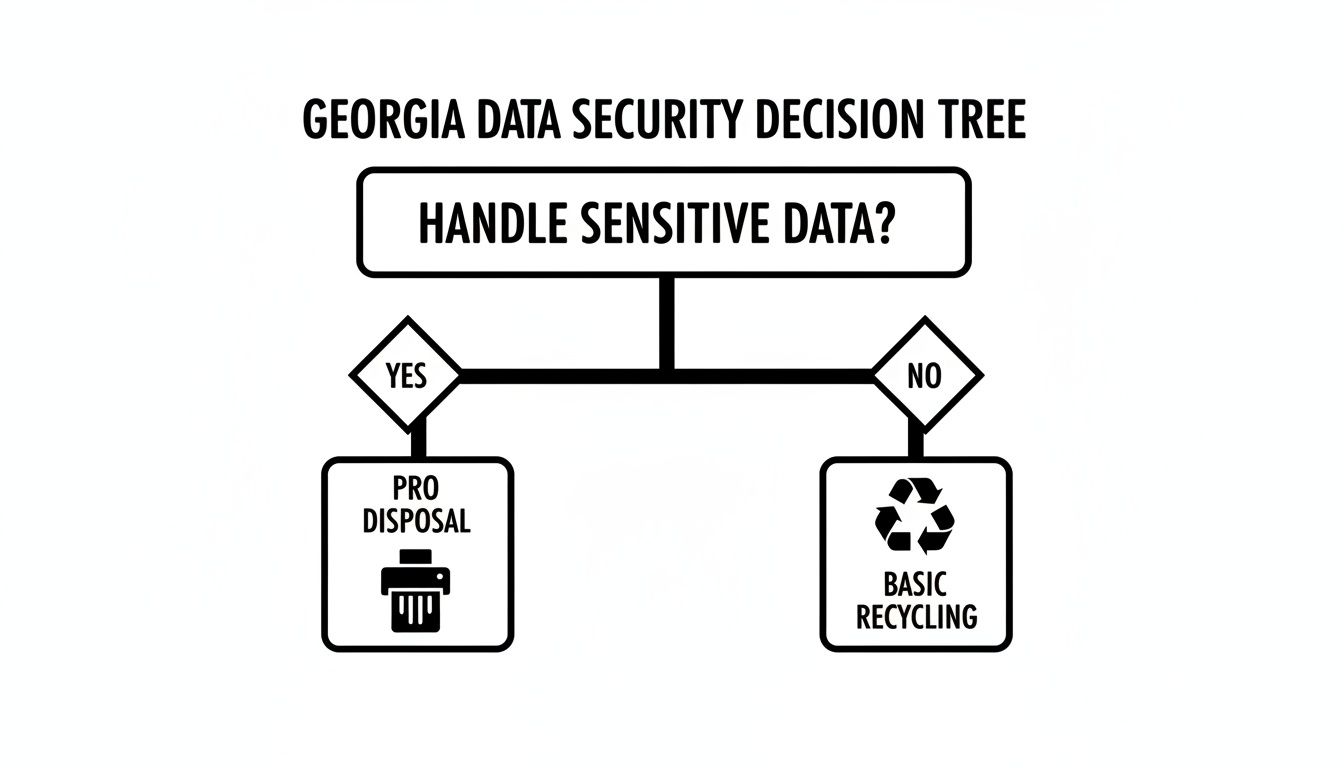
If equipment has ever processed sensitive information, professional disposal is a mandatory security measure.
On-Site Data Destruction
On-site destruction is the ideal solution for organizations requiring witnessed proof of destruction. This service brings the entire process to your location in Georgia. Mobile shredding trucks equipped with industrial-grade shredders physically pulverize hard drives, SSDs, and other media in your parking lot.
You can witness your data-bearing devices being ground into useless fragments, offering unparalleled peace of mind. This method is preferred by businesses in healthcare, finance, and government, where chain of custody and verification are paramount.
The process is straightforward:
- Secure Collection: Our technicians collect assets directly from your data center or offices.
- Serial Number Scanning: Every drive is scanned and inventoried, creating a complete audit trail.
- Witnessed Destruction: You observe as the devices are fed into the shredder at your location.
- Immediate Certification: A Certificate of Data Destruction is provided on the spot, confirming compliant destruction.
Off-Site Data Destruction
For companies managing large volumes of assets or those without space for on-site services, off-site destruction is a secure and efficient alternative. Your IT equipment is securely transported from your Georgia facility to our specialized, access-controlled destruction plant.
The process is governed by an unbroken, meticulously documented chain of custody, tracking every step from pickup to final shred.
Key Takeaway: The integrity of off-site destruction depends on the provider's security protocols, including GPS-tracked trucks, sealed containers, and strict access controls at the processing facility.
This is the perfect option for large IT refresh projects, data center decommissioning, or routine disposal needs. You receive a detailed Certificate of Data Destruction, providing the same level of auditable proof as our on-site service. Learn more about our comprehensive security and data destruction services.
Certified Data Wiping and Sanitization
If your assets retain value, physical destruction means forgoing an opportunity to recover your initial investment. Certified data wiping is the solution.
Data wiping, or sanitization, uses specialized software to overwrite data on a storage device, making the original information irrecoverable. This process adheres to strict standards like Department of Defense (DoD 5220.22-M) and NIST SP 800-88.
When does data wiping make sense?
- Asset Resale: You intend to sell retired equipment on the secondary market.
- Employee Buy-Back Programs: You plan to offer used company laptops to employees.
- Donations or Redeployment: Hardware is being donated or moved to another department.
Upon completion, we issue a certificate confirming the sanitization of each device by its serial number, allowing you to safely and compliantly redeploy or resell the hardware.
Navigating Georgia's Compliance Maze
For any business in Georgia—particularly in healthcare, finance, or technology—compliance is a legal and ethical imperative. Failure to properly manage sensitive data on retired IT assets can result in crippling fines, legal battles, and a permanent loss of customer trust.
Federal and industry regulations establish a complex framework dictating how you must protect information, from creation to final destruction. This is about more than avoiding penalties; it's about demonstrating responsible stewardship of sensitive information.
Regulations like the Health Insurance Portability and Accountability Act (HIPAA), the Gramm-Leach-Bliley Act (GLBA), and the FTC Disposal Rule require businesses to take "reasonable measures" to prevent unauthorized data access. A professional, documented disposal process is the only way to meet this standard.
Translating Regulations Into Action
Understanding regulations is one thing; implementing them is another. "Reasonable measures" for decommissioning a server room full of hardware requires a defensible, auditable process.
Here’s how specific ITAD services address key regulations:
- HIPAA: This law demands protection of patient health information (PHI). Certified data destruction ensures that PHI on old computers and medical devices is permanently eliminated.
- GLBA: Financial institutions must safeguard nonpublic personal information (NPI). Physically shredding hard drives containing customer financial data is a direct way to comply with GLBA's Safeguards Rule.
- FTC Disposal Rule: This applies to nearly every business handling consumer credit information, mandating disposal by burning, pulverizing, or shredding.
The pressure to comply is increasing. The global Data Security as a Service (DSaaS) market is projected to grow from USD 31.0 billion in 2022 to USD 55.3 billion by 2027, signaling a worldwide shift toward stronger data protection. For IT managers in Georgia, improper disposal of assets is a direct violation of these regulations. You can discover more insights about this growing market and its drivers.
Your Proof of Due Diligence
How would you prove secure disposal of every hard drive from last year's tech refresh to an auditor? This is where a Certificate of Data Destruction becomes invaluable.
This is not just a receipt; it is an official, legally defensible record of your due diligence.
A Certificate of Data Destruction details what, when, and how assets were destroyed, and confirms the transfer of custody. It is the definitive document demonstrating compliance and transferring liability away from your organization.
This documentation is essential for creating a complete audit trail, closing the loop on your data's lifecycle.
Partnering with a certified vendor that provides detailed reporting is a core risk management strategy, especially given the rigorous standards of frameworks like NIST SP 800-88. You can check out our guide on NIST-compliant media sanitization to better understand these guidelines. Professional data destruction services make compliance straightforward and secure.
How to Vet Your Data Security Partner
Choosing an IT asset disposition (ITAD) vendor is a critical partnership in risk management. The right partner acts as an extension of your security team, while the wrong one can expose your business to data breaches and regulatory penalties. For any Georgia business, thorough due diligence is essential.
This requires a critical evaluation of certifications, processes, and documentation to ensure a vendor can be trusted with your most sensitive assets.

The Certification Checklist
Industry certifications are the foundational, non-negotiable proof of a vendor's commitment to high standards.
When evaluating partners for data security services in Georgia, these two certifications are paramount:
- NAID AAA Certification: The gold standard for secure data destruction. A NAID AAA certified vendor has passed rigorous, unannounced audits of their hiring practices, operational security, and destruction processes.
- R2 (Responsible Recycling) Certification: While focused on environmental compliance, R2 also includes strict data security requirements. An R2 certified facility must demonstrate a clear process for sanitizing or destroying all data. You can learn more about what R2 certification means for your business.
These certifications serve as an initial filter to weed out vendors who lack a proven commitment to secure and responsible practices.
Scrutinizing the Chain of Custody
A vendor's chain-of-custody process is critical. This documented trail must account for your assets from the moment they leave your facility until their final disposition.
A truly secure chain of custody is an unbroken, documented, and transparent process. It should provide a clear and auditable answer to the question: "Where are my assets and who has control of them right now?"
Ask potential vendors to detail their process. Key questions include:
- How are assets transported? Are vehicles GPS-tracked and drivers background-checked?
- What security measures are in place at your facility (e.g., access controls, surveillance)?
- How do you inventory and track assets upon arrival? Can you provide serialized reporting?
A capable partner will provide clear, direct answers backed by established procedures.
Reporting and Value Recovery
Finally, examine the vendor's ability to provide detailed, auditable reports and transparent value recovery programs. A Certificate of Data Destruction is the minimum; expect serialized asset reports detailing each device's condition and final outcome.
If you have newer assets with residual value, inquire about their value recovery or IT buyback program. A reputable vendor will have a transparent process for testing, grading, and remarketing equipment, with a clear revenue-sharing model.
This level of detail is non-negotiable for both internal asset management and proving compliance. Georgia's cybersecurity market is projected to grow at a 12% CAGR from 2025 to 2031, driven by escalating cyberattacks. For IT directors, this means certified data destruction is a must-have. By using these criteria, you can confidently select a partner who protects your business as rigorously as you do.
Let's Turn This Knowledge Into Action
We have covered the high stakes of data security in Georgia, the necessity of compliant IT asset disposal, and the value a certified partner provides. Now it is time to implement a clear plan. Securing your end-of-life data does not have to be a complex process.
The path to a secure, streamlined, and compliant solution is straightforward. Our entire process is designed to simplify this crucial step for busy IT managers in Georgia. While focusing on active threats, don't overlook fundamental measures like implementing two-factor authentication, which can dramatically improve overall security.
Take Action Today
Ready to close the final loop in your data lifecycle? Getting started is easy:
- Schedule a Pickup: Contact us to arrange for secure logistics and collection of your retired IT assets from anywhere in Georgia.
- Request a Detailed Quote: Receive a transparent, no-obligation quote tailored to your specific inventory and data destruction needs.
- Set Up a Consultation: Speak with one of our experts to design a custom disposition strategy that fits your company's requirements.
Contact Beyond Surplus today for certified electronics recycling and secure IT asset disposal. Let us help you turn a potential liability into a fortified component of your security strategy.
Got Questions? We’ve Got Answers.
When it comes to disposing of old IT equipment, IT managers and business owners in Georgia often have last-minute questions. This section addresses the most common inquiries to clarify the process of working with a professional for your data security needs.
What’s the Real Difference Between Data Wiping and Physical Destruction?
Data wiping is a digital sanitization process for a hard drive. We use specialized software to overwrite all existing data with random characters, making the original information irrecoverable while leaving the drive usable. This is the best option for newer equipment intended for resale.
Physical destruction, such as shredding, is a brute-force method. The machine physically destroys the device into small fragments, making data recovery impossible. This is the preferred method for outdated or damaged hardware, or when company policy requires absolute proof of destruction.
Is a Certificate of Data Destruction Enough for Compliance?
Yes, absolutely. A Certificate of Data Destruction is your official, legally-defensible proof that your organization followed compliant procedures for handling sensitive data, satisfying regulations like HIPAA, FACTA, and the FTC Disposal Rule.
A certificate from a certified vendor is more than just a piece of paper. It details what was destroyed, the method used, and the date of destruction. This document shifts liability from your organization and provides the evidence needed to demonstrate due diligence to auditors and stakeholders. It is a foundational element of any risk management plan for end-of-life IT assets.
We’re Not in Atlanta. Can You Still Help Us?
Of course. While our main facility is in Atlanta, we serve the entire state of Georgia and offer nationwide pickup services for our commercial and enterprise clients.
Our secure logistics network is equipped to handle pickups from anywhere, ensuring the same high standard of compliant service regardless of your location. We manage all transportation details, maintaining a secure chain of custody from your facility to ours.
Protecting your company’s data is a critical responsibility at every stage of an asset's life. For a secure, compliant, and reliable partner in Georgia, Beyond Surplus is equipped to handle your needs with the highest level of professionalism. Contact us today to schedule a pickup or discuss your project.