
For businesses in Georgia's booming tech and enterprise sectors, secure data destruction is an absolute necessity, not just a task to check off a list. Simply dragging files to the trash on old hard drives, servers, or company laptops is a recipe for disaster. That deleted data is often easily recoverable, opening the door to massive risks like data breaches, steep regulatory fines, and brand damage that can take years to repair. True security for commercial and enterprise clients demands a certified process to ensure your sensitive corporate information is gone for good—permanently and verifiably.
Why Data Destruction Is Critical for Georgia Businesses
In a world where one lost hard drive can trigger a catastrophe, understanding the why behind secure data destruction is the first step toward building a truly resilient corporate security plan. Decommissioning IT assets without a certified destruction strategy is like locking up your facility for the night but leaving the vault wide open. It’s an invitation for trouble.
The stakes have never been higher, especially with Georgia's explosive growth in the data center market. Atlanta is now the world's second-largest data center market by capacity, handling an incredible volume of digital assets. This boom is fueled by staggering investments—over $40 billion in data center projects were announced in the first seven months of 2025 alone, tripling construction activity from the previous year. As your business creates and stores more data, the duty to protect it from cradle to grave becomes a non-negotiable part of your operations.
The Real Risks of Improper Disposal for Businesses
Failing to properly destroy data isn't just an IT headache; it's a business-wide threat. The consequences can ripple through every department, from finance and legal to PR and sales.
Here are the key vulnerabilities your business faces:
- Data Breaches and Reputational Harm: If sensitive client information, trade secrets, or employee records are pulled from improperly discarded devices, the breach can shatter customer trust and permanently tarnish your company's reputation.
- Regulatory Fines and Legal Action: Federal and state laws like HIPAA, the FTC Disposal Rule, and GLBA don't just suggest—they mandate—the secure destruction of protected information. Getting this wrong can lead to crippling financial penalties, invasive audits, and serious legal trouble.
- Economic Espionage: It sounds like something out of a movie, but it's a real threat for enterprises. Competitors or malicious actors can scavenge discarded hardware to steal trade secrets, strategic plans, and proprietary formulas, wiping out your competitive edge overnight.
Ultimately, secure data destruction is a core pillar of robust cybersecurity practices. It's a proactive defense that shields your assets, your clients, and your bottom line. By partnering with a certified expert for secure data destruction in Georgia, your business can manage its end-of-life IT assets with confidence, ensuring total compliance and complete peace of mind.
Understanding Your Data Sanitization Options
To make sure your company's sensitive information is gone for good, you need to get familiar with the core methods of data sanitization. Each technique brings a different level of security to the table and is best suited for specific types of IT assets and business needs. Picking the right one is your first move toward building a data destruction program that your enterprise can actually stand behind.
The three main ways to achieve complete data sanitization are physical destruction (shredding), data wiping (overwriting), and degaussing. Each has its place, whether you're getting rid of old, broken hard drives or prepping devices to be sold.
This map here shows how stored data can quickly turn into a business risk, making certified destruction a non-negotiable final step for Georgia businesses.
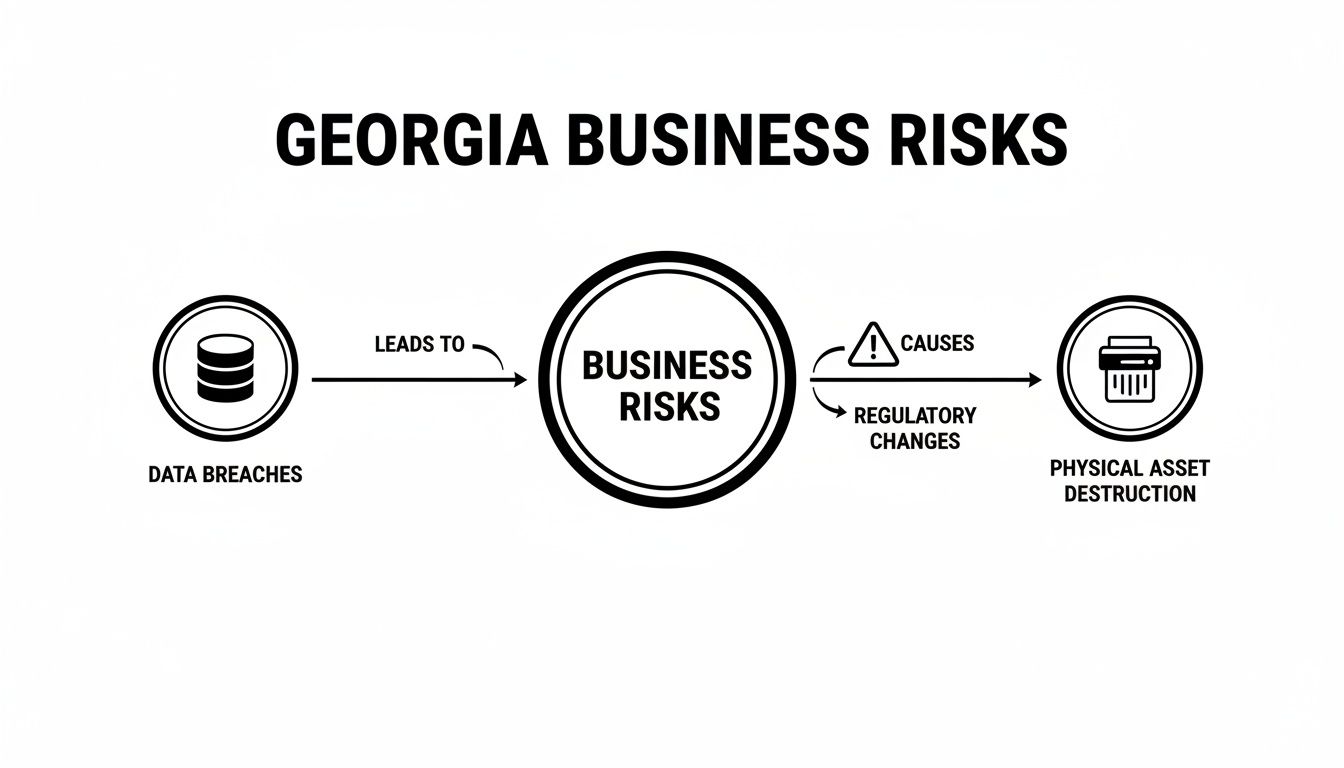
As you can see, without a secure plan, that old data just sits there as a liability. Certified disposal is what closes that loop for good.
Physical Hard Drive Shredding
Think of hard drive shredding as a high-tech paper shredder, but built for your electronics. This method is the most final and visually satisfying way to destroy data. Industrial shredders take hard drives, solid-state drives (SSDs), backup tapes, and other media and grind them down into tiny, useless fragments.
This process is the go-to choice for:
- End-of-life devices: Equipment that’s too old or broken to be reused or sold.
- High-security needs: When there is absolutely zero room for error, like with classified or proprietary company secrets.
- Damaged media: For drives that are so physically wrecked you couldn't access them with software anyway.
Because the device is literally torn to pieces, there's no coming back. Data recovery is completely impossible. This makes shredding the gold standard for permanent data elimination and a cornerstone of secure data destruction in Georgia.
Certified Data Wiping and Erasure
But what if your IT assets are still worth something? For equipment you want to resell, redeploy within your company, or donate, certified data wiping is the perfect answer. This is a software-based approach that overwrites the entire storage device with random, meaningless data—usually several times over.
It’s like trying to read a book after someone has scribbled over every single letter on every page with a black marker, three times. The original story is gone forever. Certified wiping does the exact same thing to your data, making it unrecoverable while leaving the hard drive itself perfectly functional.
This process follows strict standards like the NIST 800-88 guidelines, which lay out the official protocols for effective media sanitization. Sticking to these standards ensures the wiping process is verifiable, auditable, and compliant.
If you want to get into the weeds, you can learn more about the NIST SP 800-88 standard and see how it applies to corporate ITAD programs.
Degaussing Magnetic Media
Degaussing is a less common but extremely powerful method for certain types of magnetic storage, like older spinning hard disk drives (HDDs) and magnetic tapes. A degausser creates an incredibly strong magnetic field that instantly scrambles and neutralizes the magnetic platter where the data lives.
The process wipes all the information in a flash, but it also renders the drive totally useless afterward. It's crucial to know that degaussing does not work on modern solid-state drives (SSDs) because they don't use magnetic storage. Because of this limitation—and the fact that it destroys the drive anyway—shredding is often a much more practical and universal choice for most businesses. It really all comes down to what kind of assets you have and what you plan to do with them.
Navigating Georgia's Data Privacy and Compliance Landscape
For any business in Georgia, secure data destruction isn't just a good habit—it's a legal requirement. Getting this wrong can lead to serious consequences, from crippling fines to a damaged reputation that’s hard to rebuild. To stay compliant, you have to know the specific rules that apply to the corporate data you manage.
These regulations aren't just suggestions; they're strict mandates with very real teeth. A single mistake when disposing of a server, a laptop, or even a small batch of hard drives can quickly escalate into a full-blown compliance crisis. That’s why partnering with a certified data destruction vendor is a non-negotiable part of any smart corporate risk management strategy.
The FTC Disposal Rule Explained
At the federal level, one of the most important regulations to know is the FTC Disposal Rule. This rule affects nearly every business that handles sensitive consumer information. It demands that companies take "reasonable measures" to guard against unauthorized access to that information during the disposal process.
So, what does "reasonable measures" actually mean? In simple terms, you can't just toss old computers in a dumpster and call it a day. The FTC is clear that you must:
- Burn, pulverize, or shred physical documents that contain consumer report information.
- Destroy or erase electronic files and media so the information can't be read or pieced back together.
Failing to follow this rule can bring on heavy fines and legal trouble. It highlights why having a formal, documented process for secure data destruction in Georgia is so critical.
Industry-Specific Regulations Matter
On top of the FTC's broad rules, many industries have to deal with even tighter data handling laws. These regulations often get very specific about how personally identifiable information (PII) and protected health information (PHI) must be managed and destroyed when it’s no longer needed.
For Georgia's healthcare providers, HIPAA (Health Insurance Portability and Accountability Act) is the gold standard. The HIPAA Security Rule requires covered organizations to have solid policies for the final disposal of electronic PHI and the hardware it's stored on. This means certified wiping or physical destruction is a must for retired medical equipment and patient record systems. A deep understanding of HIPAA compliance is key to informing your data destruction policies and avoiding expensive penalties.
Financial institutions face similar pressures under the Gramm-Leach-Bliley Act (GLBA), which has specific safeguards for protecting customer financial data. Just like HIPAA, the GLBA requires banks, credit unions, and investment firms to make sure that customer information on old IT assets is completely unrecoverable.
Let's break down some of the major regulations affecting Georgia businesses.
Major Data Privacy Regulations for Georgia Businesses
These laws set the baseline for how you must handle sensitive data from its creation all the way through its final destruction.
| Regulation | Affected Industries | Data Protected | Destruction Requirement |
|---|---|---|---|
| FTC Disposal Rule | Virtually all businesses collecting consumer information | Consumer report information (credit reports, background checks, etc.) | "Reasonable measures" to destroy data, making it unreadable and unreconstructible. |
| HIPAA | Healthcare, Health Insurance, Business Associates | Protected Health Information (PHI) | Formal policies for final disposition of ePHI; data must be rendered unusable, unreadable, or indecipherable. |
| GLBA | Financial Services (banks, investment firms, insurance) | Nonpublic Personal Information (NPI) | Must protect against unauthorized access during disposal; requires shredding or destroying data. |
| NIST 800-88 | Federal Agencies & Contractors (widely adopted as best practice) | Controlled Unclassified Information (CUI) & PII | Provides technical guidelines for media sanitization (Clear, Purge, Destroy) based on data sensitivity. |
Knowing which of these regulations apply to your business is the first step toward building a compliant and defensible data destruction plan.
Georgia's Data Center Boom and Compliance Pressure
Georgia's emergence as a major data center hub adds another layer of complexity. The state’s economic incentives have fueled massive growth, with taxpayers subsidizing $474 million for data centers in the fiscal year ending July 2025. This has helped generate $3.4 billion in economic activity.
This boom means a staggering amount of data is being stored and processed right here in Georgia, which in turn increases the need for compliant secure data destruction in Georgia as hardware inevitably reaches the end of its life.
This concentration of data infrastructure puts Georgia businesses under a microscope. Regulators, partners, and customers all expect clear proof that you're handling their sensitive information responsibly from start to finish.
Key Takeaway: Compliance isn't just about avoiding fines. It's about demonstrating to your clients, partners, and regulators that you are a trustworthy steward of their data. A certified destruction process is your proof.
To keep up with these demands, Georgia businesses need a clear, defensible IT asset disposal strategy. For more details on building a program like this, check out our guide on secure IT asset disposal in Georgia. Working with a certified partner ensures that every retired asset is handled correctly according to all federal and state regulations, protecting your business from every possible angle.
Proving It Happened: Chain of Custody and Certification
In the world of corporate data security, if you can’t prove you destroyed the data, you might as well have left it on a shelf. For Georgia businesses facing audits or legal challenges, just doing the work isn't enough. You need an unbreakable, documented trail proving every single step was handled securely.
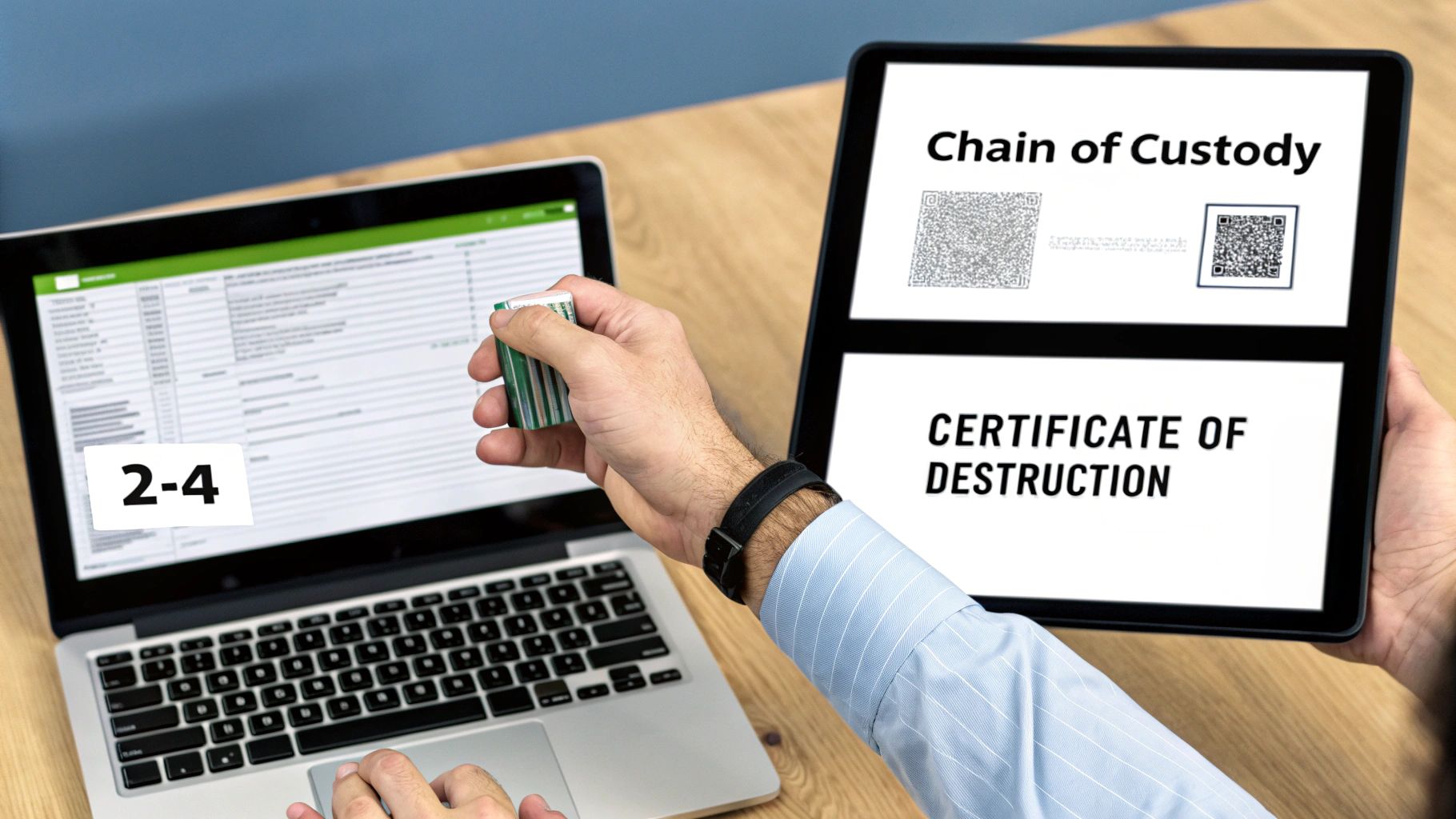
This is where the two pillars of a defensible data destruction program come in: the chain of custody and the Certificate of Destruction. These documents aren't just paperwork; they are your legal proof that you fulfilled your duty to protect sensitive information, effectively transferring liability from your organization to your vendor.
What Is a Chain of Custody?
Think of the chain of custody like the evidence trail in a legal case. It's a detailed log that meticulously tracks every single hard drive, server, and laptop from the moment it leaves your facility until its final destruction.
This document is your answer to the tough questions an auditor might ask: Who had the assets? Where were they at all times? How were they secured in transit?
A solid chain of custody record will always include:
- Asset Collection Details: The exact date, time, and location of the pickup from your Georgia facility.
- Personnel Identification: Names and signatures from both your team and the vendor's team who handled the transfer.
- Secure Transport Information: Confirmation that the assets were moved in a locked, GPS-tracked vehicle.
- Arrival Confirmation: A timestamp showing precisely when the assets arrived at the secure destruction facility.
This continuous tracking leaves no gaps where an asset could be lost, stolen, or tampered with. It creates a seamless, auditable history of the entire process.
The Certificate of Destruction Explained
After the shredders have done their job or the wiping process is complete, you receive the most important document of all: the Certificate of Destruction (CoD). This isn't just a receipt. It's a legally binding affidavit that formally confirms the permanent and irreversible destruction of your data.
This certificate is your ultimate proof of compliance. It demonstrates due diligence and is the key document you’d present during an audit or in the event of a data breach investigation. A valid CoD is essential for any business serious about secure data destruction in Georgia.
A Certificate of Destruction is more than a formality; it's your legal shield. It confirms that you have met your regulatory obligations under laws like HIPAA and the FTC Disposal Rule by ensuring sensitive data was properly destroyed.
For a certificate to be defensible, it has to contain specific, verifiable details. Without this information, the document holds very little weight. To see exactly what to look for, you can learn more about the key components of a hard drive destruction certificate.
Essential elements on a valid Certificate of Destruction include:
- Unique Serial Numbers: A complete, itemized list of serial numbers for every single asset that was destroyed.
- Destruction Method: A clear description of the method used (e.g., physical shredding, NIST 800-88 Purge).
- Date of Destruction: The exact date the destruction process was finished.
- Authorized Signature: The signature of an official representative from the destruction vendor.
- Transfer of Custody Statement: Formal language that explicitly transfers liability from your organization to the vendor.
Without these key components—especially the serialized tracking—your proof of destruction is incomplete. Always insist on this level of detail to ensure your compliance is fully documented and ready for any audit.
How To Choose A Secure Data Destruction Partner In Georgia
Picking the right partner for secure data destruction in Georgia goes way beyond just finding someone to take your old hard drives. It’s really about choosing a partner in risk mitigation. The truth is, not all providers offer the same level of security, compliance, and transparency, so doing your homework is essential to keep your sensitive data safe and your business protected.
The ideal partner doesn’t just smash your equipment. They provide a documented, defensible process that will stand up to any auditor or regulator. This means you have to look past the price tag and really dig into a vendor's certifications, security protocols, and what they can actually do for you.
Prioritize Industry Certifications
Certifications are your best friend here. They're the clearest signal that a vendor is serious about meeting the highest industry standards for both security and environmental responsibility. Think of them as an independent stamp of approval on a company's processes, giving you confidence that they operate safely and ethically.
When you're vetting a partner for secure data destruction in Georgia, make these two certifications non-negotiable:
- NAID AAA Certification: This is the gold standard for the data destruction industry, period. It involves tough, unannounced audits that check everything—hiring practices, facility access, chain of custody procedures, and the destruction methods themselves. A NAID AAA certified partner guarantees your data is secure from the moment it leaves your hands until it's completely destroyed.
- R2v3 Certification (Responsible Recycling): This one is all about being a good environmental steward. An R2v3 certified facility has to follow strict rules for managing e-waste, protecting its workers, and making sure hazardous materials are handled the right way.
When you find a partner with both certifications, you're knocking out your data security and environmental compliance obligations all at once. It’s a win-win.
Evaluate Logistics and On-Site Capabilities
How a vendor operates on a day-to-day basis will make your life either much easier or a whole lot harder. Their logistics can make the process seamless or create massive headaches for your team.
You’ll want to ask potential partners some direct questions about their services:
- On-Site vs. Off-Site Shredding: Can they bring a mobile shredding truck right to your facility in Georgia? On-site shredding is great because you can actually watch the destruction happen, giving you maximum peace of mind.
- Secure Transportation: How do they move your assets? Look for vendors who use their own fleet of locked, GPS-tracked vehicles and employ background-checked drivers to maintain a rock-solid chain of custody.
- Serialized Reporting: Do they give you a detailed, serialized report for every single asset they touch? This level of documentation is absolutely critical for your own records and for proving compliance if an auditor comes knocking.
Improper disposal is a leading cause of data leaks, and a certified partner with solid logistics and reporting helps you shift that liability. In fact, with Georgia's booming data center industry, there's growing legislative interest in how this is all handled. New bills could require greater disclosures, making provable, responsible disposal more important than ever.
Look For Comprehensive ITAD Services
Often, data destruction is just one part of a bigger puzzle called IT Asset Disposition (ITAD). Finding a partner who offers a full range of services can add a ton of value and simplify how you manage your end-of-life assets.
Choosing a vendor with comprehensive ITAD services means you can manage data destruction, electronics recycling, and value recovery through a single point of contact. This integrated approach reduces administrative overhead and ensures consistency across your entire disposition program.
Look for a partner that can also handle:
- IT Asset Buyback: Can they evaluate your retired equipment to see if it can be remarketed? This service is fantastic because it allows you to recover value from assets that still have some life in them, turning a cost into a revenue source.
- Electronics Recycling: A true full-service partner can handle all your e-waste, not just the data-bearing devices. We’re talking monitors, keyboards, networking gear, and even specialized lab equipment.
- Data Center Decommissioning: For those really big projects, you need a vendor who has experience dismantling and removing entire data center infrastructures. It's a specialized skill.
By choosing a partner who can manage the entire lifecycle—from secure pickup to final disposition—you ensure every asset is handled the right way. To see how all these pieces fit together, take a look at our overview of ITAD services in Georgia. This kind of comprehensive approach provides a secure, compliant, and efficient solution for all your IT asset disposal needs.
Common Data Destruction Questions Answered
When it comes to secure data destruction, Georgia businesses often have a few questions. We get it. Let's walk through some of the most common ones we hear to help you make the right call with confidence.
Can We Just Wipe Hard Drives Ourselves?
While the DIY approach might seem like a good way to save a few bucks, it’s a risky move for any business. The consumer-grade software you can download online often doesn't meet the strict NIST 800-88 standards required for compliance with rules like HIPAA or the FTC Disposal Rule.
Professional vendors use certified software that doesn't just wipe the data—it performs multiple overwrites and, crucially, generates a verifiable report for every single drive. That documentation is your proof for any audit. Without it, you can't prove you sanitized your data correctly, leaving your company wide open to liability.
What Is The Difference Between Shredding and Wiping?
It really comes down to one thing: shredding physically destroys the drive, making it nothing more than a pile of metal fragments, while wiping sanitizes it so it can be used again.
- Shredding is the go-to for devices that are old, broken, or hold incredibly sensitive data that you absolutely cannot risk falling into the wrong hands.
- Wiping is perfect for newer, working equipment you might want to resell, redeploy within your company, or donate. This method preserves the hardware's value while ensuring the data is 100% unrecoverable.
Think of it this way: shredding is like putting a document through a cross-cut shredder and then burning the pieces. Wiping is like meticulously erasing every word so the paper is blank and ready for reuse.
Key Insight: The real question isn't which method is "better," but which one is right for the specific asset. A smart IT asset disposition (ITAD) strategy will almost always use a mix of both. For a deeper dive, explore our comprehensive guide to keeping your information secure.
Do SSDs Need To Be Shredded Too?
Yes, absolutely. Solid-state drives (SSDs) work very differently from the old spinning-platter hard drives (HDDs). Because of how they store data across various memory chips, software-based wiping can sometimes leave behind data fragments in areas of the drive that are hard to access.
For this reason, physical destruction is the gold standard for sanitizing SSDs. Shredding them pulverizes every single memory chip, leaving zero chance for data to be recovered. It’s the highest level of security you can get for modern storage.
How Much Does Data Destruction Cost?
The cost of secure data destruction in Georgia isn't one-size-fits-all; it really depends on your specific business needs. Pricing is typically shaped by a few key factors:
- Service Type: On-site shredding, where a mobile shred truck comes to you, is typically more expensive than off-site destruction at our secure facility. This reflects the logistics and equipment involved.
- Volume: The quantity of drives or devices is a major factor. As with most B2B services, the cost per unit often decreases as the volume increases.
- Reporting Requirements: The level of detail required in your Certificate of Destruction can affect the price. For example, serialized asset tracking will cost more than a simple bulk certificate.
- Logistics: Other considerations like your location in Georgia, ease of access to the equipment, and the labor required to gather everything also play a role.
You should always ask for a detailed quote that clearly breaks down all the costs. Remember, investing in a certified, professional service is a small price to pay compared to the devastating financial and reputational cost of a data breach.
Contact Beyond Surplus for certified electronics recycling and secure IT asset disposal. We provide documented, compliant solutions for Georgia businesses, protecting your sensitive data and ensuring your peace of mind. Contact us today to schedule your secure pickup.