
When your Georgia business has a closet full of old computers, servers, or other company electronics, it’s tempting to see it as just a clean-up job. But secure IT asset disposal (ITAD) in Georgia is much more than that—it's a critical business function that directly protects your data, reputation, and bottom line. Disposing of retired enterprise IT equipment comes with serious risks for commercial entities, from data breaches to hefty non-compliance fines. This guide is a roadmap for navigating the process, designed specifically for Georgia's business owners, IT managers, and procurement professionals who need to get it right.
Why Smart IT Asset Disposal Is a Strategic Priority in Georgia
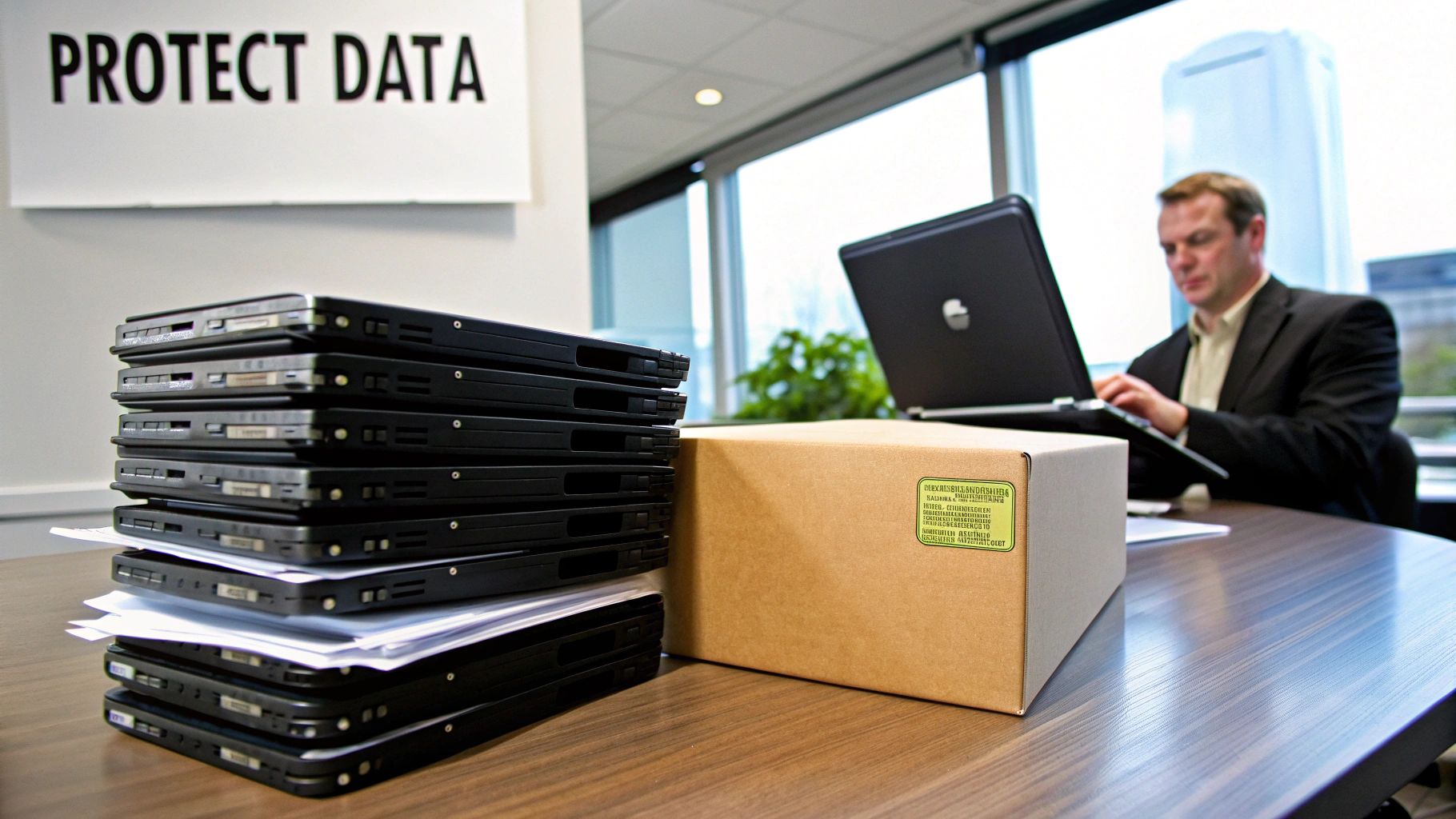
For businesses across Georgia, dealing with retired technology is no longer about clearing out a storage room. It’s a core part of risk management, financial planning, and corporate responsibility. Every single outdated server, laptop, and mobile phone is a container holding a history of sensitive company and client information.
If not handled correctly, these old assets can quickly turn from useful tools into massive liabilities. An improper disposal process can expose your company to devastating data breaches, irreversible brand damage, and serious financial penalties from federal regulators.
That’s why a proactive approach to secure IT asset disposal in Georgia isn't just an operational task—it’s a strategic imperative. The goal is to build a documented, secure, and repeatable process for every piece of equipment that reaches the end of its useful life.
The True Scope of E-Waste and ITAD
The sheer volume of electronic waste is staggering. In 2023, the United States alone generated a jaw-dropping 6.9 million tons of e-waste. This number highlights the massive challenge facing businesses everywhere, including right here in Georgia.
This mountain of retired tech is why the IT Asset Disposition (ITAD) market is booming. It's expected to jump from $20.66 billion in 2025 to a projected $31.89 billion by 2029, growing at an impressive 11.5% compound annual growth rate (CAGR).
This growth signals a major shift in how businesses think. Companies are finally recognizing that ITAD is the final—and most critical—phase of a hardware's lifecycle. To fully grasp its importance, it helps to see disposal as the last step in a broader Asset Lifecycle Management strategy. It's at this final stage where the biggest risks, and the best opportunities for value recovery, truly lie.
A well-structured ITAD program is more than just a checklist; it's a comprehensive strategy. The table below outlines the core components that every Georgia business should have in place.
Core Components of a Secure ITAD Program
| Component | Core Objective | Business Impact |
|---|---|---|
| Data Security | To ensure the complete and verifiable destruction of all sensitive data on every device. | Prevents data breaches, protects brand reputation, and avoids costly legal liabilities. |
| Regulatory Compliance | To strictly adhere to all relevant federal and industry-specific data protection regulations. | Avoids hefty fines for non-compliance with laws like HIPAA, FACTA, and the FTC Disposal Rule. |
| Value Recovery | To identify assets with resale potential, generating revenue to offset disposal costs. | Turns a cost center into a potential revenue stream, improving the overall IT budget. |
| Environmental Responsibility | To ensure all materials are recycled or disposed of according to certified environmental standards. | Demonstrates corporate social responsibility and prevents harmful materials from ending up in landfills. |
By building your program around these pillars, you can confidently navigate the end-of-life process. You'll not only protect your business but also turn a potential liability into a strategic advantage, ensuring total data security while staying on the right side of the law.
You can learn more about how a certified e-waste recycling program supports these goals at https://sonitechllc.com/beyond-surplus-e-waste-recycling-georgia/.
Navigating Data Disposal Laws for Georgia Businesses
It’s a common myth among Georgia businesses that having no single, state-specific data destruction law means you can relax about compliance. The truth is actually the opposite. Companies here are held to a host of federal regulations that dictate how you must handle sensitive information, and they apply no matter where your office is.
This legal landscape can feel like a tangled web, but getting a handle on your obligations is the first step toward protecting your company. Your responsibility doesn’t just vanish when you unplug a hard drive or pull a server from the rack. In fact, your duty to safeguard the data on that equipment stays with you until it's verifiably and permanently destroyed.
Trying to sidestep these rules isn't an option. The consequences for non-compliance are severe, with fines that can easily run into the millions. That’s not even counting the kind of reputational damage a data breach can do. A solid secure IT asset disposal Georgia program isn't just good practice; it's your best defense.
Key Federal Laws You Must Follow
Several powerful federal laws set a non-negotiable standard for data protection that directly impacts Georgia businesses. Each one is designed to protect different kinds of sensitive information, creating a comprehensive net of compliance you need to be aware of.
- HIPAA (Health Insurance Portability and Accountability Act): This is the big one for any organization that touches Protected Health information (PHI). It requires you to have safeguards in place to protect patient data on any device, right through to its final disposal.
- GLBA (Gramm-Leach-Bliley Act): If you're a financial institution—from a bank to an investment firm—GLBA is your rulebook. It mandates the protection of consumers' private financial information and has very strict guidelines for getting rid of customer records.
- FTC Disposal Rule: As part of the Fair and Accurate Credit Transactions Act (FACTA), this rule demands that businesses take "reasonable measures" to destroy consumer report data so it can’t be pieced back together.
These regulations don't just apply to massive corporations. They cover any business that handles these specific types of data, making compliance everyone's job.
What “Reasonable Measures” Actually Mean
The phrase "reasonable measures" in the FTC Disposal Rule might sound a bit vague, but it sets a clear expectation: you need to have a formal process that you can prove works. Just hitting "delete" or doing a quick reformat on a hard drive doesn't cut it, since that data is often easy to recover with off-the-shelf software.
The core principle is simple: liability for the data stays with the data owner until it has been professionally and certifiably destroyed. When you partner with a certified ITAD vendor, you effectively transfer that liability, creating a documented, defensible record that protects your organization.
This is exactly where a professional ITAD partner becomes so critical. For IT directors in Georgia's booming data center scene—which is second only to Northern Virginia in investment—the pressure is immense. Hardware refresh cycles are getting shorter, which means more retired servers and SSDs all needing certified destruction. Beyond Surplus meets this demand head-on with on-site hard drive shredding that aligns with government standards, cryptographic erasure for SSDs, and complete chain-of-custody documentation that guarantees compliance.
The Certificate of Data Destruction: Your Legal Shield
At the end of the day, proving you were compliant is just as important as the act itself. After your assets have been properly handled, a certified ITAD vendor will give you a Certificate of Data Destruction. Think of this as more than just a receipt—it's your legal proof that you met your obligations.
This certificate carefully lists the serial numbers of every single device and confirms the exact date and method of destruction. It becomes your audit-proof record, showing that your company is serious about data security and follows federal law. To really dig into the technical standards that make this process so secure, it's worth reviewing the official guidelines for media sanitization. You can learn more in our deep-dive on the NIST SP 800-88 framework. This piece of paper is your ultimate safeguard if your disposal practices are ever questioned.
Choosing the Right Data Destruction Method
When it's time to retire your company's IT gear, just hitting 'delete' or formatting a hard drive is like leaving the front door unlocked. It’s simply not enough to protect your business from a breach. For any Georgia organization that's serious about secure IT asset disposal, picking the right data destruction method is a make-or-break decision for your compliance and risk management strategy.
Enterprise-level destruction isn't reversible. It's designed to make absolutely certain that your sensitive information is gone for good. The key is understanding the two main paths you can take: physically destroying the device or digitally erasing it. Each has its place, and the best choice really boils down to the type of equipment you have and whether you're hoping to resell it to recover some value.
Physical Destruction: The Ultimate Failsafe
When data can't fall into the wrong hands, no matter what, physical destruction is the only answer. It’s exactly what it sounds like—methods that completely demolish the storage device, making data recovery physically impossible.
- Shredding: Picture a paper shredder on steroids, but built for electronics. Hard drives, SSDs, tapes, and other media are fed into an industrial shredder that pulverizes them into tiny, unrecognizable fragments of metal and plastic. This is the gold standard for any end-of-life device where security is the absolute top priority.
- Degaussing: This technique uses an incredibly powerful magnetic field to scramble and erase the magnetic data stored on traditional hard disk drives (HDDs) and old-school magnetic tapes. While it works like a charm on older media, it's critical to know that degaussing is not effective on modern Solid-State Drives (SSDs), which don't store data magnetically. You can get the full rundown in our guide on what degaussing is.
Physical destruction is the go-to when your compliance rules are iron-clad or when there's zero chance the device will ever be used again.
Data Erasure: Preserving Value While Ensuring Security
Data erasure, also known as data wiping, takes a different approach. It uses specialized software to write over every single part of a storage device with random ones and zeros. This process is repeated several times, effectively burying the original information under layers of digital noise, making it unrecoverable.
Think of it this way: instead of turning a sensitive document into confetti (shredding), data erasure is like using a permanent black marker to completely redact every word, leaving the page intact but the original text unreadable. The huge advantage here is that the physical drive is still perfectly functional, so it can be safely refurbished, resold, or redeployed.
This method is perfect for newer or high-value assets like laptops, servers, and networking gear where you want to capture that remarketing value without ever compromising on security.
Special Considerations for Modern SSDs
Solid-State Drives (SSDs) are a different beast. Because of the way they spread data across various memory chips to prevent wear and tear (a process called wear-leveling), standard wiping methods can sometimes leave behind recoverable data fragments. It's a risk you can't afford to take.
For SSDs, the industry relies on a more sophisticated technique called Cryptographic Erasure (CE). In simple terms, this method targets and deletes the unique encryption key that makes the data on the drive readable. Once that key is destroyed, all the encrypted data instantly becomes permanent, indecipherable gibberish. It's a fast and incredibly secure way to sanitize the drive.
For Georgia businesses, working with an ITAD partner who gets these technical details is non-negotiable. It's the only way to guarantee total data security across every type of device in your inventory.
Comparing Data Destruction Methods
Use this comparison to choose the right data destruction method based on your asset type, security needs, and remarketing goals.
| Method | Best For | Security Level | Allows Reuse | Compliance Standard |
|---|---|---|---|---|
| Shredding | End-of-life HDDs, SSDs, and other media requiring maximum security. | Absolute | No | NIST SP 800-88 Purge |
| Data Erasure | Functional laptops, servers, and HDDs intended for resale or redeployment. | High | Yes | NIST SP 800-88 Clear/Purge |
| Degaussing | Older magnetic media like HDDs and backup tapes (not for SSDs). | High | No | Varies by device |
| Cryptographic Erasure | Modern SSDs with built-in encryption, especially in data centers. | High | Yes | NIST SP 800-88 Purge |
Making the right call between these methods is how you ensure your company’s most valuable asset—its data—is fully protected every step of the way.
The Importance of Chain of Custody and Certifications
When you hand over your old IT assets, your work isn't done—it’s just getting started. Secure IT asset disposal in Georgia isn't about that final moment of destruction. It's about the entire, verifiable journey your equipment takes from the second it leaves your sight. This documented trail is called the chain of custody, and it's your single most important tool for proving security and compliance.
Think of it as the evidence log for your company's sensitive data. A solid, unbroken chain of custody gives you a detailed, step-by-step account of who handled your assets, where they were, and what happened to them at every stage. It turns what could be a massive security blind spot into a transparent, auditable process that lets you sleep at night.
In an audit, this documented journey is your best defense. It provides concrete proof that you did your due diligence and met every regulatory requirement. Without it, you’re left with a huge gap in your security protocol.
From Your Door to Final Disposition
A truly robust chain of custody isn't just a vague idea; it's a series of key checkpoints designed to maintain total security and accountability. This is a structured sequence that leaves no room for doubt or error.
A professional ITAD partner will manage this process meticulously, typically following these steps:
- Serialized Asset Tagging: Before a single server or laptop is moved, each piece of equipment is inventoried and given a unique serial number. This creates the initial record that gets tracked through the entire process.
- Secure Transport: Your assets are then moved in locked, GPS-tracked vehicles. This simple step prevents any unauthorized access or loss while the gear is in transit from your Georgia facility to the secure processing center.
- Controlled Facility Access: Once they arrive, your assets are checked into a secure, monitored facility with strict access controls. Only authorized, background-checked personnel can handle the equipment.
- Audit-Proof Documentation: When it's all said and done, you receive a detailed report, including a Certificate of Data Destruction, that reconciles the final outcome for every single serialized asset.
This whole workflow is guided by a clear decision-making process, ensuring the right method is used for every asset.

This flowchart visualizes the choice: if a drive can be safely reused, it undergoes certified data wiping. If not, it moves on to physical shredding for complete, irreversible destruction.
Decoding Industry Certifications
So, how can you be sure a vendor can actually maintain this level of security and environmental responsibility? The answer is third-party certifications. These aren't just fancy logos for a website; they are hard-earned proof that a vendor is committed to the industry’s highest standards.
Certifications like R2v3 and e-Stewards require vendors to undergo rigorous, ongoing audits of their data security protocols, environmental practices, and employee safety measures. Choosing a certified partner means you're selecting a provider whose processes have been independently verified to be secure, ethical, and compliant.
For businesses in Georgia, two certifications really stand out as the gold standard:
- R2v3 (Responsible Recycling): This certification takes a holistic approach, covering everything from environmental protection and data security to the health and safety of workers. An R2v3-certified vendor guarantees your assets will be managed responsibly from start to finish.
- e-Stewards: Developed by the Basel Action Network, this standard is famous for its incredibly strict rules against exporting hazardous e-waste to developing nations. It puts a heavy emphasis on environmental justice and data security.
By prioritizing vendors with these credentials, you're not just hiring a service. You're bringing on a partner who has proven their dedication to excellence. To better understand what goes into these tough standards, you can discover what R2 Certification is in our detailed guide. This knowledge helps you make a choice based on verified trust, not just a sales pitch.
Turning Retired IT Assets into Revenue

Most businesses see retired technology as a pure cost center—just another line item on the budget for data security and compliance. But if that's your only view, you're missing a massive financial opportunity. A strategic secure IT asset disposal Georgia program can flip that script, turning those old assets from a liability into a real revenue stream.
Think about it: much of the equipment you decommission still holds significant market value. The hardware your IT department just replaced could be exactly what another organization is looking for. Partnering with a certified ITAD vendor connects you to this secondary market, helping you get a substantial return on your initial investment.
Identifying High-Value Assets
Not all retired equipment is created equal, of course. Certain categories consistently hold their value better than others and are prime candidates for buyback programs. To make sure you're not leaving money on the table, it helps to understand the basics of how to liquidate assets for maximum return, as those same principles apply here.
Keep an eye out for these key assets when planning for value recovery:
- Servers and Data Center Equipment: Enterprise-grade servers, storage arrays (SANs), and networking switches often have a long and useful life well beyond their first deployment.
- Laptops and Desktops: Business-class laptops and workstations, especially more recent models from brands like Dell, HP, and Lenovo, are always in high demand on the refurbished market.
- Networking Gear: Routers, firewalls, and other hardware from leading manufacturers can be remarketed effectively.
The trick is to work with a partner who actually knows the fair market value of these components and has the network to sell them.
The IT Asset Buyback Process
A professional IT asset buyback program isn't just about selling old gear. It’s a structured, auditable process designed to squeeze every last dollar out of your equipment while guaranteeing your data stays secure every step of the way.
Shifting your mindset from disposal to disposition is a powerful financial move. A well-managed ITAD program should, at a minimum, pay for itself through value recovery. For many businesses, it becomes a consistent source of revenue that improves the overall IT budget.
This is strategic value recovery, not just disposal. You're tapping into a refurbished gear market projected to hit USD 32.7 billion in 2025 and grow by 11.2% to USD 84.9 billion by 2034. For data center operators decommissioning entire racks, our nationwide pickup fleet minimizes disruption, turning what could be a huge liability into a revenue stream while supporting the circular economy.
Connecting Profitability with Sustainability
The best part? The financial upside of remarketing your assets is directly tied to your company's sustainability goals. Every single device that gets refurbished and resold is one less piece of equipment that needs to be manufactured from raw materials or melted down for recycling.
This approach is the very definition of the circular economy in action. You're extending the life of your electronics and slashing the environmental impact of e-waste. By participating in a buyback program, your Georgia-based business strengthens its corporate social responsibility (CSR) profile, showing a real commitment to sustainability that resonates with customers, stakeholders, and employees alike. To learn more, check out our comparison of the top IT asset disposition companies.
How to Select the Right ITAD Partner in Georgia
Choosing a partner for your company's secure IT asset disposal in Georgia isn't about finding the lowest bidder. It's a decision based on trust. The right vendor becomes an extension of your risk management team, protecting your data, keeping you compliant, and guarding your brand. The wrong one? They can expose you to devastating data breaches, stiff legal penalties, and environmental fines.
So, how do you make the right call? You have to ask the right questions. It’s not about what a vendor says they’ll do; it’s about what they can prove. A top-tier ITAD partner will welcome your questions and give you clear, verifiable answers. Use this as your checklist to vet potential vendors and find a partner who truly has your back.
Vetting Security and Compliance Protocols
Security is the absolute baseline. Your number one goal is to confirm that a potential partner has the facilities and procedures to guarantee your sensitive data is gone for good.
Start with these critical security questions:
- On-Site Services: Do you offer on-site hard drive shredding? Can my team witness it at our facility? This is the gold standard for assurance.
- Documentation: Will I get a serialized Certificate of Data Destruction for every single hard drive, server, or phone you take?
- Chain of Custody: Walk me through your chain of custody process. Ask about secure, GPS-tracked trucks, locked containers, and facilities with controlled access.
- Employee Vetting: Are the employees who handle our assets background-checked and trained on data security?
A confident, capable partner will have solid answers ready to go. Any hesitation or vague responses should be seen as a major red flag.
Verifying Environmental and Industry Certifications
Certifications aren't just logos for a website; they are objective proof that a vendor meets the industry's highest standards for environmental responsibility and data security. Don't just take their word for it—ask to see the paperwork.
Choosing a certified partner is all about mitigating risk. Certifications like R2v3 mean the vendor has passed tough, independent audits of their entire process, from data security to environmental handling. It's a verified promise of excellence.
Key questions to ask about certifications:
- What certifications do you hold? You’re looking for R2v3 (Responsible Recycling) or e-Stewards. These are the gold standards in the ITAD world.
- Can I see a copy of your current certificate? Any legitimate vendor will be happy to share this with you for verification.
These credentials are what separate the real professionals from operators who might be cutting corners and putting your business on the line.
Evaluating Logistics and Value Recovery
Finally, a great partner makes the whole process easy while getting you the best possible financial return on your old equipment. Their logistics and value recovery process should be transparent and buttoned-up.
Consider asking:
- Logistics: How do you handle pickups for a business our size here in Georgia? Do you run your own fleet or use a third party?
- Valuation Process: How do you figure out the fair market value for our equipment that can be reused? Can you provide a detailed, itemized report?
- Revenue Sharing: What’s your revenue-sharing model for assets you resell, and how is it all documented?
By digging in with these pointed questions, you can cut through the sales pitch and build a disposal plan that is secure, compliant, and maybe even profitable. You’ll find a true partner committed to protecting your organization from start to finish.
Common Questions About IT Asset Disposal
Even with a solid plan in place, Georgia businesses usually run into a few specific questions when it comes to the nuts and bolts of IT asset disposal. Getting straight answers can clear up any confusion and give you confidence in your process.
What Is the Most Secure Way to Dispose of Old Hard Drives?
When you need absolute, undeniable data security, nothing beats physical destruction through industrial shredding. This isn't just deleting files; it's a process that completely pulverizes the drive's platters, making it physically impossible for anyone to recover a single byte of data.
While certified data wiping is a great, secure option for drives you plan to resell, shredding offers airtight proof of destruction for any media at the end of its life.
For businesses with strict compliance needs—think healthcare, finance, or legal—on-site shredding is the gold standard. It allows your own team to witness the entire destruction process from start to finish, leaving no room for doubt.
What Documentation Should We Expect After Disposal?
A professional ITAD partner absolutely must provide thorough documentation to officially close the loop on your assets' lifecycle. You’re not just getting a receipt; you're getting legal proof. At a minimum, you should walk away with two critical documents:
- A Certificate of Recycling: This document confirms that your old equipment was handled in an environmentally responsible way, not dumped in a landfill.
- A serialized Certificate of Data Destruction: This is the big one. It lists every single asset by its unique serial number and certifies the exact date and method of its destruction.
Think of these certificates as your legal shield. They are crucial for passing any kind of audit and formally transfer all liability from your company to the vendor, protecting you from any future claims.
Can We Earn Money from Our Old IT Equipment?
Yes, you definitely can. Through a process often called IT Asset Value Recovery (ITAVR) or a buyback program, your functional, used equipment can actually become a new source of revenue. Assets like laptops from the last few generations, servers, and networking gear often hold significant value on the secondary market.
Once your data has been securely and verifiably wiped clean, your ITAD partner can refurbish and resell the equipment. You then get a share of the sale, which can easily offset your disposal costs and, in many cases, turn that pile of old hardware into a welcome check for your business.
Contact Beyond Surplus for certified electronics recycling and secure IT asset disposal. Visit us at https://sonitechllc.com.