

Storage rooms and cage corners fill up the same way in most telecom environments. A router comes out during a refresh, a shelf of handsets gets replaced, an old PBX stays online “just in case,” and before long you’re paying for space to store equipment nobody is using.
That pile isn’t just clutter. It’s tied-up value, and if it’s handled poorly, it’s also a security and compliance problem. Telecom gear often holds more than hardware value. It can carry configs, logs, call data, credentials, and network details that shouldn’t leave your control without a documented process.
From Clutter to Capital An Introduction to Selling Surplus Telecom Gear
A network refresh ends on Friday. By Monday, retired switches, routers, handsets, and transport gear are stacked in a cage with no clean inventory, no named owner, and no written disposition plan. At that point, the resale question is only half the job. The other half is preventing exposed configs, call records, asset disputes, and chain of custody gaps from turning a routine hardware sale into a security incident.
Teams that recover strong returns from surplus telecom gear run the process like asset disposition, not warehouse cleanup. They identify what still has secondary market value, isolate anything that should be scrapped, document condition, and control custody from deinstallation through final settlement. That discipline protects margin and reduces the chance of a compliance problem later.
The timing matters.
After a migration or site closure, equipment often sits untouched until the people who pulled it have moved on to other priorities. Then the practical problems show up fast. Asset tags are missing, licenses and accessories are no longer matched to the right unit, and nobody wants to certify what data may still reside on the equipment. Resale value drops at the same time internal risk goes up.
There is still an active market for reusable telecom hardware, especially when sellers present equipment in a way buyers can verify and price without guessing. Sellers that already handle broader surplus electronics resale services in Georgia usually understand this point well. Clean records, controlled handling, and documented data disposition consistently separate high-recovery lots from problem lots.
Surplus telecom gear loses value quickly when the seller cannot document ownership, condition, testing status, or how data-bearing devices were handled.
The practical approach is simple:
- Identify the assets clearly before asking for quotes
- Contain security risk early by treating telecom gear as potentially data-bearing
- Screen buyers on process and accountability instead of headline price alone
- Control pickup, packing, and paperwork so liability transfers cleanly
Handled correctly, surplus telecom equipment becomes recovered budget instead of dead stock. Handled poorly, it creates the kind of audit and security exposure that wipes out whatever resale value was on the shelf.
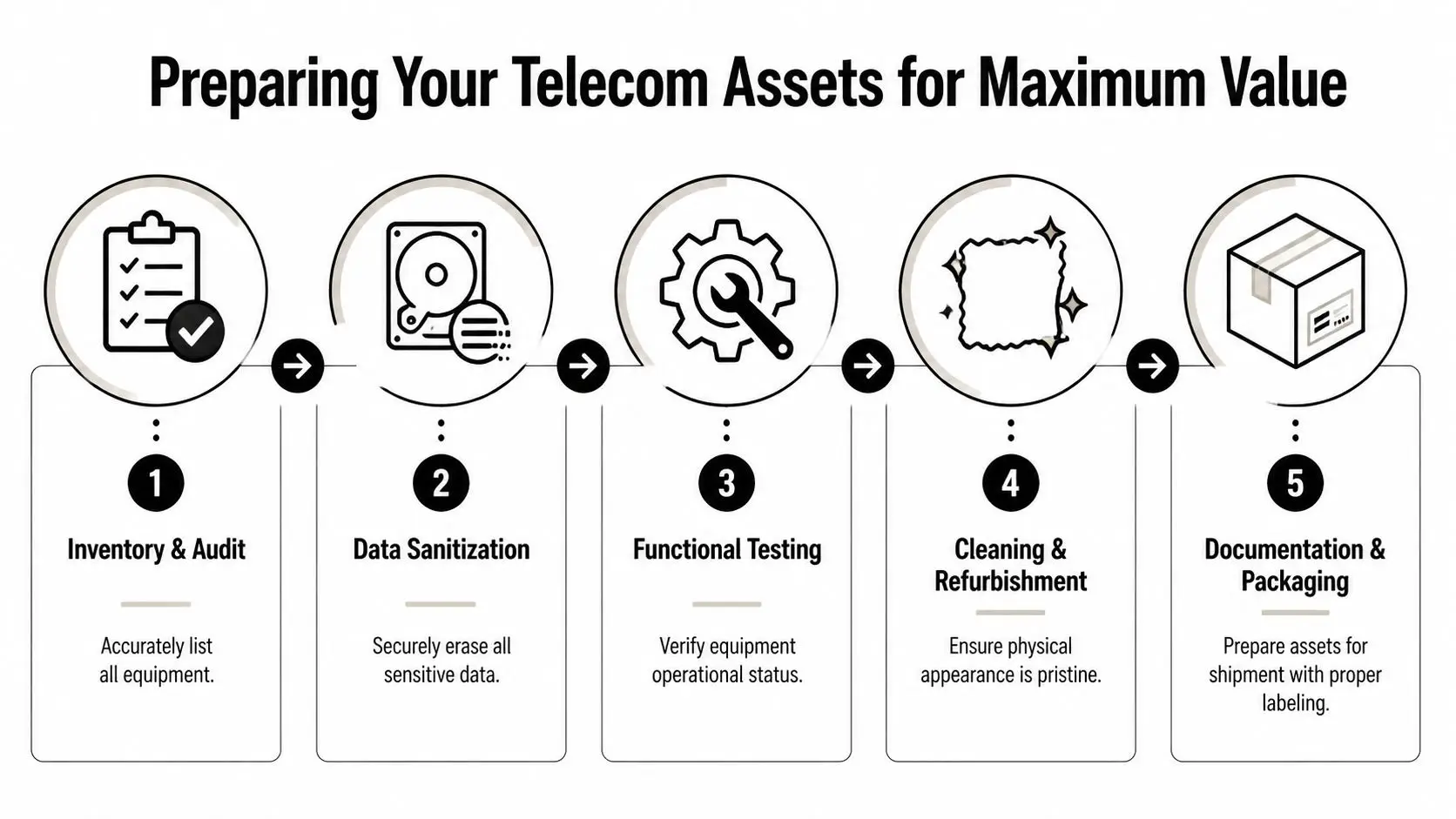
Preparing Your Telecom Assets for Maximum Value
The best resale projects start long before the first quote request. Buyers pay for clarity. If your list says “misc. Cisco equipment,” expect a vague offer or a steep inspection holdback. If your list includes exact model numbers, serials, installed modules, power supplies, software status, and condition notes, you’ll get sharper pricing.
Start with a physical inventory
Walk the room, cage, or storage area and record each asset as if a third party has to identify it without your help. For telecom gear, that usually means:
- Manufacturer and model such as Cisco, Mitel, Polycom, ShoreTel, Nortel, Panasonic, or Toshiba
- Serial number and asset tag so finance, IT, and the buyer can reconcile the same unit
- Configuration details including line cards, optics, power supplies, rack ears, handsets, licenses, or controllers
- Condition notes covering cosmetic wear, broken ports, missing covers, or signs of water or battery damage
- Operational status such as pulled working, powers on, untested, or failed
If you can, photograph racks before teardown and photograph each lot after staging. That solves a lot of disputes later.
This process also helps uncover stranded spend. A structured invoice audit and inventory reconciliation can uncover 10% to 25% in savings by identifying errors and redundant services, and organizations using centralized processes lose 6.2% of annual revenue to contract value leakage versus 12.4% for those without, according to CenterPoint Group’s telecom procurement analysis.
Reconcile inventory against contracts and records
The physical walk-through is only half the job. The other half is proving the assets are surplus.
Match your field inventory to purchase records, fixed asset lists, circuit bills, maintenance agreements, and MACD history. That’s where you catch common problems:
- Equipment still tied to an active service agreement
- Units listed in finance but already missing from the site
- Duplicate hardware bought for projects that never launched
- “Ghost” services that survived after the hardware was removed
When companies skip reconciliation, they often sell too little, keep too much, or miss gear that still has useful value.
Present assets the way buyers think
Telecom surplus buyers price risk as much as hardware. Every unknown pushes the quote down. You can improve offers by reducing uncertainty before the buyer asks.
A simple prep standard works well:
| Item | What buyers want to see |
|---|---|
| Asset list | Clean spreadsheet with model, serial, qty, and notes |
| Testing | Clear pass/fail or “pulled from working environment” status |
| Completeness | Matching accessories, power units, cards, and handsets grouped together |
| Packaging | Palletized, labeled, and segregated by product family |
| Documentation | Site contact, pickup constraints, and release approvals ready |
Practical rule: If a buyer has to sort, identify, test, and argue over missing parts, they’ll protect themselves by lowering the bid.
For larger projects, tie this work into your broader IT asset lifecycle management process. That keeps refresh planning, retirement timing, and value recovery aligned instead of treating surplus as an afterthought.
Clean and stage before quote day
You don’t need to cosmetically restore every item. You do need to make the lot legible. Dusty shelves, mixed model families, unlabeled boxes, and random accessories signal poor controls. Clean gear, grouped lots, and accurate labels signal a seller who knows what’s leaving the building.
That difference matters in telecom resale. Buyers will pay more readily for equipment they can move quickly into testing, refurbishment, resale, or responsible recycling.
Ensuring Ironclad Data Security and Compliance
Price matters. Data control matters more.
A lot of buyer-focused content talks about how fast someone can pick up your excess fiber, phones, or switches. Far less attention goes to what’s stored on the devices and what happens if that information leaves your site without proper sanitization. That’s the part that creates legal exposure.
Treat telecom hardware like data-bearing equipment
Routers, firewalls, PBX systems, voice gateways, session border controllers, servers, and storage tied to telecom environments can retain credentials, call detail records, IP schemes, customer information, and network configurations. Even when the hardware looks old, the data on it can still be sensitive.
A key risk in selling surplus telecom equipment is data security, and many buyers focused on hardware acquisition don’t address certified wiping or compliance with the FTC Disposal Rule, as noted in this discussion of surplus telecom equipment risks.

Match the sanitization method to the asset
Different devices require different handling. A disciplined process usually separates assets into categories:
- Certified data wiping for equipment that can be sanitized to a recognized standard and kept in a reusable resale stream
- Degaussing for media where magnetic destruction is appropriate and reuse isn’t the goal
- Physical destruction for failed drives, damaged media, or devices that policy requires to be shredded
If your organization follows a recognized sanitization standard, require the buyer or ITAD provider to document it. A good reference point is NIST SP 800-88 guidance on data sanitization.
Documentation transfers liability better than promises
A buyer saying “we wipe everything” isn’t enough. You need records that identify what was processed, how it was processed, and when custody changed hands.
Ask for:
- Chain-of-custody records from pickup through final disposition
- Certificates of data destruction tied to serial numbers or lot IDs
- Certificates of recycling for items that can’t be reused
- Downstream transparency if any material leaves the buyer’s direct control
A clean audit trail protects your company long after the truck leaves the dock.
If you’re comparing channels, it also helps to understand how asset sales and liquidation workflows differ. This overview of DIYAuctions' liquidation process is useful because it shows why documentation, inspection terms, and transfer conditions matter before equipment changes hands.
Compliance isn’t separate from value recovery
Many sellers make the wrong trade-off in this scenario. They assume secure wiping and careful documentation reduce resale value. In practice, poor controls usually reduce it more. If the buyer doubts the data was handled properly, they’ll either downgrade the equipment to scrap, add fees, or refuse the lot entirely.
One factual example fits here. Beyond Surplus offers nationwide pickups, chain-of-custody documentation, buyback support, and certified data destruction as part of telecom and IT asset disposition workflows, which is the kind of combined process many enterprise sellers need when they can’t separate value recovery from compliance.
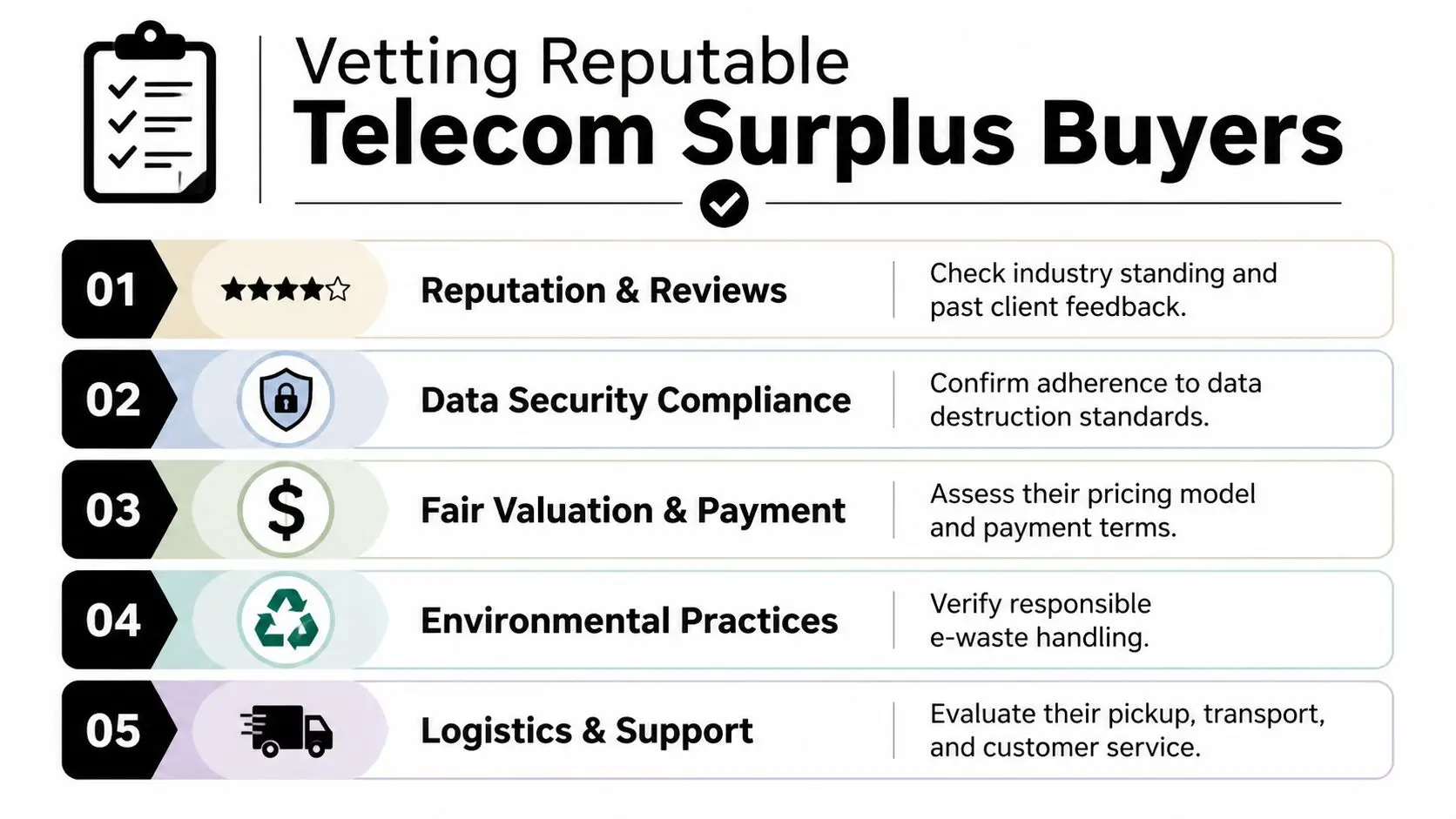
Identifying and Vetting Reputable Telecom Surplus Buyers
A buyer can offer a strong number on Monday and become a compliance problem by Friday. That usually happens when the seller evaluates the quote before evaluating the operating model.
In telecom disposition, buyer fit matters as much as price. The wrong outlet can turn reusable gear into a disputed lot, delay payment for weeks, or create exposure if data-bearing equipment and scrap streams are handled poorly.
Know which type of buyer you are dealing with
The market is fragmented, and buyer capability varies more than many teams expect.
Telecom operators usually buy selectively for redeployment, sparing, or product-specific demand. They may pay well for certain in-demand items, but they rarely cover the full chain from removal through reporting and end-of-life processing.
Specialized resellers understand product families, revision differences, parts harvest value, and resale velocity. They are often a good fit for clean, well-identified lots such as routers, switches, optics, PBX systems, and business phone inventory.
Full-service ITAD firms are built for projects with more operational risk. They can coordinate deinstallation, packing, serialized tracking, data destruction, resale, and recycling under one scope. That matters when assets are spread across sites, mixed in condition, or tied to internal audit requirements.
Ask questions that expose execution risk
A polished website and a fast quote do not tell you how the job will be handled once equipment leaves the rack. The useful questions are the ones that expose process discipline.
Security and compliance checks
- How do they process data-bearing telecom assets such as call managers, voicemail systems, appliances with SSDs, or gear that stores saved configurations?
- What records do they issue at pickup, intake, and final disposition
- Can they identify downstream vendors for recycling or destruction if material leaves their control?
- Will certificates tie back to serial numbers or lot IDs instead of a generic project summary?
Commercial checks
- Is the offer fixed, or subject to inspection and grading
- Which conditions trigger deductions such as missing cards, licensing issues, damaged ports, freight, or repack charges?
- When does title transfer, and when does payment release
- Who decides whether an item is resale, parts harvest, or scrap
Logistics checks
- Who is responsible for de-racking, packing, and labeling
- Who carries transit risk and insurance coverage
- Can the buyer support site restrictions such as badging, limited dock hours, lift-gate needs, or after-hours removals?
One weak answer is manageable. A pattern of vague answers usually means the seller will absorb the risk later.
Use a documented review process
Buyer selection should be handled like vendor approval, not an informal resale conversation. Security, legal, operations, and finance often care about different failure points, so the review criteria need to be written down before the equipment moves.
A documented vendor due diligence checklist for ITAD and surplus buyers helps teams compare bidders on the same terms. It also prevents a common mistake I see in large projects: choosing a buyer based on headline recovery value while ignoring inspection rights, reporting quality, and downstream controls.
The same discipline shows up in other sales environments too. These field-tested sales strategies are useful because they reinforce a point that applies here as well. Repeatable process usually outperforms improvisation.
What a credible buyer should provide without delay
A serious buyer should be able to produce core documents early in the conversation.
| Area | What to request |
|---|---|
| Chain of custody | Pickup records, lot IDs, signatures, transfer points |
| Insurance | Proof of transport and handling coverage |
| Scope | Written inclusions, exclusions, and site responsibilities |
| Settlement | Payment timing, inspection window, and adjustment terms |
| End-of-life handling | Reuse, recycling, and destruction records |
If a buyer resists documentation, avoids specifics on downstream handling, or pressures your team to release equipment before terms are clear, stop the process and requalify the account. In this part of the market, speed without controls usually costs more than it returns.
Managing the Sales Process and Logistics
A lot looks clean on the spreadsheet, then pickup day exposes the gaps. The buyer arrives and asks who boxed the line cards, whether rails are included, which pallets are cleared for release, and whether any of the gear still holds site-specific configuration data. At that point, pricing is no longer the main issue. Control is.
Treat the sale like a controlled disposition project, not a casual resale. The goal is to recover value without losing custody records, delaying site work, or creating a compliance problem because telecom equipment moved before the paperwork was settled.
Run a real RFQ, not an email blast
Send every bidder the same asset file and the same scope. That is how you get offers you can compare.
Your RFQ should cover:
- Asset details with model, serial, quantity, condition, installed options, and included accessories
- Site conditions such as access hours, dock availability, security check-in, liftgate needs, and any union or escort requirements
- Work scope including packing, de-racking, palletizing, cable removal, data destruction, recycling, and reporting
- Commercial terms covering payment timing, inspection period, title transfer, freight responsibility, and deductions
For larger projects, pull in operations, IT, finance, legal, and security before release approval. Telecom surplus often sits inside active facilities, shared cages, branch closets, and carrier rooms. One missed assumption can stall pickup or create a chain-of-custody gap that is hard to explain later.

Compare offers on total outcome
A strong offer is clear, scoped, and enforceable. A weak offer is usually high on page one and full of conditions on page two.
Review each bid against the same set of questions:
- Purchase price by line item or lot
- Included labor and packing services
- Testing assumptions and downgrade rules
- Freight terms and risk of loss
- Payment trigger and settlement timing
- Required reporting after pickup
This is also where security and compliance need to stay in view. If a buyer plans to sort, test, or wipe equipment offsite, the inspection window, serialized receipt, and downstream documentation matter as much as the price. If those controls are vague, the operational risk sits with the seller.
Teams that want cleaner handoffs and fewer process misses can borrow ideas from these field-tested sales strategies. The useful takeaway is simple. Process discipline protects margin.
Define the statement of work before the truck is booked
Pickup day should confirm the plan, not create it. The statement of work needs enough detail that site staff, the buyer, and your internal stakeholders all read it the same way.
Include the items that usually cause disputes:
- Packing ownership for loose handsets, blades, cards, optics, and rack hardware
- Deinstallation steps if assets are still powered, mounted, patched, or tied into live infrastructure
- Transport terms including who schedules freight, who loads, and when title and custody transfer
- Exception handling for missing serials, damaged units, non-conforming material, and abandoned scrap
- Closeout documents for serialized reconciliation, certificates of destruction, recycling records, and final settlement
The handoff is complete only when records match reality. Equipment can leave the building and still remain your problem if the serial count is off, the buyer mixes lots in transit, or the paperwork does not show how sensitive devices were processed.
If the project includes rack removals, cage cleanup, or mixed infrastructure, tie the sale to a documented data center decommissioning process. That keeps telecom assets under the same custody, security, and reporting controls as the rest of the environment.
Common Pitfalls When Selling Used Telecom Hardware
The highest offer usually isn’t the best offer. It’s often the least defined offer.
One common scenario goes like this. A buyer offers strong pricing on a lot of switches, phones, and PBX shelves. After pickup, they reduce payment because power supplies were mixed, firmware was old, some gear was untested, and freight “came in high.” Those issues may be real. The problem is that none of them were resolved before release.
Red flags that show up late if you don’t check early

- Inspection-only pricing means the initial quote is more teaser than commitment.
- Consignment language can delay payment until the buyer resells the gear, if they ever do.
- Unclear data handling leaves you exposed if devices contained sensitive configs or logs.
- No serialized receipt makes it hard to prove what departed the site.
- Bundled recycling charges can erase value from the reusable part of the lot.
Another mistake is mixing good resale stock with low-value scrap. If everything is palletized together, the buyer may price the whole shipment conservatively. Separate reusable telecom gear from damaged units, batteries, scrap metal, and non-working accessories.
Short examples worth remembering
A facilities team clears a closet fast because they need the space back. They hand over boxes without reconciling to the inventory. Weeks later, finance asks why assets still on the books have no disposal record.
An IT manager accepts a bid from an out-of-state buyer who promises prepaid freight and quick settlement. Pickup happens, but the buyer stops responding during inspection. Without strong chain-of-custody paperwork and defined commercial terms, recovery gets messy.
Cheap process control becomes expensive after the equipment is gone.
The safest mindset is simple. Don’t evaluate telecom surplus buyers only on what they say they’ll pay. Evaluate what they document, what they exclude, and what recourse you have if the transaction changes after pickup.
Partner with a Certified ITAD Expert for Total Peace of Mind
Selling surplus telecom gear isn’t a warehouse cleanup task. It’s an asset recovery project with security, compliance, logistics, and documentation attached to every step.
The companies that do this well are disciplined before the sale starts. They inventory thoroughly, sanitize data properly, vet buyers hard, and document every transfer of custody. That’s what protects value and prevents the usual surprises after pickup.
If your team is managing decommissioned telecom hardware across offices, data centers, clinics, schools, or distributed sites, use a process that treats the equipment like a business asset until final disposition is complete.
Contact Beyond Surplus for certified electronics recycling, secure IT asset disposal, telecom equipment buyback, and documented chain-of-custody support that helps your organization recover value while reducing security and compliance risk.